

Why You Should Start Every Week With This Classic New Orleans Meal

There are dishes that New Orleans cooks routinely break out for special occasions, but red beans and rice isn't typically one of them. Rather, it's a part of the weekly routine, traditionally cooked and served on Mondays. The reason for this is surprisingly practical: Historically (going back to at least the 1800s), Monday was laundry day in many New Orleans households. At the time, the task required hours of physical work. So, home cooks needed something that wouldn't require much attention. Enter red kidney beans, which needed a long simmer but little supervision, allowing them to quietly cook away while the laundry was done. This useful solution eventually turned into an ingrained custom, making Monday red beans and rice a regional specialty. Today, we've obviously got washing machines, but if Monday has you feeling drained, this wonderfully low-effort dish delivers tenfold. Plus, the combo of beans simmered until tender and served over rice offers up fiber, protein, iron, and antioxidants, making it not only comforting but also nutritious.
There's no agreed-upon origin story or single inventor for red beans and rice, but it's generally believed to have come from the kitchens of Louisiana's African-American communities. Going further back, enslaved Africans likely brought the idea to North America from West Africa, where bean and rice stews were part of the culinary canon. Another explanation of the dish's origin centers around the fact that beans were cheap, rice was abundant in southern Louisiana, and leftovers like ham bones were an economical way to add flavor.
How to make it and where to find it
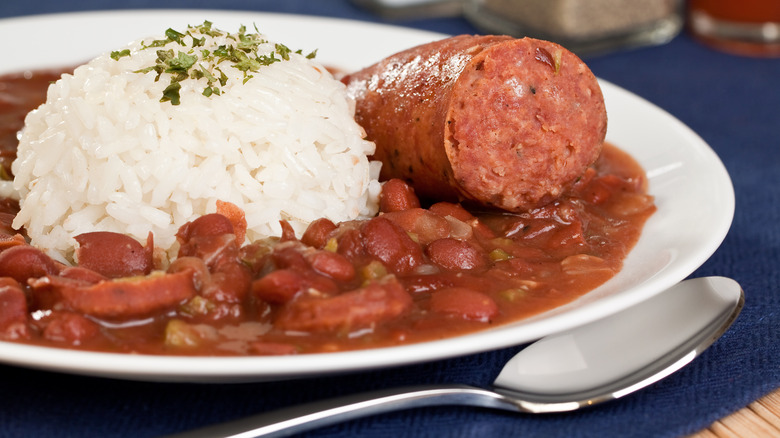
While recipes vary from kitchen to kitchen, red beans and rice generally starts with dried red kidney beans, soaked or rinsed, and then slowly cooked with onions, celery, and bell peppers — the classic Creole "holy trinity," and a variation on the French mirepoix. Smoked pork, such as ham hock, is usually added for extra flavor and richness; this is part of the dish's history, as ham bones left over from Sunday dinners were often used. The beans are cooked until they partially break down, thickening the stew naturally, rather than relying on added starches. The rice is cooked separately, and the beans are served on top. Some versions add more ingredients, like herbs or spices, as well as additional meat — often andouille or another smoked sausage.
In New Orleans culture, red beans and rice shows up in home kitchens and corner stores, but despite its domestic origins, it's just as much of a mainstay in restaurants, especially on Mondays, when many menus still feature it as a special. That said, the best places to get it tend to be those offering more home-style dishes, including renowned spots like Li'l Dizzy's and Dooky Chase, rather than the city's iconic upscale creole spots like Brennan's. But with a dish this straightforward, it's easy to make at home: If you're stuck grinding away on a long-winded task and need to make an easy hands-off dinner, take a cue from Creole culture and throw some red beans and rice on the stove.