

The Plate Ratio Rule To Ensure A Balanced Meal
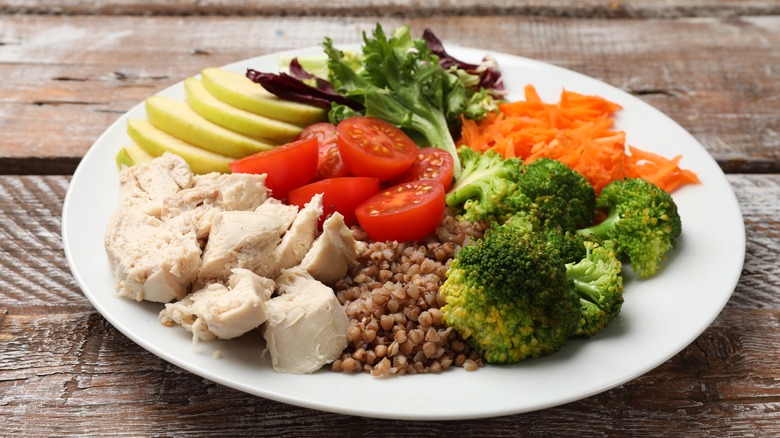
When you try to look up the "right" way to eat online, you'll get bombarded with more opinions than you can count. If you're looking for balance — rather than an approach that cuts out food groups — you may want to stick with the Harvard-backed Healthy Eating Plate ratios. The team at Harvard University's T.H. Chan School of Public Health recommends a fruit-and-veggie-heavy plate with limited processed foods.
To create a balanced meal, you'll want to dedicate at least half of the space on your plate to produce, including more vegetables than fruits (sorry to be the bearer of bad news, but the team at Harvard says that potatoes don't get a pass to count as vegetables). The other half of your plate should be split evenly between whole grains (like quinoa) and protein, according to Harvard's recommendations. Try to stay away from highly processed proteins (like sausage) and stick with leaner, whole-food options (like chicken or fish). Finally, your meal should include some healthy fats (try an infused olive oil to add healthy fats and a burst of flavor) and a glass of water. The University of Utah agrees with Harvard's recommendations, and adds that it's okay to have some coffee or tea with your meals — as long as you down a glass of water first.
What does a balanced meal actually look like?

It can be pretty easy to use Harvard's plate ratio recommendations if you're having separate meal components. For example, if you're having a grilled chicken breast with veggies, fruit, and a sweet potato, it's easy to stick to the ratios. Things get a little more challenging when you start mixing things up, however. Keeping ideal ratios in mind is a smart way to create balanced salads, casseroles, grain bowls, and more.
If you're making a wrap or sandwich, try to use a whole grain base. This is also a good start for pasta bowls (whole grain pasta can take a little bit of getting used to, but it's a viable option). When making burrito bowls, go with brown rice over white rice for a whole grain boost. (Pro tip: Getting a brown rice burrito bowl instead of a burrito at Chipotle both gives you more bang for your buck and allows you to get a serving of whole grains.)
When it comes to choosing the fruits and veggies for your plate, the doctors at Harvard want you to "aim for color and variety." This might mean expanding your horizons and introducing new fruit and veggie options into your kitchen. Try challenging yourself to pick out a new-to-you fruit or vegetable each time you're at the grocery store to help you find new favorites.