

8 Vintage Kitchen Appliances That Were Ahead Of Their Time
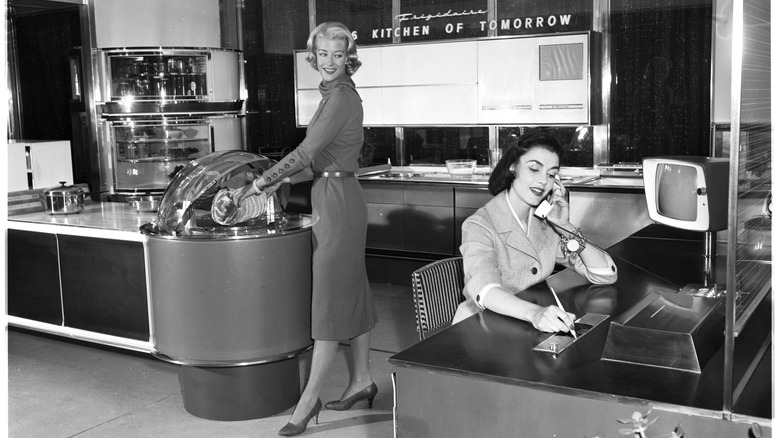
Kitchen appliances that saved time and improved food safety and preparation were truly transformative after centuries of hard manual work. We take them for granted now, but even the most basic blenders and mini-choppers were once fantasies inside the head of someone tired of doing all this work themselves. The wave of inventions that hit kitchens and homes in the 19th and 20th centuries was unmatched, and combined with burgeoning technology, some inventions were unbelievably futuristic. (Did you know that there was a working "picturephone" in the 1960s and 1970s? Remember that the next time you make a video call.)
Many appliances were light-years ahead of what people had been using, and food and cooking culture today would be vastly different if it hadn't been for people's frustration, along with some happy accidents. While some of these appliances aren't in use anymore, their legacy lives on through language and memory. One appliance that started as a joke even resurfaced decades later in a slightly different form. Here are 8 vintage kitchen appliances that were ahead of their time when they were introduced to home cooks.
General Electric's combination refrigerator with rotating shelves
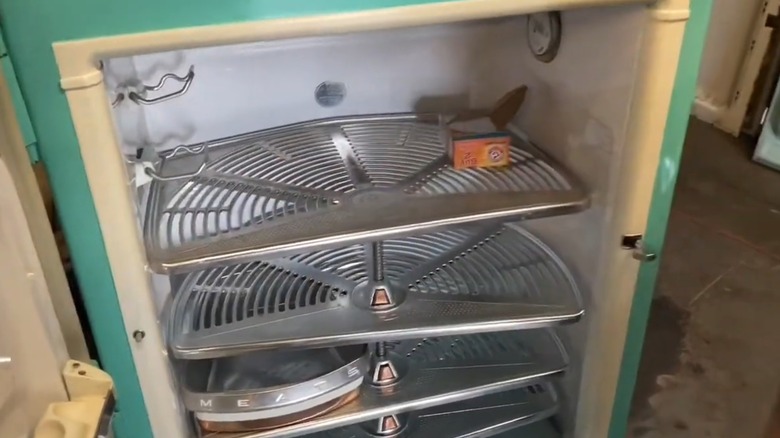
Refrigerators and freezers used to be separate appliances until General Electric introduced a two-compartment freezer-fridge model in 1939. (The two-door combination unit came along in 1947.) That was cool, no pun intended, but then the company did something even cooler: Create a combination unit where you could rotate the shelves to reach items in back. These models were made in the mid to late 1950s, but you can still find them secondhand.
When you open the refrigerator door of one of these models, the interior looks fairly normal until you see the pole running down the center of the refrigerator in front. The top shelf may be stationary, but the shelves underneath it can rotate out and around easily. The refrigerators also have built-in wine racks above the top shelf.
The models do have some drawbacks, namely that the rounded edges of the rotating shelves reduce the overall amount of space you have to store items. But if you normally don't store items all the way in the back corners anyway, the rotating shelves are simply genius.
The icebox

Those refrigerators were cool, but the history of cooling food didn't start with them. You used to have to store food in pits with harvested ice blocks. But in the mid-1800s, people were able to start using iceboxes, which were literally boxes that held ice and food. Think of them as early ice chests or coolers. Early iceboxes were made of wood with a metal lining inside and something like straw in the walls to act as insulation. The boxes used the fact that cool air falls to keep everything cool. Ice would sit inside at the top, while perishable food sat below it. The iceboxes of the early and mid-1900s got a little fancier in terms of material, but the concept remained the same. And yes, this is the appliance that gave icebox cakes their names.
While we'll never give up our refrigerators and freezers, the icebox itself was a monumental improvement. These smaller boxes allowed people to keep food cold in their homes and apartments, without needing to access an exterior pit. The melting ice could lead to leaks if you didn't keep an eye on it, but the box was convenient and generally affordable enough for most people to have one. It wasn't until the 1930s that many started buying refrigerators powered by electricity, although people's preferences clearly shifted as the new refrigerators didn't have the same problem with leaks from melting ice, nor did they require new ice blocks.
The Chambers stove
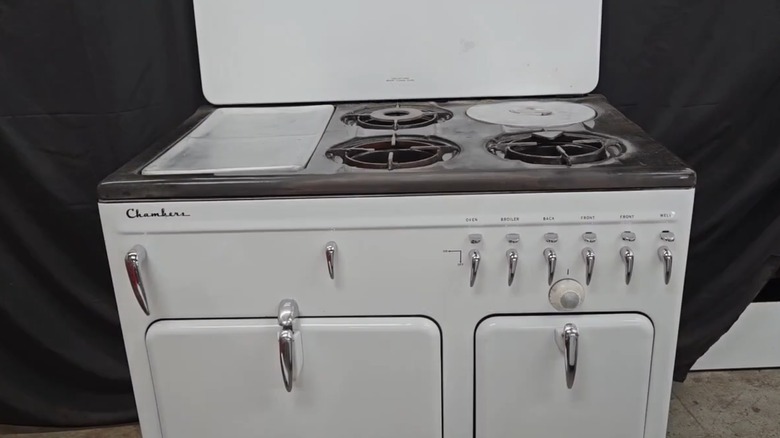
The Chambers stove was an older stove that came in a few models starting in 1912. It's one of those fabulous vintage stoves with multiple ovens and burners, along with a grill. But the Chambers stove was more. Each was constructed with incredible craftsmanship, and many still work even today. If you move to Baltimore, for example, you may find the stove in your rental is a real Chambers model. (The stove had become extremely popular there, and many owners never switched them for more modern stoves.) Aside from the variety of cooking they made possible, Chambers stoves were ahead of their time because they included a way for cooks to set more accurate temperatures, which they didn't have to adjust constantly.
One other feature of Chambers stoves that made them so advanced was a device called the ThermoWell (or ThermoDome on early models). This was a container that would heat up and then stay hot even without extra gas. You could essentially slow-cook or roast something without any fuel or power once you'd gotten the ThermoWell up to the right temperature. The ThermoWell was based on the insulated fireless cookers used earlier in the century. One other feature was a combination griddle and covered stovetop broiler. You could use the surface as a griddle, but you could also raise the griddle to reveal a broiler and tray that you'd fill with food. You'd then lower it back down into the stovetop to let the food cook.
The Honeywell H316 kitchen computer

The Honeywell H316 kitchen computer was amazing, in theory. It was one version of the Honeywell H316 General Purpose Computer, which came in three different styles, including a pedestal version, with a wide desk space in front of the controls. Originally, this was meant to be an office computer, and Honeywell didn't market it for home use.
But then someone at Neiman-Marcus decided to advertise the pedestal version as a kitchen computer in its 1969 Christmas catalog. This was meant to be one of its sort-of joke gifts, along with similar offerings such as his-and-hers submarines and suits of armor. But Neiman-Marcus really offered it, claiming you could use it to balance checkbooks, store recipes, and compute menus for dinner parties. You'd get the computer along with an apron, cookbooks, and a two-week programming course, all so you could stop using index cards for your cake recipes. That plus the hefty price tag — $10,600 in 1969 dollars — meant no one bought the thing for home use.
So, how was this ahead of its time if it was meant more as a tongue-in-cheek offering? Turns out that it was the first computer offered for sale to the public as a consumer product. Even though it didn't work out, it was like a predecessor to all those recipes you have stored on your tablet. Whoever decided to list it in the catalog was thinking ahead.
The Radarange
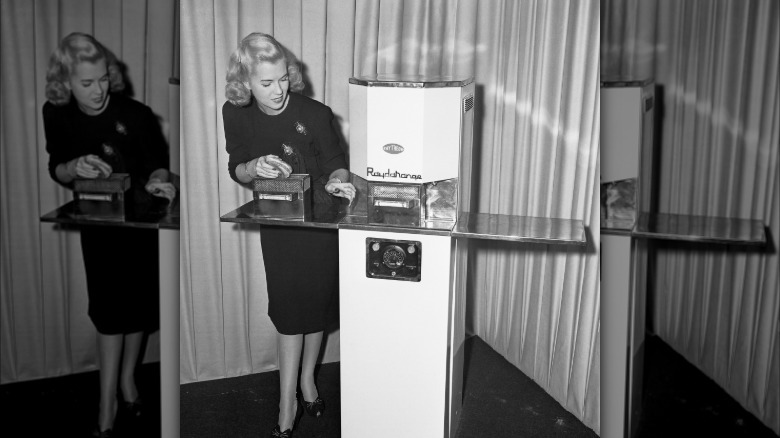
Microwave ovens sound like something that came about in the 1970s and 1980s, and it's true that the first mass-produced and affordable microwaves didn't appear in stores until 1967. But microwave ovens are actually older than that, and they were pretty much an accidental result of experiments after World War II. Raytheon had provided magnetron tubes to the military to power radars. Once the war was over, the company started looking at ways to use the tubes for other purposes. Researchers already knew that radio waves could cook food, but the application of this knowledge had previously been limited to an experiment at the 1933 World's Fair.
In 1945, an engineer named Percy Spencer discovered by accident that heat from the tubes he was working with caused some food in his pocket to heat up. He started experimenting with popcorn and eggs and realized this phenomenon might have a use in the kitchen. Eventually, Raytheon developed a prototype microwave oven called the Radarange. In 1955, Raytheon teamed up with appliance company Tappan to produce the first home microwaves. Those were huge and so expensive that most people couldn't buy them. But by the mid-1960s, Raytheon bought the appliance company Amana, and that alliance led to the first home countertop microwaves. Those models were still expensive, but they were within reach of more household budgets.
The pop-up toaster

You could say the invention of the electric toaster itself was ahead of its time, but what really brought making toast into the modern era was when toasters themselves told you the toast was done. Before powered toasters, you toasted bread by placing it in a pan or holding it carefully over a flame. Electric toasters were a sign of progress with electrical technology, but they didn't really help make toast any better. You still had to watch the toaster and manually turn the bread because you could toast only one side at a time. You were still doing all the work, just with an electric heating apparatus instead of a fork over a flame.
Burnt toast was so common in the cafeteria at one Minnesota factory that a worker there decided he had to do something. That was Charles P. Strite, who worked on a new version of the toaster between 1919 and 1921, incorporating dual-side toasting, an ejection spring, and a timer. He got his patent and immediately started selling the appliance to restaurants, of course. No more burnt toast for lunch. By 1926, the Toastmaster was finally available to the public with an updated, adjustable timer. You still had to be careful, and to this day, you've got to clean the crumb tray and ensure the bread doesn't get stuck, lest it start a fire. But the pop-up toaster and its automatic timer gave cooks a lot more freedom.
The food processor
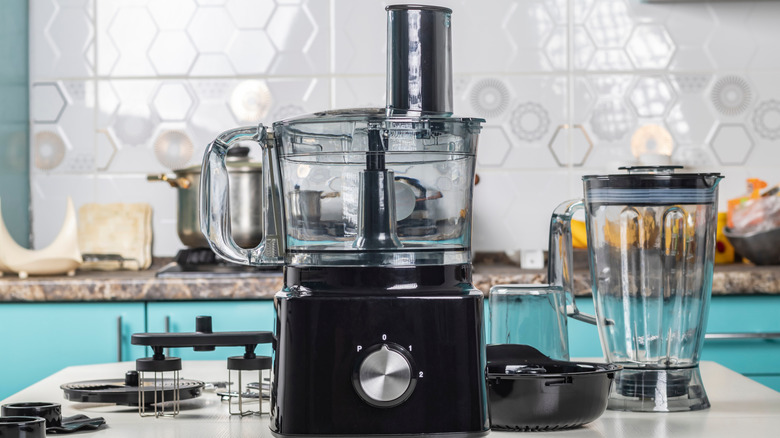
The food processor was a giant leap in food-prep technology. Previously, all you had were blenders and knives. Blenders were easy to use, but you weren't cutting butter into flour or slicing vegetables with a blender. You could chop and mince to an extent before the blender pureed the ingredients. As for knives, all that manual chopping and slicing took time and effort. If you had dexterity or arm mobility issues, a knife could be very difficult to use. In fact, it was all that time spent using a knife that spurred people to start looking at ways to automate the process.
Industrial food-processor models sprang up in France and the U.S. in the late 1950s. However, it took until the 1970s for the food processor to become really popular. That was when Carl Sontheimer saw a demonstration of the Magimix, a model of food processor made for the home kitchen. Sontheimer signed on to handle U.S. distribution and spent several months adjusting the model before debuting it through his new company, Cuisinart. The food processor moved a lot of manual preparation into a machine that took only seconds to do what had taken at least several minutes before. The change in how easy it was to prepare and mix ingredients was stunning, and Julia Child considered it "the single most important invention since the electric mixer," according to the National Museum of American History.
Top-oven ranges
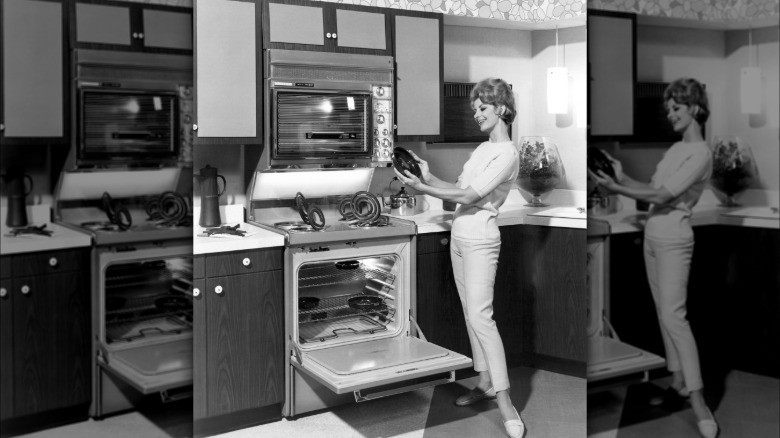
The double-oven range was introduced to consumers in 1932. But in the 1950s and 1960s, several brands introduced ranges with ovens above the stove, and they equipped them with enough features to make each a marvel of convenience. First, these top ovens often had glass doors that let the cook see what was going on during the cooking process without having to actually open the oven and let out heat. Glass-door ovens weren't new, but they didn't really become popular until the mid-20th century, when improvements in heat-resistant glass allowed for safer cooking. The fact that these glass-door ovens were at eye level also meant that cooks could quickly check the oven and then refocus attention on the stove.
Some of the models had one oven above the stove and one below, while others, like the Tappan Fabulous 400, had both ovens located above. If you required only one oven, or you needed two but had the Tappan, you could bake or roast something without having to bend down, making cooking less arduous. Additional features included foldout cutting boards, cabinets, and ways to hide the stove burners when they weren't in use. The models had a few drawbacks, such as a low-top stove that prevented the use of large saucepans on the back burners.