

Why Classic Peanut Butter Cookies Always Have Fork Marks

Answers to questions like, "Why is the sky blue?" tend to elicit a knee-jerk response like, "That's just the way it is" — the same one parents everywhere might be tempted to give a 4-year-old inquirer. The same might be true of a query about why peanut butter cookies have those signature crosshatch fork marks on top. A bigger question might actually be whether the fork marks serve a particular purpose or are just emblematic of this particular type of cookie.
Some of the first recipes for peanut butter cookies appeared in George Washington Carver's 1917 peanut-growing treatise, "How to Grow the Peanut: And 105 Ways of Preparing It for Human Consumption." But none of the three recipes he included as examples of preparing peanuts for human consumption contain instructions for doing anything but dropping the dough from a spoon and baking. The first instance of the crosshatch marks seems to have appeared sometime around 1932. Some sources have claimed it appeared in the July issue of Schenectady Gazette that year. But the gazette's editors have discovered it was actually a syndication and appeared in many papers around that time, though it does appear to be the first recipe that used crosshatches. But the criss-cross fork move likely first became national baking canon thanks to a 1933 recipe published in "Pillsbury's Balanced Recipes."
The reason behind the instruction is less clear. Some claim the fork marks directly relate to helping flatten the dough so the cookies bake properly, though many bakery-style peanut butter cookies come sans fork marks. Others suggest the signature marks are purely decorative.
Are the fork marks functional?
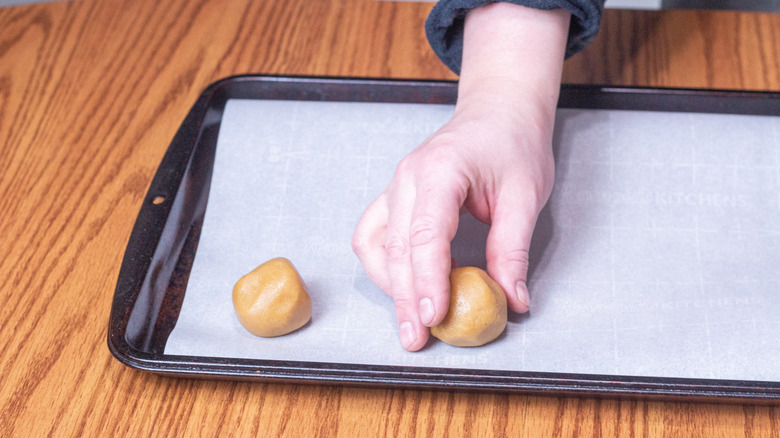
The 1933 Pillsbury recipe refers to these peanut-butter forward treats as "balls," likely because the dough was dense thanks to the abundance of thick peanut butter in the recipe. Traditionally, thick peanut butter cookie dough is usually portioned out and rolled, often in hot little hands, into spheres and then placed in pleasing rows on a cookie sheet. The final treatment before the cookies hit the oven is to firmly press down on each ball with a fork and then turn the pan 90 degrees and repeat the move to transform the dough ball into a flatter shape that resembles a cookie.
The functional argument for the fork marks quickly becomes clear to anyone who misses this step on a ball or two. The ball shape doesn't cook very evenly in the oven, becoming kind of an amorphous blob. By squishing the dough a bit in alternating directions, each cookie spreads out evenly, allowing for a more uniform bake. That seems especially important when you're making something like two-ingredient peanut butter cookies, which have no liquid or fat except what's in the peanut butter already.
Do fork marks just look distinctive?
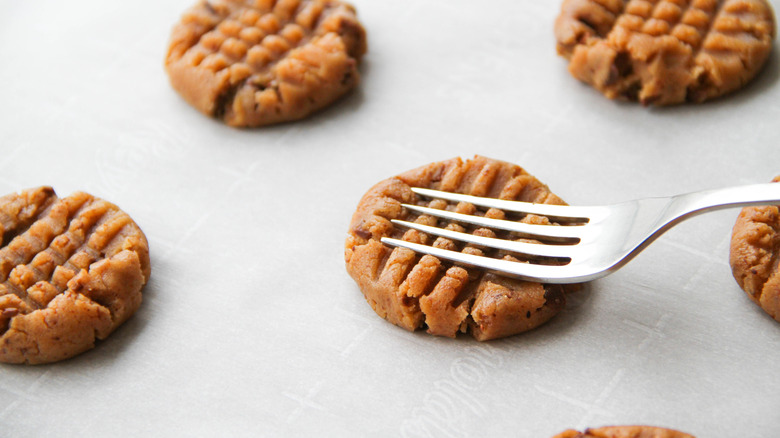
Another theory, put forth by a New York Times reader in 1979, simply asserts that the alternating fork pattern differentiates peanut butter cookies visually from other types of cookies. In other words, the signature move is an immediate visual cue that these cookies are of the peanut variety. At this point, it may just be nostalgic, though it conveniently identifies peanut butter cookies for those with peanut allergies too. And in reality, even if the marks are functional, you could just use a spatula for even baking. The use of a fork is clearly decorative to some degree.
Whichever camp you fall into, it may be the case that peanut butter cookies have those marks because that's the way they've been since the first time we remember having them in the elementary school cafeteria. Regardless, peanut butter cookies are undeniably rich and satisfying and one of the easiest cookies to make, so there's no reason not to give it a shot and see whether flattened or not flattened comes out better.