

This Trader Joe's Cheese Has Living Organisms In The Rind. They Actually Make It Fancier (And Taste Better)

You never know what great new products Trader Joe's is going to release, and that's what keeps many of us coming back. One of the more intriguing recent additions to the dairy aisle is a beautiful sunset-hued cheese with a unique, lunar crater-like rind. It's called mimolette and comes from France's Normandy region. It's aged for at least 12 months before being sold, which contributes to its nutty flavor with caramel notes, but there is another surprising reason that mimolette is so cool-looking and delicious, and it has to do with cheese mites. The tiny mites gather on the rind of the cheese during the aging process, and as they burrow into this outer layer, the holes they create encourage air flow in the cheese, which in turn helps flavor development.
If the thought of your cheese coming with a side of mites makes you a little queasy, not to worry. All of the mites are removed as the final step in the process of preparing the cheese for consumption. The cheese mites are either brushed off by hand or blown off with compressed air, and if there happen to be any stragglers, they will not make it through the vacuum seal process that takes place before the mimolette is exported.
Mimolette's production process makes it versatile
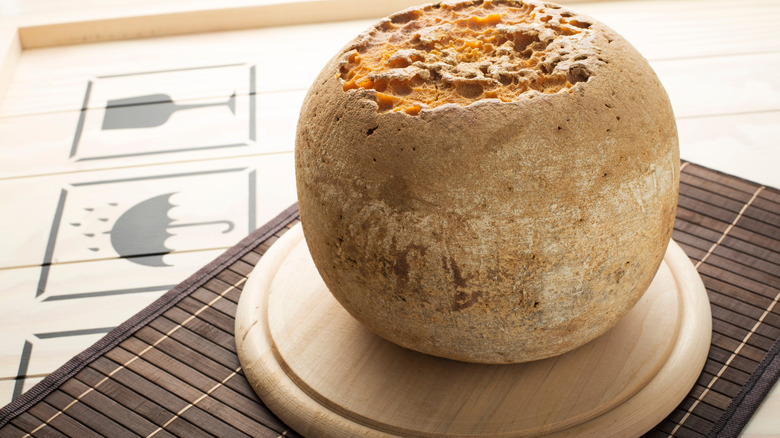
Like many aged cheeses, mimolette goes through quite the process before it ends up on your ultimate charcuterie board. Curdled milk is cut into soft blocks and placed in nylon-lined molds that form the cheese into cannon-shaped balls. The balls of mimolette then get a multi-day salt bath to help pull out moisture and add flavor. Next, they are placed in a cheese cave, where they sit on wooden boards to ripen for about half a year. After this, producers gently hit each one with a mallet to test how much air is inside. If it seems very airy, its ripening time is over; it will be sold as young mimolette — mild, soft, and creamy.
The cheeses that "pass" the mallet test continue the ripening process, during which natural mold grows on the rind. This is when the cheese mites are intentionally introduced to the process. Once the mites get going on the mimolette, they create holes in the cheese's rind, yielding a crusty, cratered appearance. The longer the cheese ages, the stronger its flavor and the more lunar-like it appears.
The distinctive production process of mimolette is not just a conversation starter; it also leads to a very versatile cheese. Due to the fact that it is aged but does not have a super strong flavor like Stilton or Roquefort, mimolette can be used on cheese boards, in grilled cheeses for a creamy, nutty flavor, or paired with robust red wine like Bordeaux. This cheese also works surprisingly well with chocolate, with the salty, caramel notes complementing the sweetness.