

9 Hanukkah Food Traditions, Explained
We may receive a commission on purchases made from links.
Each year, Jews across the globe celebrate Hanukkah. This holiday, which starts on the 25th day of the ninth month of the Hebrew calendar, is observed for eight days and nights. Hanukkah, which translates to "dedication," celebrates the re-dedication of the Holy Temple of Jerusalem following the conquest of a Syrian-Greek army by the Maccabees. Upon the re-dedication, the story recalls that a miracle occurred. The menorah had just enough oil to burn for one day, yet it shone brightly for eight, hence the length of the Hanukkah celebrations.
Hanukkah celebrations are generally punctuated by the lighting of the menorah, gift-giving, the spinning of the dreidel, and the consumption of various symbolic foods. Symbolic foods play an integral role in every Jewish holiday — major or minor — and Hanukkah is no exception. The foods served throughout the celebrations not only serve as a means of retelling the story underlying the reason for the holiday — consuming them is a tactile reminder of the fundamental tenets and themes that make each celebration so important to those of the Jewish faith.
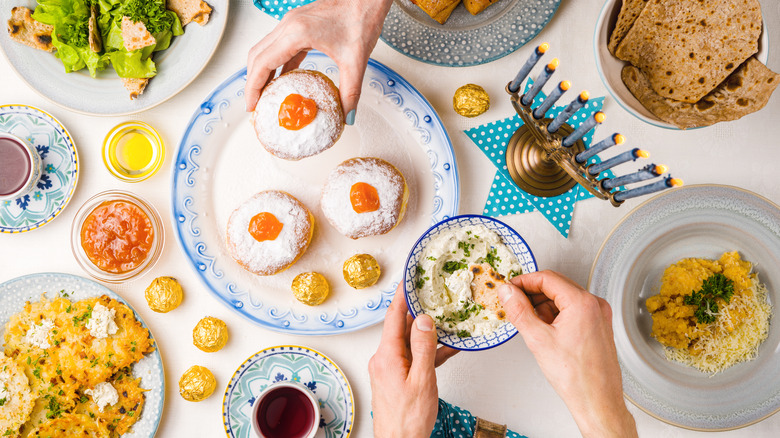
Though each country varies in exactly which foods it consumes during the Hanukkah celebrations, there are some commonalities across cultural traditions. From latkes and gelt to challah and sufganiyot, these are a part of primary Hanukkah food traditions.
Latkes
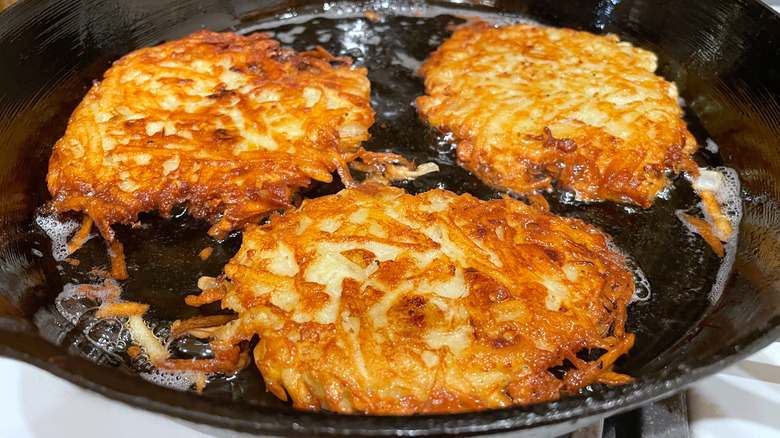
If there is one food most frequently associated with Hanukkah, it is the iconic potato pancake, known as a latke. Latkes are essentially a fritter that is composed of shredded potatoes and onions bound together with flour and eggs and fried until golden brown and crispy. Though they originated in Eastern and Central Europe, the tradition of eating latkes during Hanukkah has spread across the globe.
The symbolism behind the latke is to commemorate the oil that kept the menorah alight for eight days during the re-dedication of the Holy Temple of Jerusalem by the Maccabees. By frying the potato pancakes in oil and consuming them, Jews pay homage to this miracle. Interestingly, the tradition is relatively recent, only emerging in the 18th or 19th century when potatoes became a staple of the diets of impoverished Ashkenazic Jews residing in Europe.
Perhaps the most essential factor to consider when serving latkes at Hanukkah is what to put on them. Two toppings are commonly served atop latkes — sour cream and applesauce — and which reigns supreme is of utmost importance to Jews. Every household has its own take, with some preferring the lighter, sweet, and savory juxtaposition that applesauce lends to a latke. Others enjoy the tang and richness that sour cream confers upon these crispy potato delights.
Challah
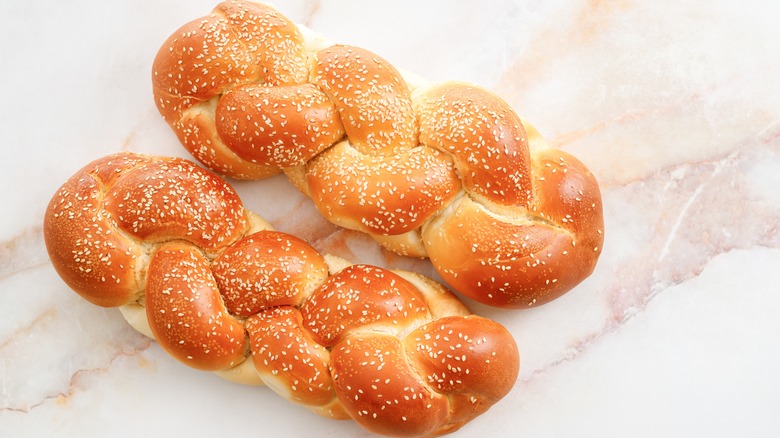
Challah is a variety of enriched, yeast bread that features prominently on any Friday evening Shabbat or Jewish holiday menu. Eggy, golden brown, airy, and bouncy, this bread is characterized by its distinctive shape, which is punctuated by braided strands, each symbolic of something different. The tradition of serving challah emerged in Eastern Europe with Ashkenazic Jews and made its way to America, where it assumed its sweeter, more refined version.
Challah has biblical origins, though its modern-day iteration hardly resembles the dense round cakes that were described within the Book of Samuel. These loaves were often brought to the temple as offerings for priests. Today, when challah is prepared and served for the holidays, including Hanukkah, a mitzvah known as Hafrashat Challah is performed. This involves separating a portion of the dough and burning it while saying a specific blessing.
Unlike the round challah served at Rosh Hashanah, loaves served at Hanukkah are elongated and formed by three or six strands. The three strands typically represent truth, peace, and justice, while the six strands can symbolize the six days of the week that are bound together by Shabbat. Challah can be served as-is or topped with sesame or poppy seeds, which are believed to represent manna from heaven.
Sufganiyot
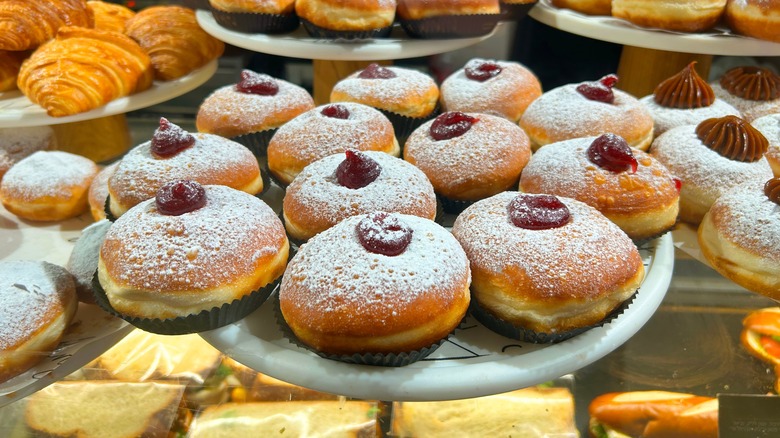
Like latkes, sufganiyot are fried in oil, representing the fuel that kept the menorah lit for eight days during the rededication of the Holy Temple of Jerusalem by the Maccabees. Though fried dough is a tradition generally attributed to North African and Sephardic Jews who resided there, the earliest reference to jelly-filled donuts can be found in a German cookbook dating to 1485. Modern-day sufganiyot are a hybrid of Sephardic and Ashkenazic traditions, fusing European and North African sensibilities.
The formalization of sufganiyot as a Hanukkah tradition is generally attributed to the Israeli Labor Federation. In the 1920s, sufganiyot were made the official food of Hanukkah, which led to the employment of countless bakers during the holiday season. According to Time, nearly 18 million sufganiyot are eaten during Hanukkah in Israel alone each year, with numerous more consumed worldwide in various iterations.
Among the more popular permutations of fried doughnuts found in cultures around the world are Moroccan sfenj, Spanish Bimuelos, Hungarian fànk, Danish ebelskivers, Italian donuts, and Greek loukoumades. These can be served as part of a meal or as a sweet treat during the Hanukkah festivities, alongside other traditional foods.
Kugel
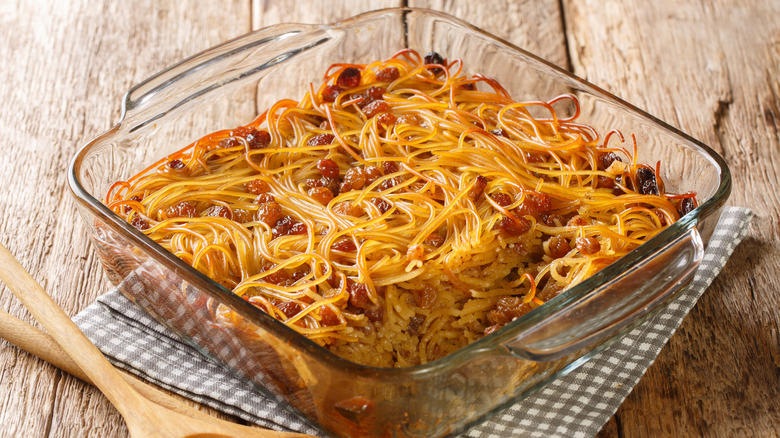
When it comes to celebrating special occasions, Jews love a casserole as much as any gentile. Perhaps the most popular casserole to be featured at most holiday celebrations, including Hanukkah, and on the Shabbat menu is the kugel. The kugel is a dish of Ashkenazic Jewish origin, meaning it hails from Eastern Europe. The earliest iterations of a kugel were fashioned from leftover bread pastry. This evolved to include noodle or lokshen kugel and rice kugel in the 1500s and eventually potato kugel in the 19th century.
The key feature of a kugel that makes it ideal for inclusion in Jewish festivities is that it can be prepared in advance and allowed to cook without active involvement, in accordance with the rules of Shabbat. Early varieties were steamed in an earthenware pot known as a cholent in communal ovens. Modern iterations are typically baked in the oven.
Kugel recipes are as diverse as the Jewish diaspora, with virtually every household having its own proprietary version. Some are sweeter, with dried fruits and farmer's cheese, while others are savory, featuring caramelized onions and seasoned with abundant quantities of pepper. Still more have been adapted to modern-day palates, including unusual additions like a crushed cereal or French-fried onion topping.
Hanukkah Gelt
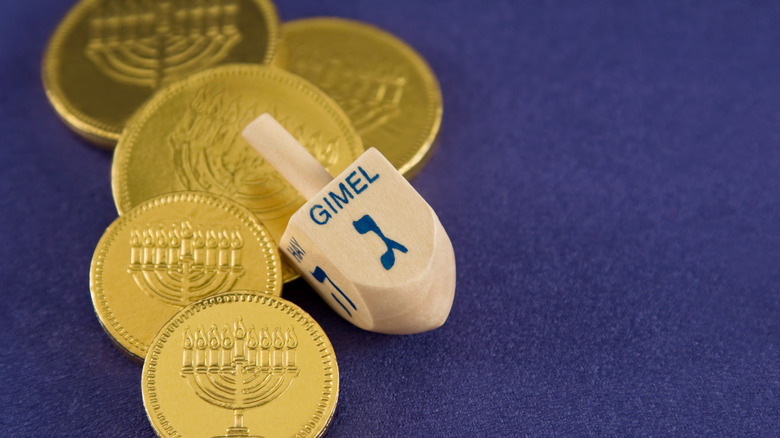
Gelt, which is the Yiddish word for money, is a Hanukkah tradition that is generally reserved for children. These foil-wrapped chocolate coins are staple tokens that are passed out on every night of the Hanukkah celebrations as a reward for studying the Torah and reinforcing the importance of Jewish education. Children frequently use the gelt to play the game of dreidel.
Historically, rabbis would travel far and wide to educate poor and illiterate Jews about the Torah and Judaism. Though the reward for this education was generally considered to be the act of spreading the word of the Torah itself, small tokens of gratitude were encouraged. These chocolate tokens symbolize this in a modern, meaningful, and tangible way.
Most gelt is made from rather mediocre milk chocolate and is sold in nets. That said, some companies are elevating the tradition of Hanukkah gelt by using higher-quality, sustainably sourced, fair-trade chocolate. Among the more bougie varieties on the market are the organic, dark chocolate gelt from Lake Champlain Chocolates and those from The Dreidel Company, which are made from premium Belgian milk chocolate.
Brisket
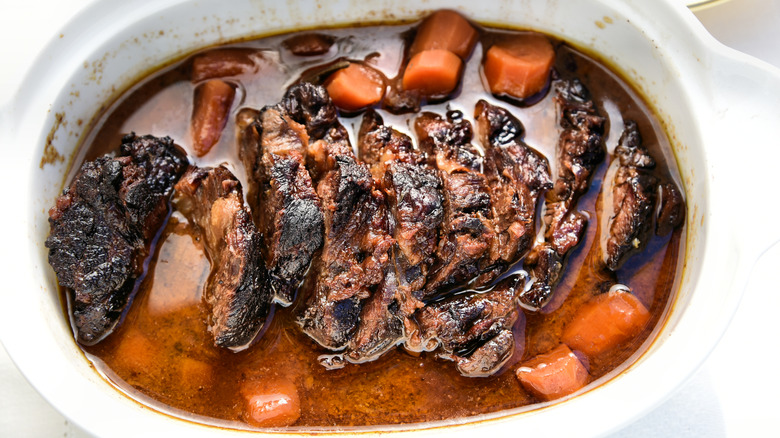
Though not exclusively a Jewish food, brisket is indeed a staple of many a menu served at Shabbat and other Jewish holidays in the United States, including Hanukkah. Many Jewish-American families rely on this cut of meat for its cost-effectiveness and capacity to feed a large crowd. The cut, sourced from the bottom front half of the cow, is known for being rather tough and loaded with connective tissue, which makes it especially well-suited for low-and-slow culinary methods. It is also among the few Kosher cuts of beef available to observant Jews.
From a practical perspective, brisket solves a very real problem for those who avoid cooking during the Sabbath. It requires lengthy, slow preparation to enable the meat to become tender and supple. The meat can be started at sundown at the beginning of the Sabbath and allowed to braise for up to 48 hours without it being an issue.
Though preparations vary depending on where in the country you may go, many involve slowly roasting and braising the meat along with root vegetables and aromatics, which slowly dissolve and turn into an unctuous sauce. Other recipes may include more premium ingredients, like red wine and mushrooms, while still more lean into local delicacies and flavors, including Southern variations featuring a dash of sweet and spice — and generous heaps of barbecue sauce.
Roasted Chicken
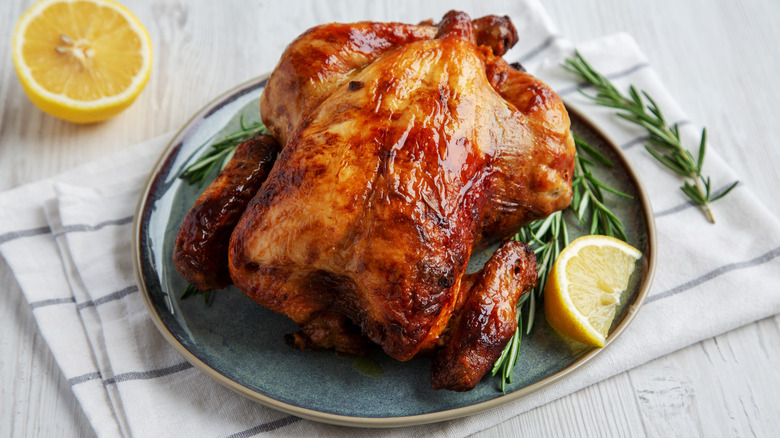
Few things are as delectable as a whole roasted chicken. Though this isn't necessarily a food that is exclusive to Jews or Hanukkah, it does feature prominently on dinner tables across America during the Sabbath and other holidays, particularly in the households of Ashkenazic Jews hailing from Eastern Europe.
The custom of eating chicken in a Jewish home is less religious or symbolic than it is traditional. Because meat has long been considered a commodity item, scarcity became the mother of invention in the "old country." Eastern European Jews had to figure out ways to feed a family and create a meal that was special with readily available resources, which often included poultry. Chickens were useful for a number of reasons: not only did they produce eggs, but their fat (or schmaltz) could be rendered and used for cooking when keeping Kosher.
Though many of the best Hanukkah roast chicken recipes are simple, featuring lemon, garlic, and aromatic herbs for flavor, some involve more ethnic ingredients drawn from Sephardic cultures. Among these are recipes featuring dates and pistachios, giving the bird a decidedly Middle Eastern flair, and others featuring classic Mediterranean fruits and vegetables, like quince and Jerusalem artichokes. As a bonus, the leftover meat from these can be repurposed into deep-fried meat patties or fritters in keeping with the symbolism that makes Hanukkah so unique and delicious.
Rugelach
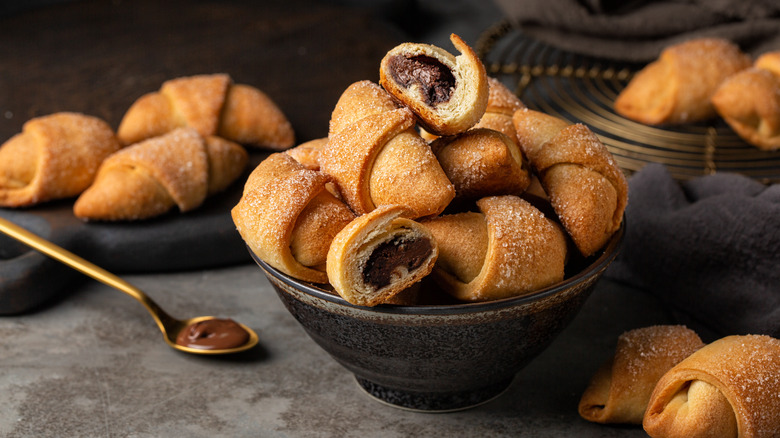
Rugelach are a special, crescent-shaped, filled pastry that originated among Eastern European Ashkenazi Jews in Poland during the Middle Ages. These pastries evolved and made their way to America and beyond with Jewish migrants fleeing anti-semitism. They are a common fixture at Jewish celebrations of all kinds, notably Rosh Hashanah and Hanukkah.
When eaten at Hanukkah, rugelach symbolizes blessings and good fortune, and its richness is a reminder of the miracle of the menorah staying lit for eight days. Their production often involves the whole family and can be a means of sharing stories and fostering community as they are carefully assembled and baked.
Though rugelach dough is often made with cream cheese, variations abound, making them suitable for all Jewish audiences, both kosher and non-kosher. Common fillings include fruit jam, nuts, chocolate, and even savory items, like cheese, vegetables, and meat. Rugelach are readily available from Jewish bakeries across the United States, and they can be frozen, making them a great item to stock up on during the holiday season.
Matzo Ball Soup
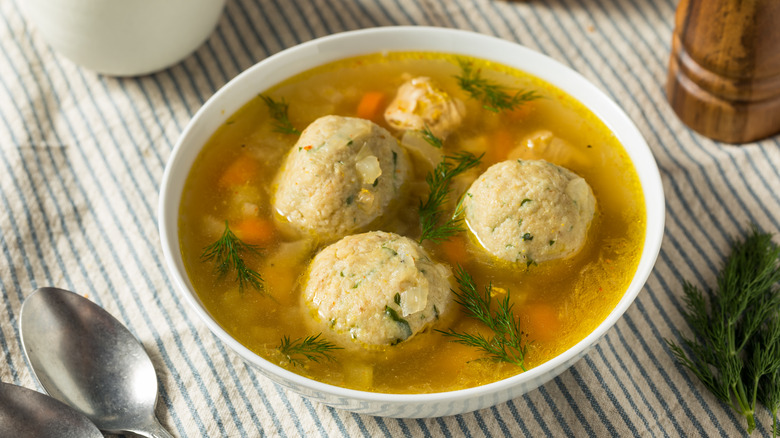
No discussion about traditional Jewish holiday foods would be complete without mentioning a classic and comforting matzo ball soup. Again, while not specifically a symbol for Hanukkah, this dish is a common fixture on celebratory menus during this time of year because it is the perfect remedy for a cold, winter day.
Matzo ball soup recipes are incredibly diverse, with some versions featuring a clear broth laden with plump dumplings made from matzo meal and others more akin to a chicken noodle soup in consistency. The Matzo balls themselves are fashioned from matzo meal mixed with eggs, water, and oil. They can be light and fluffy, or dense and chewy, depending on the chef and the household.
Matzo balls are likely of Eastern European origin, though their precise genesis is up for debate. That said, when they make an appearance on any menu, particularly a celebratory meal, they are likely to remind Jews of purity, redemption, and community.