

10 Mistakes Everyone Makes With Deep Fried Turkey
We may receive a commission on purchases made from links.
When it comes to preparing the centerpiece of the Thanksgiving table, the turkey, it's safe to say that most of us will resort to our tried-and-true, oven-baked recipes. These preparations are undoubtedly classics, as the bird can be stuffed with any number of dressings, paired with aromatics, and prepared safely within the comfort of one's own home. However, for folks who aren't afraid to get their hands greasy, there is an alternative: deep-frying the bird.
Not only is watching a massive Thanksgiving turkey fry to a crisp in a pot of sizzling, spattering oil a spectacle, but it also renders the skin of the turkey perfectly crisp and flavorful. That being said, the risk-to-reward ratio for many folks is skewed in the direction of, "Yeah, I think oven-baking is fine." There is no shortage of videos posted on YouTube and shared on social media of deep-fried turkeys going horrendously wrong, leading to explosions, house fires, and outright dangerous situations. However, as long as you're safely frying your bird — and taking all the precautions to ensure that it comes out crisp and flavorful — you might consider deep-frying your turkey going forward. In order to get some insights on what not to do when deep-frying a turkey, we consulted the experts: Jonas Favela, executive chef at Stock & Bond and Tellers inside The National, Autograph Collection in Oklahoma City, and executive chef Sergio Ledesma of Geraldine's in Austin, Texas. They shared the biggest safety mistakes folks make with deep-fried turkey and how to safely, and flavorfully, prepare your bird.
1. Overflowing the pot
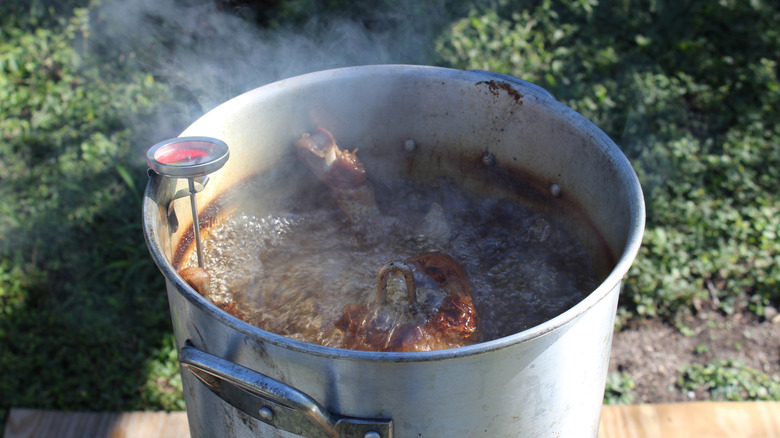
When we asked executive chef Jonas Favela what the most common safety mistake people make when frying their turkey, his answer was simple: "Hands down, it's underestimating how much oil expands when heated or how fast it can boil over." And that certainly makes sense; if you're just eyeballing how much to add to the drum, chances are that you're not going to get the right amount. "People fill the pot too high, drop the bird in, and suddenly the driveway looks like a scene from 'Apocalypse Now,'" he says. Hot oil sputtering from the vessel and coursing down your driveway is probably not the best way to start your Thanksgiving.
Executive chef Sergio Ledesma offered a helpful hack for determining exactly how much oil you need to add to your pot. He suggests that before you even pull out the oil, grab your turkey pot and fill it with water, then submerge your bird in it completely. Once you're sure that the water has not crested above the surface, you can remove the bird and place a mark on the side of your pot so you know exactly how much to fill it up next time. If you try this hack, just make sure to dry off your bird completely before frying. As a rule of thumb, Ledesma explains that a small bird may require about 3 gallons of oil, while a sizable 20-pounder may need something closer to 5 gallons.
2. Forgetting to take proper safety measures
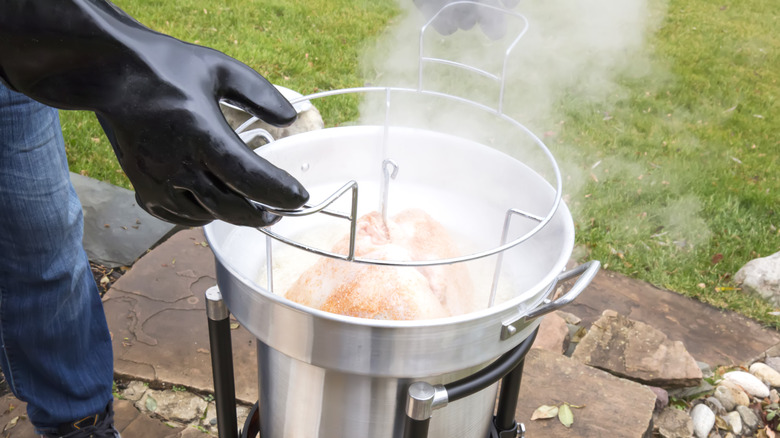
The worst mistakes you can make when deep-frying a turkey may not lead to just a bad-tasting bird — it can also burn your house down. Those YouTube videos aren't lying about how volatile the oil is, and if you cook your turkey in the wrong spot, you could be kicking off turkey day with a call to the fire department.
The first thing to consider is location. "Some people set up right next to the garage or under a porch. You want open air and no overhead structure, middle of the driveway is perfect, not under your [carport]," says Jonas Favela. Favela also recommends checking to make sure that your fryer isn't wobbly or sitting on uneven ground. "If it wobbles even slightly when empty, it's unsafe," he says.
Sergio Ledesma says that clearing the area is important and recommends keeping a distance of 6 to 10 away from the bird as it's cooking. "Only the person monitoring the oil and temperature should be near it — and even then, they should stay at arm's length rather than leaning over the pot," he says, also recommending that children and pets be secured and kept away from the drum. And if you get the honor of fishing the turkey out of the sputtering oil, be sure that your arms and hands are covered and that you are aware of where the oil is at all times. Keeping a dry or chemical fire extinguisher handy, per Favela's recommendation, is also critical.
3. Not fully thawing the bird
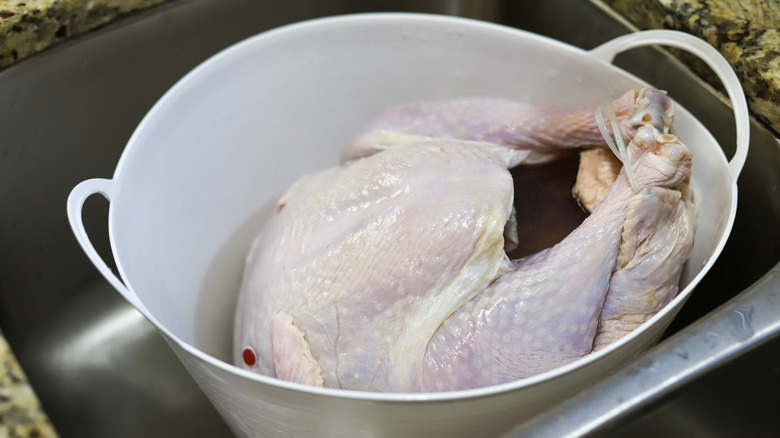
As you may remember from your middle school science classes, oil and water don't mix. And when it comes to deep-fried turkey, well, they can cause, what Jonas Favela calls, a "[napalm-type] of situation." One of the most dangerous mistakes that people can make when deep-frying their turkeys is plunging a frozen turkey — even a partially frozen one — into hot oil. "Water expands thousands of times when it turns to steam, that's the explosion you see online," he explains. Sergio Ledesma shares that the oil sputtering upwards isn't the sole problem, either: "If oil splashes onto the burner's open flame, it can ignite a grease fire that's nearly impossible to control with water," he says. And even if you don't have the same fireball scenario as shown in insurance advertisements, any residual moisture on the skin can also destroy any hope of a crispy bird.
As such, you'll want to make sure your bird is completely thawed and as devoid of water as possible. Ledesma recommends thawing the turkey in the fridge, rather than on a countertop, because it keeps the turkey's temperature outside of the danger zone — above 40 F. Favela's rule of thumb for thawing is 24 hours for every 4 to 5 pounds.
4. Using a wet brine instead of a dry one
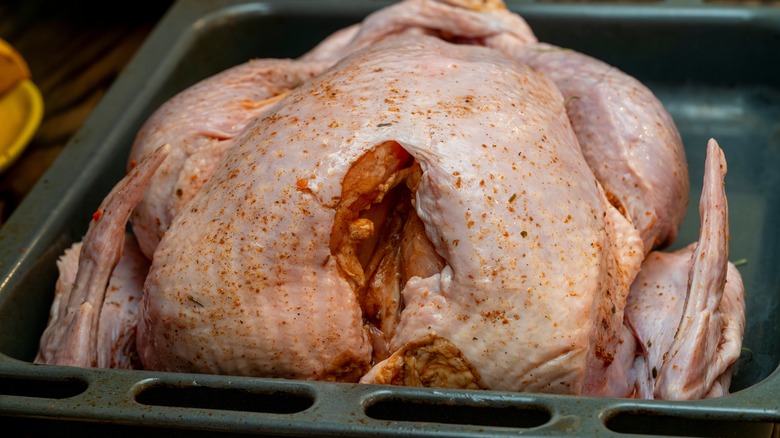
As we mentioned, you should be wary of mixing moisture and hot oil. However, you shouldn't let this important scientific construct prevent you from making a flavorful turkey. Instead of opting for a wet brine, meaning submerging or injecting it with a salt solution, you should add dry seasonings to your bird instead. Not only can a water-based brine ruin your meat's flavor, but it can also result in a fireball when you go to drop it in the oil. Sergio Ledesma is a proponent of the dry seasoning method and also suggests not stuffing anything into the cavity of the bird. He shares that if you are going to go the brine route, you'll want to pat it dry and leave it uncovered in the fridge so all of that surface moisture can evaporate.
Jonas Favela concurs. "Avoid wet brine right before frying [because] they add surface moisture," he says. "Use a dry rub or inject a marinade at least 12 hours in advance so it can absorb it." Some of the best seasonings include salt, pepper, garlic, and herbs. It's important to note that some of these seasonings will come off in the oil, so coating your bird in them well-before cooking will give them a chance to penetrate into the flesh and flavor it.
5. Using the wrong type of oil for frying
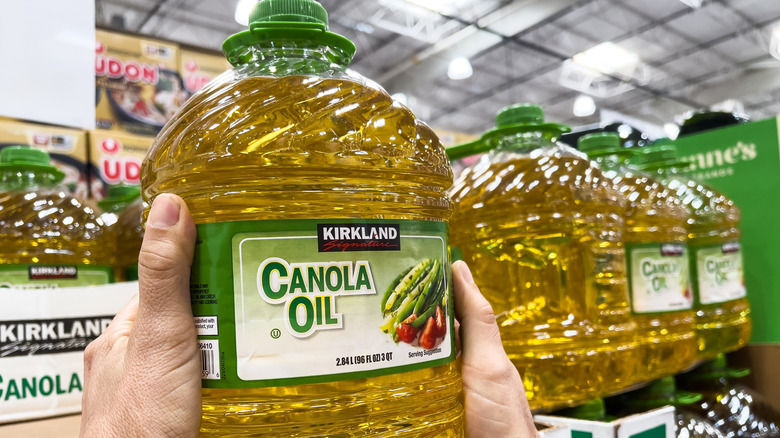
There are so many different types of cooking oil out there that it may be a bit daunting to find one that works best for you — especially when it comes to deep frying. Sergio Ledesma is a proponent of peanut oil for frying turkey — provided that no one at your table has an allergy — because it has a decent flavor and can reach high temperatures safely. Jonas Favela agrees, adding that peanut oil also has superior heat retention. However, our experts note that you can also use other types of oil, including canola or corn, if you are cooking for someone with a peanut allergy. All of these oils are relatively affordable and widely available — plus, you can buy them in bulk at stores like Costco.
While there are many oils that you can (and should) use for deep-frying your Thanksgiving bird, there are also many that you should avoid. Finishing oils, for instance — including extra virgin olive oil, walnut oil, and macadamia nut oil — are not suitable for frying because of their flavor and stability (plus, you probably don't want to sink that much money into cooking oil, considering you have to use several gallons of it to fry your turkey). Unrefined oils, as a whole, should be avoided for deep-frying anything.
6. Not frying the bird at the right temperature
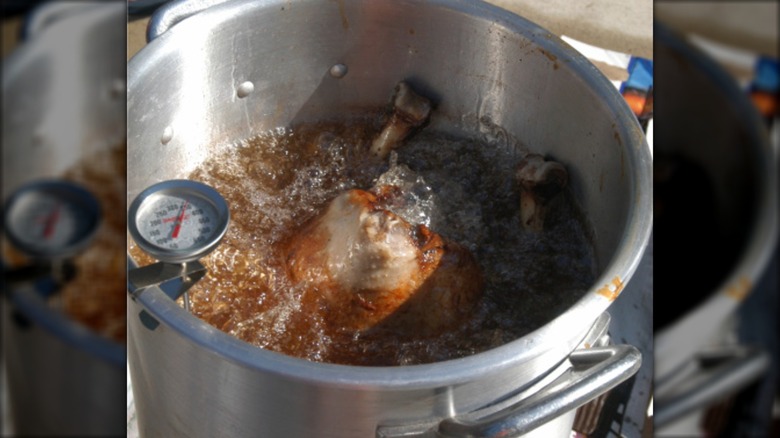
Temperature is one of the most important parts of frying anything, including turkey. Jonas Favela shares that when you put the bird into the oil, it will drop the temperature of the liquid by between 50 and 75 F. As such, you should bring the temperature up to about 375 F pre-bird, so it eventually hits the sweet spot of around 325 F. Sergio Ledesma recommends a similar temperature — around 330 F — for what he calls "nice crispy skin, [and] cooked and juicy turkey."
Ledesma's tip for keeping the temperature of the oil constant is to have a fryer thermometer nearby. Fryer thermometers are usually made of metal, rather than plastic, meaning they won't melt or get damaged by splattering oil. You should also always pick one with a long stem, as you need it to reach near the bottom of the pot. The popular Efeng Thermometer, for example, has a 15-inch stem and adjustable rest so you can perch it on the corner of your pot.
7. Plopping your bird into the oil
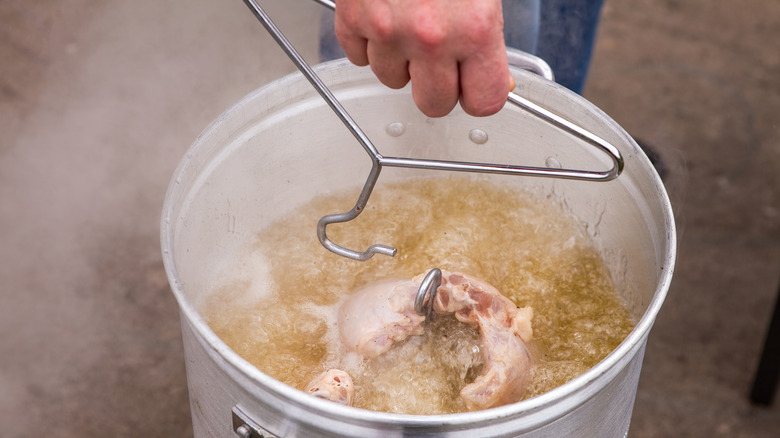
One of the most dangerous points of the whole turkey-making affair is dropping the bird in the oil. The secret, as our experts noted, is to never throw the bird into the oil. "Slow and steady wins the race, lower it a few inches at a time," says Jonas Favela. If you tossed the bird in, you may cause the oil to overflow and splash everywhere, burning you (if you're not wearing adequate protective equipment) and potentially igniting when it hits the burner. Instead, Sergio Ledesma suggests using a basket or hook to put the bird in and fish it out once it's done cooking.
The key to preventing flare-ups, Favela shares, is to control the burner when you're lowering your turkey into the oil. He suggests always turning the burner off when you place the turkey in the oil, then turning it back on once the bird is safely nestled in the hot oil. This prevents, what he calls, a "giant ball of fire." "Although they are entertaining to watch on YouTube, you don't want to be that person," he says.
8. Carving it too early
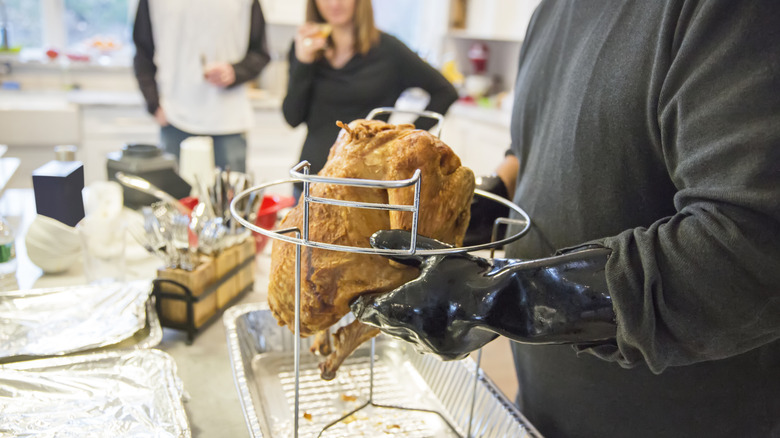
One similarity between a turkey you'd cook in the oven and one you'd deep fry is that they both have to rest for an adequate amount of time before cutting and serving. Sergio Ledesma recommends pulling the bird once it reaches an internal temperature of 165 F. After that, he says that the bird needs to sit and drain before it can be carved.
Another mistake that you may be making when it comes to resting your deep-fried turkey is trapping in steam. To preserve the skin's crispness, Jonas Favela cautions against covering the bird in foil. "Keep it tented lightly with a towel in a warm area with airflow," he offers as an alternative. Per Favela, the bird should rest for about 20 minutes so that the juices can redistribute (just as they would for a baked turkey) and so that the crust can stay perfectly crispy.
9. Incorrectly storing the oil for later use
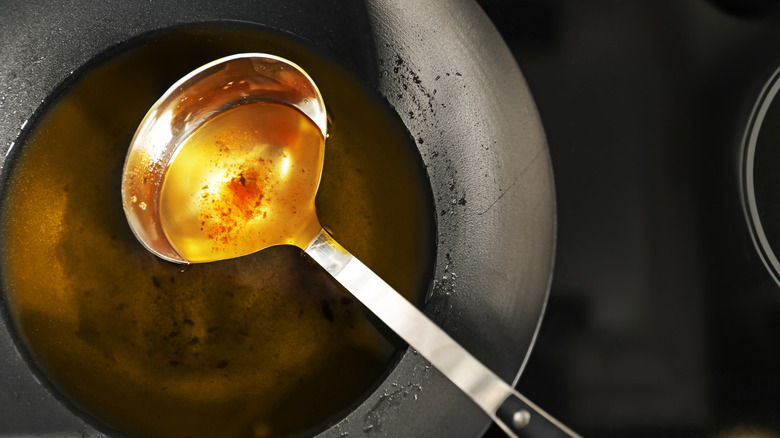
Frying oil isn't cheap, so you may feel inclined to save it after your bird has finished cooking. Both of our experts note that fryer oil from your turkey can be stored for later use, but there are some important precautions that you should take to ensure that it does not go rancid. Jonas Favela recommends straining the oil while it's still warm to remove any particles, then storing it somewhere cool and dry. "Use it within a month for another fried day," he says. Once the oil is filtered and stored, Sergio Ledesma says it can be used for two to three more fryings.
The best way to filter and store frying oil properly is to run it through a strainer with a funnel. If you don't remove these impurities, you may taste turkey on your next fry, or your oil just won't last as long. And if you don't plan on using that oil again, be sure to dispose of your cooking oil correctly to prevent clogging your drains.
10. Serving it with the wrong sides
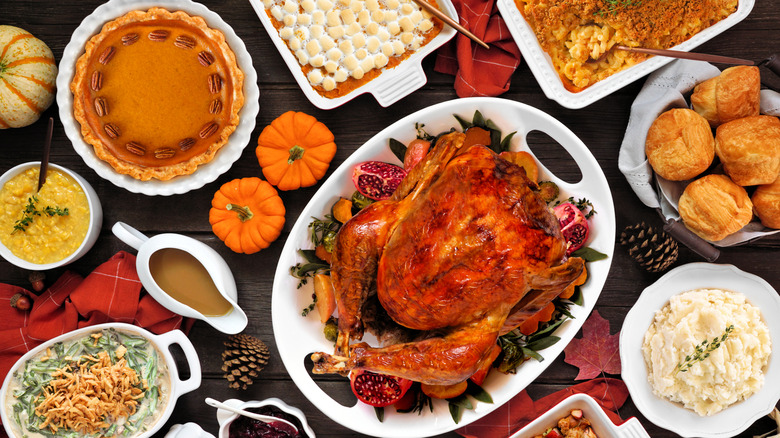
Fried turkey is delicious, but it's only at its peak when paired with other tasty sides. Luckily, you have some options here — thanks to our experts. Sergio Ledesma is on the Thanksgiving food train and touts his appreciation for mashed potatoes, stuffing, sautéed asparagus, and a "good gravy."
Jonas Favela, on the other hand, thinks a little outside of the box and recommends pairing deep-fried turkey with bolder flavors, including cornbread stuffing slathered with a spicy-sweet jalapeño honey butter, punchy garlic and Parmesan mashed potatoes, baked mac and cheese with crunchy shallots, and a cinnamon-spiced cranberry-orange relish. Oh, and don't forget the greens; he suggests charred Brussels sprouts, Swiss chard, or broccoli casserole. "Keeps the plate honest, but we all know the star of the show will be the perfectly fried turkey," he says.