

Don't Be Afraid To Do This At A Korean BBQ Restaurant
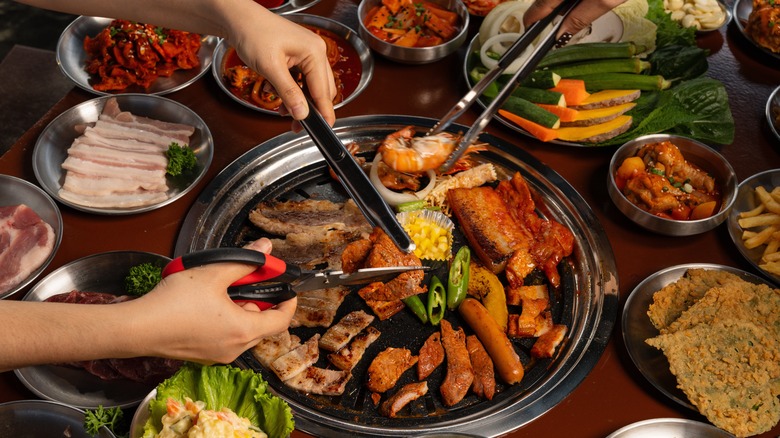
More than just a meal, dining at a Korean barbecue restaurant is meant to be a full-on experience. Unlike many conventional restaurants where food is served fully cooked and plated, KBBQ offers you the chance to cook your own meat right at the table, surrounded by heaping side dishes of banchan and rice. But what amounts to a delicious novelty experience for many experienced diners can make others nervous. What if you over- or undercook the meat, or forget to follow important tips like flipping it only once? For anyone worried about messing up their meal, Sam Yoo has one simple piece of advice: Just ask the waitstaff to cook it for you.
Yoo is the chef and owner of Golden Hof, a Korean bar and grill in New York City that features a full KBBQ menu. At his restaurant, Yoo says he and his staff prefer to cook the meat and suggest it to guests. "There are guests who come in and want to cook it, and we try to [dissuade them], just because if they burn it, then it's sort of on them," he says. "Whereas if we burn it, obviously we will replace it."
The popular image of KBBQ is as a do-it-yourself endeavor, and Yoo admits that is what Korean customers typically expect. Even at a traditional Korean restaurant, however, he says, "they'll cook the meat for you. You just have to ask them." If they refuse, that's a "service issue."
Tips for cooking the meat yourself
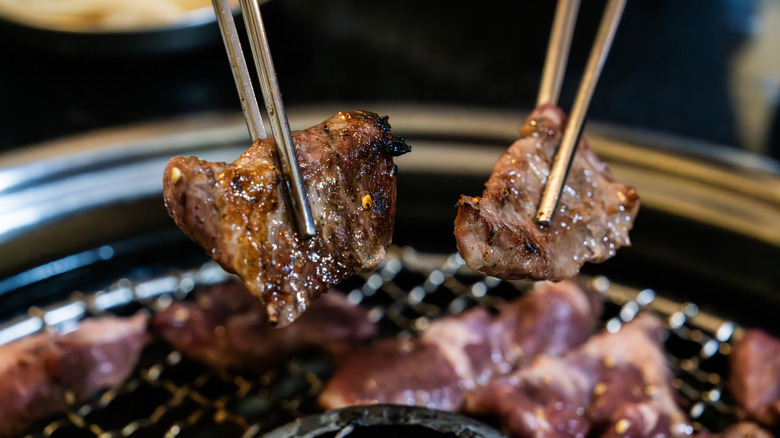
If cooking the meat at a Korean barbecue restaurant makes you nervous, you can always ask the staff to step in. But maybe you don't want to let your nerves stop you from giving it a go yourself. In that case, Sam Yoo says you can still ask the staff for tips on how to eat KBBQ like a pro, and offers a few of his own to keep in mind.
Part of the fun of eating Korean barbecue is trying a wide variety of can't-miss meats. There are sometimes dozens of cuts of beef, pork, chicken, and seafood to choose from, and while it's great to try as many as possible, they may differ a little on optimal cooking time. With marinated meats in particular, Yoo says to be extra-careful, as "they typically have some sort of sweetener, whether it's honey or sugar, which is going to caramelize faster and burn."
Though many people often use medium-rare as their go-to level of doneness, Yoo says it's not the best option for all cuts of KBBQ meat. Kalbi, also known as short ribs, should be cooked "more on the medium side," Yoo advises, while with unmarinated cuts like ribeye or strip steak, "obviously those you can cook medium-rare and it's not a problem," he says. Pork belly should be cooked on the medium-well side, he adds. Getting to know how each cut is properly cooked is the best way to ensure an out-of-this-world Korean barbecue experience.