

2 Telltale Signs That You Shouldn't Order Raw Oysters At A Restaurant (And One That Means You Should)
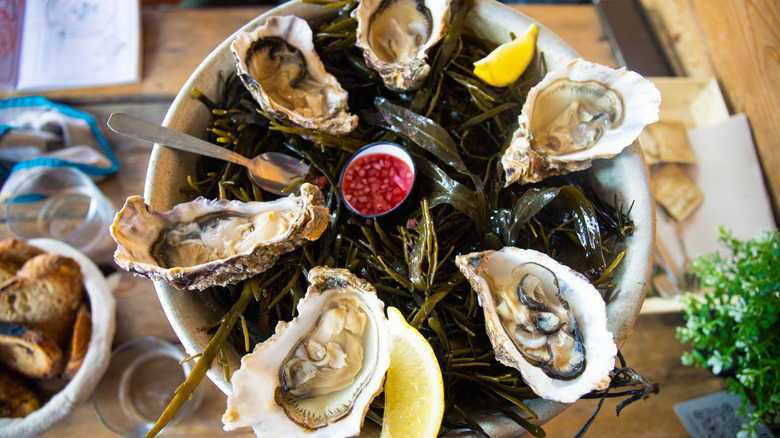
If you're not afraid of a little slurping, raw oysters are pretty much the ultimate appetizer. A food that was once seen as cheap protein morsels, oysters on the half-shell have since become a symbol of beachy luxury, complete with a price tag to match. Develop a taste for them, and they become incredibly addictive — salty, briny, and uniquely sweet, especially with the right toppings. It can be tempting to order a dozen every time you dine at a restaurant that offers them, but before you indulge, do a little investigating.
As anyone who's ever gotten food poisoning can tell you, nothing good can come from eating questionable shellfish. Even if they don't make you sick, it's still a good idea to stick to high-quality oysters from reputable sources rather than taking chances. But how can you tell if a restaurant's oysters are up to par? Chowhound spoke exclusively with Reid Shilling, the chef and owner of Cowbell Seafood & Oyster in Washington, D.C., for answers.
It used to be clearer when and where to eat oysters — only eat oysters near the sea or at certain times of year, for instance. "There was once a time where people said don't eat oysters in months without an 'R,' but modern aquaculture has made it safe to consume [year-round]," Shilling tells us. Additionally, "farming and shipping logistics have made it easy to get high-quality product ... even if you're nowhere near the water," he says. Still, most restaurants will have certain indicators telling you when to steer clear of the raw bar and when to slurp away.
Avoid unphotogenic oysters

In this day and age, it's common practice to look up a restaurant and read reviews on Yelp or Google before ever visiting. Not only can this give you a better sense of the menu and which dishes are a must-try, it can also tell you which dishes you're better off skipping — including oysters. "It's a good idea to look at photos online from guests who have ordered oysters at the restaurant you're going to," Reid Shilling says.
Look out for green flags like whole, uncut bellies. "Oysters should appear circular and in one piece," Shilling says. "If you see a scrambled oyster or something that looks like it's been chewed already, proceed with caution." If you can't find photo reviews online, take a surreptitious glance around the restaurant when you arrive to scope out the look of the shellfish. You can also look out for these tells in your own order, and don't be afraid to send it back if something looks off. "It's likely that a restaurant that takes the time to properly train its oyster handlers on how to properly shuck also cares about where they come from, the dates on the tags, [and] the source they are buying from," Shilling says.
Say no to unsanitary shucking
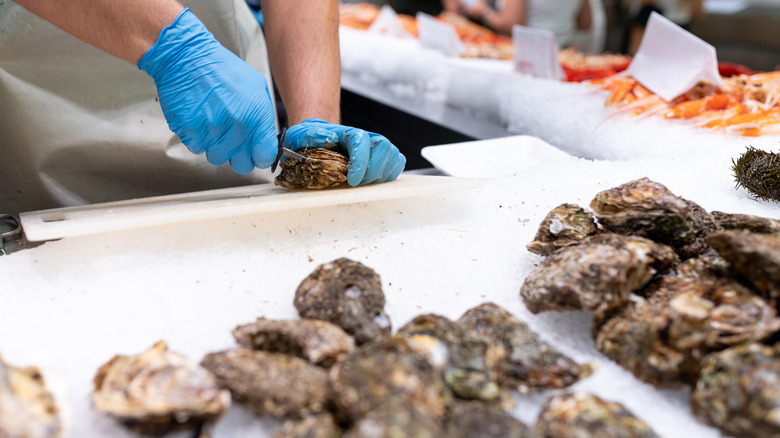
One of the fun things about eating raw seafood is its presentation, which starts all the way back at the preparation stage. To that end, many dedicated seafood eateries have open concept kitchen areas for their raw bars that give you a glimpse into the oyster shucking process. If you're unsure whether or not to order the oysters, Reid Shilling says that peeking into these shucking areas can offer major clues. "Observe how much care they use — is the area clean? Are the towels clean? Are they sanitizing the area between rounds of shucking?" he asks.
Sanitation is not the only factor to look for. Like any perishable food, oysters and other shellfish need to be stored carefully to ensure they remain safe to eat. More questions to ask include, "Do they tend to their displays appropriately? Are the oysters on ice or buried (they actually don't like to be stored buried in ice)? Are they laying flat or standing up?" Shilling explains, "oysters open and close, and if they are standing up when they open, their liquor falls out." Properly stored oysters will be adequately refrigerated and not kept in pools of water.
Look for restaurants that go directly to the source
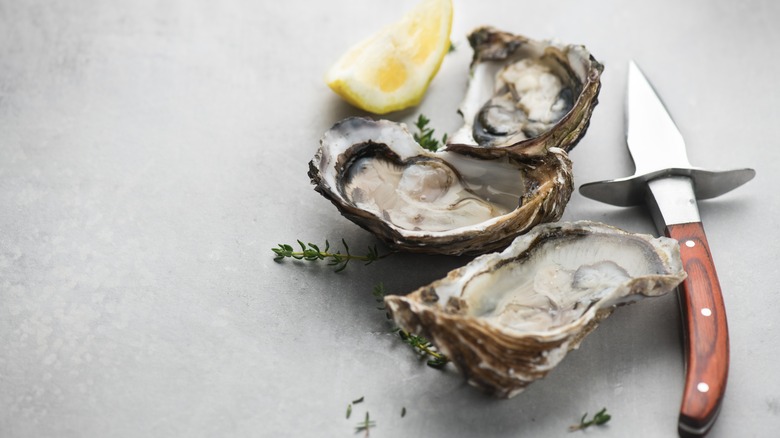
Nothing is better than seafood fresh from the sea, and since most of us can't catch our own oysters, the next best thing is to get them directly from someone who can. That's why the number one indicator that a restaurant's oysters will be worthwhile is their sourcing. "Try to find restaurants that get oysters direct from the source. Scott from Orchard Point brings us our oysters the day they come out of the water. There's no middleman, no shipping, no delay," Reid Shilling says of his own restaurants' oyster supply. He explains, "oftentimes a middleman increases the time from when they are harvested to your plate, which increases likelihood of spoilage." That doesn't mean that using a "middleman" is always problematic, but direct sourcing is always a positive sign.
Sourcing also clues you into where a restaurant's oysters are harvested, which influences the size, texture, and flavor of the meat. "It's always fun to try whatever is local, but colder waters usually produce better-quality oysters than warmer," advises Shilling. That's because "warmer water promotes growth," which can lead to overly soft or mushy meat, he explains. Many seafood restaurants, including Shilling's own Cowbell, serve a variety of different oysters. "Each [has] different flavor profiles, so guests can enjoy comparing oysters and their sometimes not-so-subtle differences," he says.