

The Humble Spam Meal That Quietly Became A Global Comfort Favorite
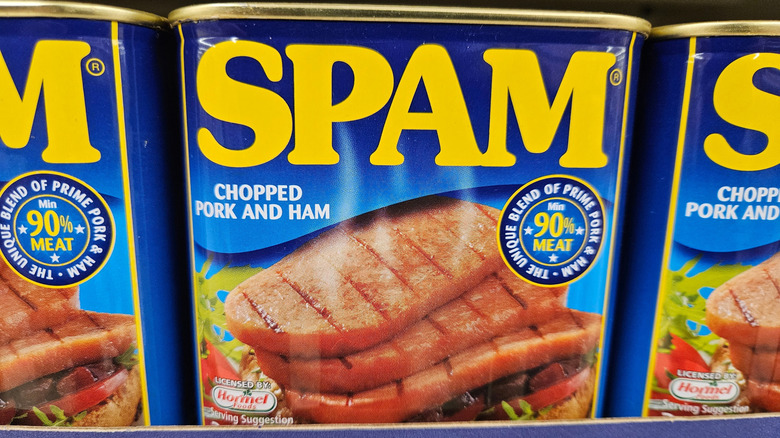
Spam, the canned meat introduced by Hormel Foods back in 1937, often gets a bad rap. It's no coincidence that unwanted emails are called spam, but this pork product is a key ingredient in a comfort food that can be found in a host of places stretching from the United States (especially Hawaii) to South Korea to the Philippines and elsewhere across Asia.
It's Spam fried rice and there's a reason it has such a devoted fanbase. Fried rice is already a comfort food on its own that's also economical, since it can make use of a variety of leftovers. But then throw an extra-special ingredient into fried rice to upgrade it, like this salty, umami-rich pork product with a bologna-like texture and, when combined with a mix of rice, vegetables like peas and carrots, and eggs, you end up with something truly special.
Like many foods, Spam fried rice's origins are murky. Some believe it was born in Hawaii, while others suggest it hails from East Asia. What we do know is that all these places have their own take on the dish and that the most likely source of the Spam was the U.S. military. Beginning in World War II and continuing through other conflicts, including the Korean and Vietnam Wars, the shelf-stable canned meat was sent in abundance to American soldiers stationed abroad. They often traded it with locals or abandoned it upon returning home, so it ended up incorporated in traditional dishes despite the disruptive and sometimes painful context of its arrival.
The many types of Spam fried rice
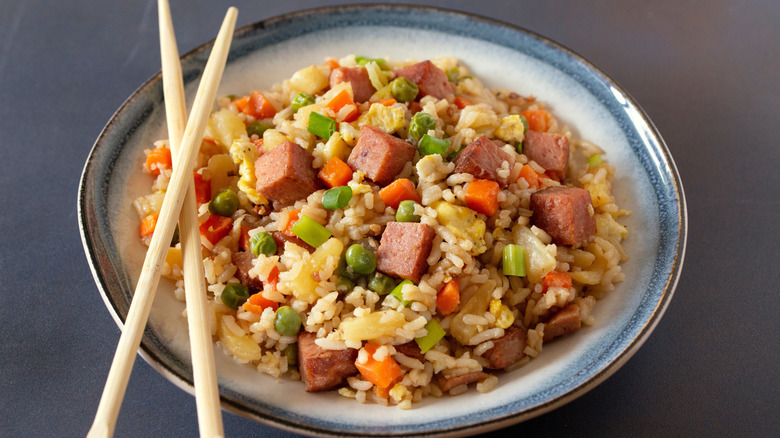
There's no question Hawaii and Spam have a deep, abiding culinary love affair. The state is by far the biggest consumer of this canned pork product in the U.S., with Hawaiians consuming nearly 7 million cans a year. Although the best known dish that incorporates this canned meat is Spam musubi, which is marinated and grilled Spam on a bed of rice wrapped in Nori seaweed, Spam fried rice is also a popular comfort food on the islands, especially considering its ties to the foodways of East and Southeast Asians who immigrated to Hawaii. It's popular enough to have inspired variations such as Spam fried rice omelets. Spam fried rice is also prevalent in other parts of the U.S., especially among Asian Pacific Americans.
The dish is also commonly eaten outside of the States. In South Korea, Spam fried rice often includes kimchi, a condiment made from fermented vegetables such as napa cabbage, as a key ingredient. You can even find prepackaged versions at 7-Eleven convenience stores there. A version in Singapore is flavored with curry powder, a traditional spice used in many of the country's dishes. It's also popular in Malaysia and the Philippines. Spam fried rice is a much loved comfort food in so many parts of the world that if you haven't tried it or made it at home before, you should so you can find out what you've been missing.