

Coffee Grinders Vs Espresso Grinders: What's The Difference, Really?
We may receive a commission on purchases made from links.
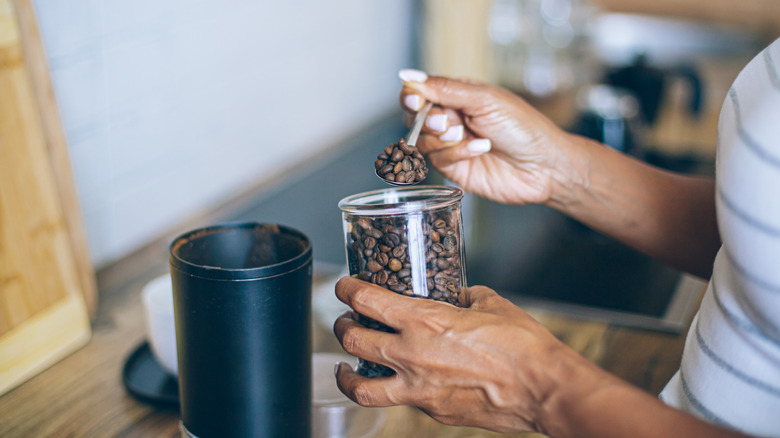
For complete coffee beginners and even the casual enthusiasts, we can all agree that choosing between a coffee grinder and espresso grinder can have you staring at the spec sheet for hours — because what's the difference, really? Chowhound spoke with Matt Woodburn-Simmonds, coffee expert and former barista, to help you feel like a pro in no time, and finally put this perplexing issue to rest. "Standard coffee grinders often have settings for every brewing type, from espresso up to French press, with big steps between each setting, allowing for a large range without literally hundreds of settings," Woodburn-Simmonds exclusively told us, further explaining that coffee grinders' burrs are especially fine-tuned for efficiency no matter the grind size. Meanwhile, espresso grinders work like this: "[They] will have smaller 'steps' between settings, or be completely 'stepless,' meaning you have complete control of the grind size." Their burrs offer better accuracy, too — which can help you achieve a finer consistency that's needed in espresso machines — allowing you to grind coffee beans perfectly every time.
Woodburn-Simmonds also highlighted the importance of grind consistency depending on your brewing method, emphasizing the need to choose between a coffee and espresso grinder to make the best cup. If the grind for your espresso is uneven, you won't be able to maximize the needed extraction for this 30-second process, which ruins the shot. Meanwhile, a French press can filter the larger bits, making it more forgiving to use with coarse grounds.
Picking the right grinder that works for every brew
Whether you're thinking of getting the best budget coffee grinders or balling for a whole cafe-like setup at home, choosing the type of grinder is essential. However, Matt Woodburn-Simmonds explained that it's still possible to use a regular coffee grinder for espresso — but it does come with its own challenges. "You may have a little more trouble dialing it in with less precision, assuming the grinder does grind fine enough for espresso in the first place," he shared. While it may be different from a cup you can get from a nice cafe, you'll get better at it over time if you're willing to jump through hoops, learning through trial and error. You might even be able to get away with it by boosting espresso flavor before grinding your coffee beans.
Otherwise, you might want to invest in a grinder that can work in both brewed coffee and espresso. Woodburn-Simmonds recommends the 1Zpresso J-Ultra, which he also uses. DF64, a type of grinder that a lot of different companies offer, is also pretty good for its consistency and flexibility. Prices are generally reasonable, too. However, while it could work for coffee grounds, it's still better for espresso, as its burrs produce a fuller-bodied flavor. As such, using it might lack defined, crisp flavors that you'd usually want to highlight when brewing with a French press.