

Determinate Vs Indeterminate Tomatoes: How To Choose The Right One For Your Garden
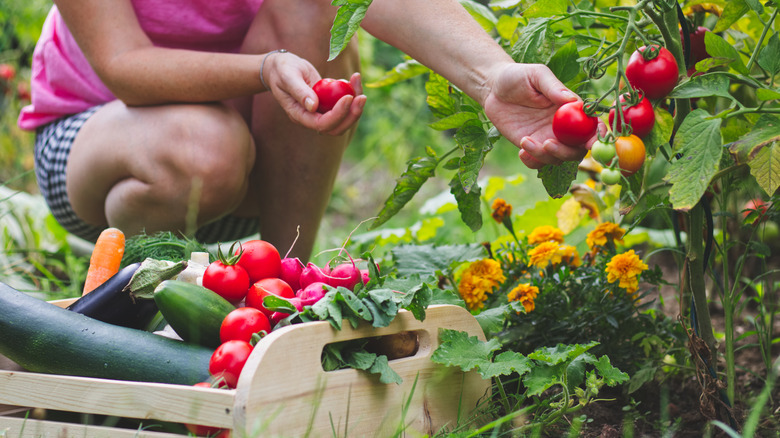
There's nothing quite like growing your own food and enjoying freshly plucked seasonal produce from your garden. However, maintaining an entire vegetable patch isn't everybody's cup of tea, and even if you've got the space and inclination to do it, one of the foremost tips for beginner vegetable garden-keepers is to pay attention to how much effort a particular plant takes to maintain. If you'd like to grow tomatoes, know that they require special consideration and planning.
While some varieties of tomatoes are easier to grow than others, before picking out a plant (or several), there's an important choice to make — whether you should grow determinate or indeterminate tomatoes. This influences how and when the tomatoes will grow and sometimes even how you'll use them. Determinate varieties have bushier plants that are easier to manage and generally more compact, while indeterminate varieties grow much longer vines. The former also has a set fruiting period, while the latter continues to produce tomatoes for the duration of the growing period.
To help you figure out which kind is right for your garden and cooking needs, as well as how to best care for either type of tomato plant, we had an exclusive chat with an expert: Erika Nolan, homestead consultant and creator of The Holistic Homestead, which you can find on Instagram and YouTube. "Most slicing and sauce varieties of tomatoes are determinate varieties, while most indeterminate are cherry tomatoes," she explained. Therefore, the kind you choose influences how you can use them. "However, it really depends on where you're located to suggest which varieties grow best," she says, suggesting that buyers should research the tomato variety they're interested in to figure out whether they are determinate or indeterminate, especially since some varieties might surprise you.
Determinate tomatoes are for small spaces and fixed yield times

Whether large heirloom beauties or bunches of little cherry tomatoes, these fruits grow profusely but can be prepped in innumerable ways, so you're unlikely to have too many to use up. Plus, you can always can them for use during the winter months to add a delicious summer tang to your dishes. If you plan on going the latter route and wish to preserve tomatoes, the determinate variety is the one to choose. These tomatoes have a short and intense growing season of a few months, and will give you a large number of tomatoes.
Determinate tomatoes are often considered best for beginners since these plants are easier to maintain, require less pruning, and are more compact. However, you will need some amount of open space and a support structure to grow the vines. "Only specialty tomato varieties like Tiny Tim that you can grow in a pot will not need a trellis, but for most, you need structural support. Without support, the plants will fall over and snap," Erika Nolan said. "Both determinate and indeterminate tomatoes need staking. Such that it makes most sense, especially if you want to grow both or change it up year to year, to use the same trellising method." Therefore, the good news is that once you set up a few sturdy stakes for your tomato vines, you may be able to change from determinate to some smaller indeterminate varieties without having to tweak your gardening setup too much.
Indeterminate tomatoes require more planning but fewer plants

Growing indeterminate tomato varieties requires more planning in order to make the most of their extended growth and harvesting period. "Indeterminate tomatoes will grow literally 'indeterminately,' meaning no end in sight unless there's a frost or disease that takes them out. You need a solid structure to support that growth," Erika Nolan said. "If you want to grow indeterminate, go for cattle panels or tall arches. Think of them like vines that need extensive support." If the support is insufficient, your tomatoes could end up lying on the soil as they grow. "If you were to let them bramble on the ground, there's a greater chance of disease spread through soil contact and the leaves," Nolan warned. "Larger varieties, though, require more care and are more prone to pest damage, ruining the larger fruits."
Fortunately, the fact that indeterminate varieties keep producing tomatoes through most of the growing season means you need very few plants, especially if you're looking to grow cherry tomatoes. Nolan noted that most people won't need more than one cherry tomato plant. Instead, she suggested a nuanced approach to growing tomato plants: "Eating fresh throughout the season is less about indeterminate versus determinate and more about staggering your planting times — also known as succession planting."
Variety in your vegetable garden, which you can slowly build up as your green thumb gains confidence, gives you a range of produce through the growing season. Plants that grow particularly well alongside tomatoes can also be used to easily expand your vegetable garden, while having both determinate and indeterminate tomato varieties lets you make the most of your tomato vine support setup and enjoy produce all throughout the growing season.