

Does It Really Matter Which Way Your Utensils Point In The Dishwasher?
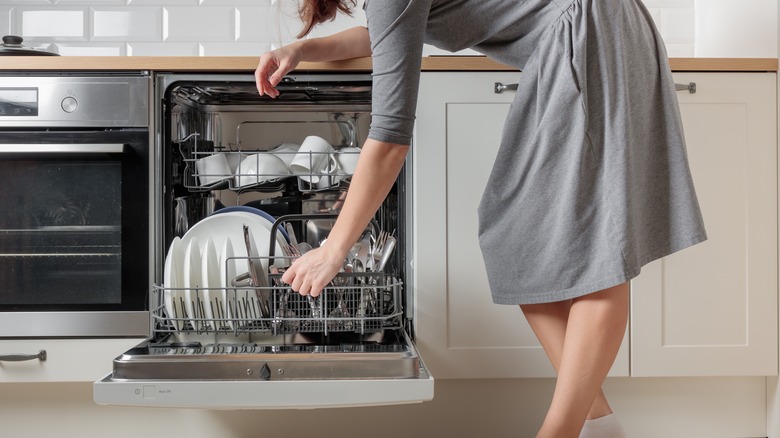
If you find yourself fighting with other members of your household about the correct way to load a dishwasher, you're not alone — especially when it comes to whether your utensils should face up or down. If you're team handle-down, we've got good news: your method is the clear winner. Katie Dills, president of The Cleaning Authority, talked exclusively with Chowhound about everything you need to know to make the most of your dishwasher's cleaning power.
When it comes to the handle-up-or-down debate, Dills says there's a reason why handle-down makes the most sense. When you place your silverware so the prongs of forks or scooping surface of the spoon face up, "the water and detergent don't have to fight through the silverware basket to reach the stuck-on food," according to Dills. An important exception to the handle-down rule: knives. "You should always place knives handle up for safety," says Dills.
While placing your forks and knives in the dishwasher handle-down is the first step toward getting super-clean results, it's not the only thing you need to keep in mind. "If you have a traditional basket, make sure you mix your utensils," advises Dills. "This way you don't have spoons and forks resting against each other." If your dishwasher happens to have a third rack area where you can place silverware, Dills recommends laying each utensil flat, allowing the water and detergent to evenly wash each item.
How to load (and unload) your dishwasher for maximum effectiveness

Understanding how to point your silverware correctly isn't the only thing you need to know to get the most out of your dishwasher. Katie Dills says that understanding what goes on each rack can make a major difference in how clean your dishes are at the end of each cleaning cycle. Loading delicate items on the bottom rack is one of the most common dishwasher mistakes, and can result in serious damage to your favorite dishes. If you're unsure of whether an item can withstand the serious heat and pressure of the dishwasher, it's best to roll up your sleeves and wash the dish by hand.
For a standard load that doesn't contain delicate items, you'll still want to be careful when it comes to placement, according to Dills. The top rack is designed to hold smaller pieces, "including mugs and glasses, small bowls, large utensils, etc.," says Dills. "The bottom rack receives stronger water pressure and higher temperatures, so use this area for plates, pots and pans, casserole dishes, etc."
No matter how you decide to load your dishwasher, there are a few more tips you can implement to help you make the most of every load. First, run your dishwasher at night instead of during the day, as you can typically make good use of lower energy rates. You'll also want to be sure to clean your dishwasher's filter regularly — even the most smartly loaded dishwasher can't do a great job if the filter is clogged with gunk.