

How To Properly Set Up A Buffet For Smooth Serving
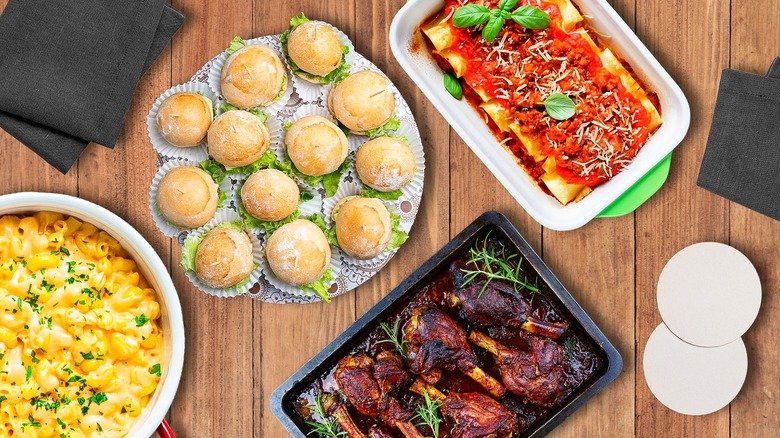
If you're having guests over, there are many meal styles that might be worth considering. If you're serving a small handful of people and want to emulate an intimate atmosphere, a dinner party with an entire spread you make yourself might be in order. Or, you could go for a potluck to take some of the effort off your shoulders. One of our favorites, and one that you should seriously consider whether you're feeding 10 people or 100, is a buffet.
Buffets might seem like a thing of the past, conjuring memories of family trips to Golden Corral or your local Chinese buffet. But when it comes to hosting, it's a format that just makes sense. People can add as much or as little food as they'd like to their plates, and you don't have to spend time plating or serving guests yourself. However, buffets do come with some caveats and challenges as well as questions about how exactly to set them up.
A good buffet should move like a well-oiled machine. Thankfully, we sought advice from several experts to help identify potential cogs in that buffet machine and learn how to ensure that your buffet line moves as quickly and as effectively as possible. They are Vanessa Gordon, CEO and founder of East End Taste; Katherine Lewin, founder of Big Night; Laide Olambiwonnu, founder of Pickytarian; Brian Strayer, director of catering at Rubio's Coastal Grill; Brandon Dorsky, co-owner of Yeastie Boys Bagels; Steve Ingber, a private chef and founder of MileHighCook; and Joe Lilly, executive chef of Kingston Resorts.
Consider setting up your buffet near the kitchen
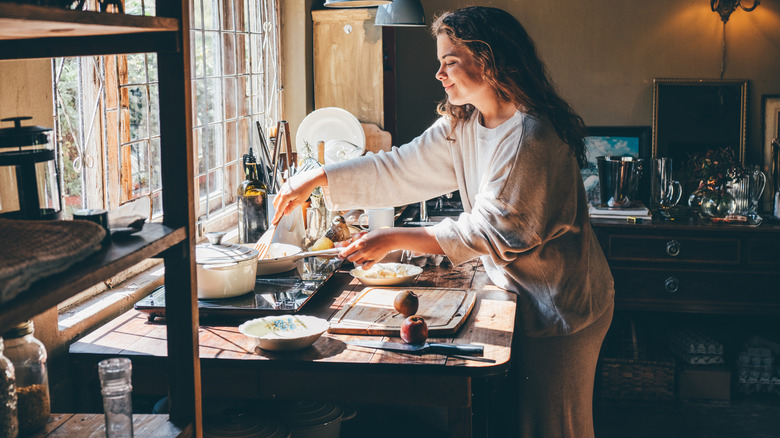
Before you start thinking about which foods to put on your table, you have to think about where you plan to set up your buffet table. The location will depend on many factors, including whether you're serving it in your own home or a rented event space, how much food you plan to serve, and how many guests you plan to invite. However, one common theme that our experts shared when it comes to setting up your buffet is that it's important to place it near the kitchen, as it makes warming up food, serving, and cleanup easier.
"What I like to do is have the hot dishes in the kitchen so [that] as the host, I can keep a closer eye on them, reheat/keep heated as necessary, and [have] the cold dishes in the living room or dining room," says Vanessa Gordon, CEO and founder of East End Taste. This way, you won't have to walk as far if you need to refresh a plate of hot food or if you need to grab another set of serving utensils from a drawer.
Katherine Lewin, founder of Big Night, also recommends putting food near the kitchen as people tend to naturally gravitate toward that area. "Part of the joy of a buffet with friends and family is the traffic jam. It's a good place to chitchat with someone while filling up your plate," she says.
Don't skimp on the napkins and coasters
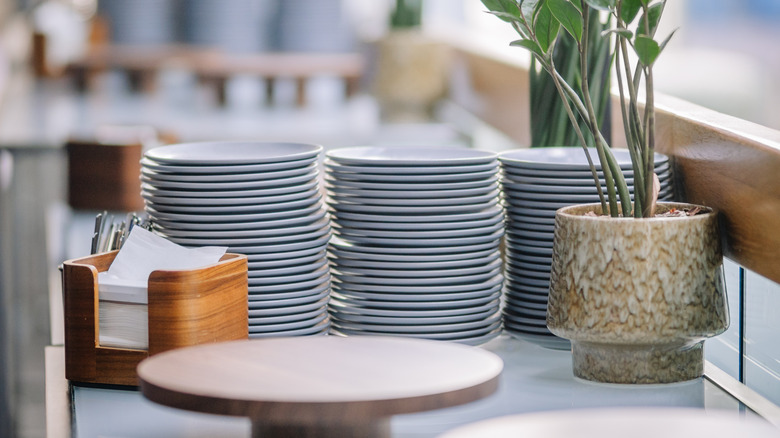
One of the big mistakes that people make when setting up a buffet is not considering the small details that can make or break the meal. While you may have your menu and food figured out, you could be in some serious trouble if you forget about one essential in particular: napkins. "I cannot tell you how many events and private parties I have been to where I do not see enough (or even any!) napkins or coasters; coasters are very important," Vanessa Gordon says. She also recommends keeping cleanup essentials, like wet wipes and paper towels nearby, as well as stocking up on straws and stirrers for drinks. You don't want your guests to leave their wet glasses on your favorite wood grain coffee table, nor do you want any greasy fingers touching your couch. Stocking up on these essentials — and having a good supply of coasters and napkins floating around your space — will help keep things clean and tidy.
Then comes the important question: Where exactly should you stock the napkins on the buffet line? You could put them on a separate table, but this may cause some folks to have to double back when they realize they've forgotten them (or worse, wipe their fingers on their clothes). Brian Strayer, director of catering at Rubio's Coastal Grill, recommends stocking napkins at the end of the buffet table so that people don't need to hold extra things in their hands as they're making their way down the line.
Prioritize food safety and keep dishes at temperature
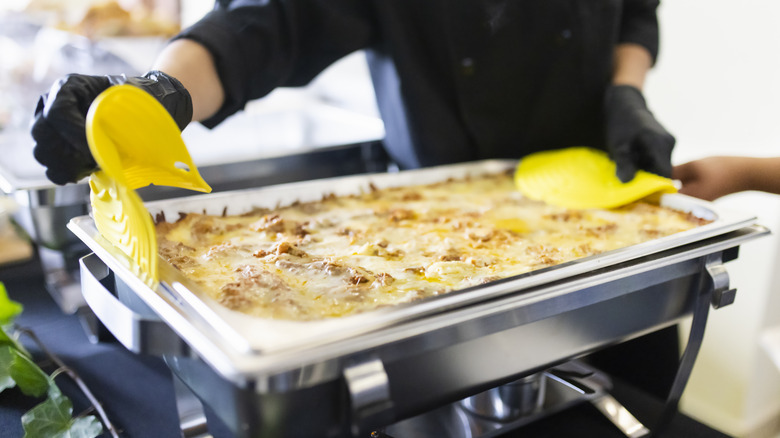
As a host, you have to be conscious of not only making and serving delicious food on your buffet but also keeping your guests healthy by following food safety protocols. Buffets are breeding grounds for foodborne illness, especially if food is left to sit out for hours on end. Bacteria multiply as the food sits in the "danger zone" between 40 degrees Fahrenheit and 140 degrees Fahrenheit, so as a host, you need to make sure to keep hot food hot and cold food cold.
Luckily, our experts offered some food safety tips. "Electric induction cooktops are probably the simplest, safest, most accessible type of equipment for a repeat host to keep catered food warm," says Brandon Dorsky, co-owner of Yeastie Boys Bagels. "While they are not per se catering equipment and would not work for keeping all food types warm, induction burners work great for soups, pastas, and other potted items that should be maintained at a minimum level of heat." He suggests chafing dishes and chafing fuel as a more budget-friendly solution for keeping food warm. Joe Lilly, executive chef at Kingston Resorts, advises using chest coolers to keep food cold, and even suggests getting a heat lamp.
After your food has been put out, it's important to monitor its temperature to keep it out of the food safety danger zone. Private chef Steve Ingber recommends storing small batches of food in the oven at a low temperature and replacing emptied pans regularly. Not only will this make your buffet look like it always has fresh food, but it will also prevent large amounts from sitting out for too long.
Consider multiple food lines to keep people moving
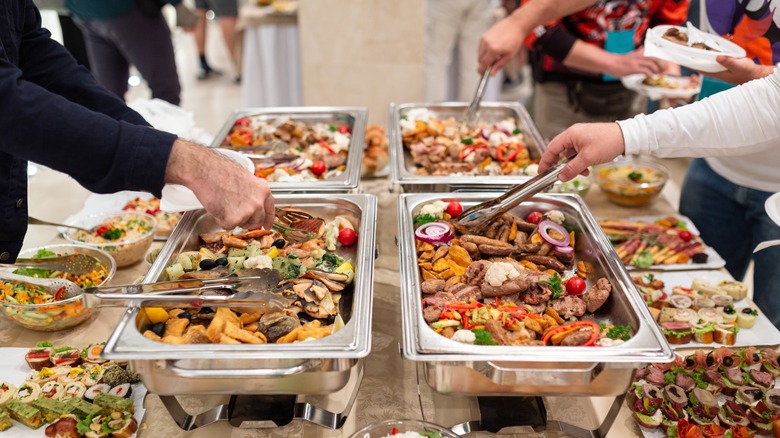
There's nothing worse than standing in line at a buffet, watching the crowds bottleneck in front of you. You're already so hungry, yet you have to wait as other people spoon food onto their plates ahead of you. In order to keep the line flowing, you may want to consider setting up separate food lines. Don't set your buffet up against a wall. Instead, make sure that you can have adequate flow on both sides of the table. You'll want to stock up on extra serving utensils, too, so that folks can grab food from both sides of the table without having to awkwardly lock eyes over a slotted spoon. Steve Ingber recommends doubling up on popular (or what you think will be popular) items on the buffet table to keep things moving. He also offers a rule of thumb: 1 linear foot of buffet per three or four guests, with between 18 inches and 2 feet between the lines on either side of the table. This will give enough room for people to go around and mill about along the buffet line.
Another way to encourage flow is to set up separate tables. "If I have enough space, I separate food stations with clear signs — appetizers on one table, mains on another, desserts somewhere else entirely. This spreads people out instead of creating one giant bottleneck," says Laide Olambiwonnu, founder of Pickytarian. Of course, this approach depends on the amount of space that you're working with. "Looking at your menu and understanding your space limitations when creating a menu can help you streamline offerings," Joe Lilly says.
Put apps before mains
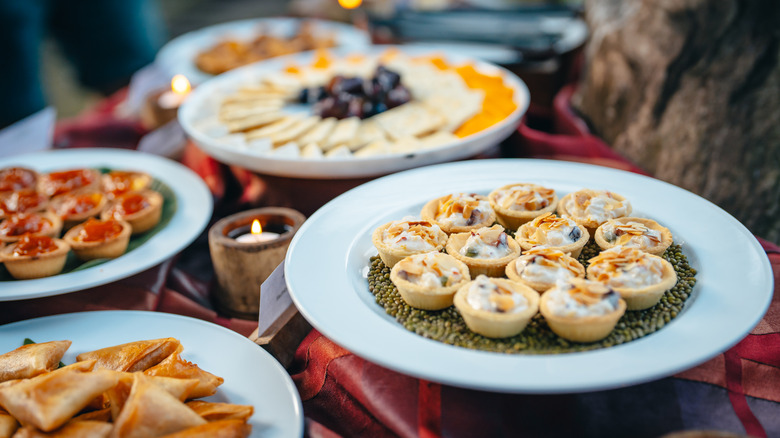
Think of a well-designed buffet line like a gradient. You have your light apps at the front, then make your way to your salads and grains, and then mains. Chef Steve Ingber prefers this model because it prevents people from doubling back to the start and allows them to better portion their dish. He recommends using 9- or 10-inch plates, as the limited real estate encourages folks to move faster while discouraging food waste.
Another thing that many of our experts voiced was that condiments always belong at the end of the line. The last thing you want is for people to double-back because they forgot to get dressing for their salad or ketchup for their fries. Plus, it will minimize mess on the plate, as there will be more room for main dishes. If you want to expedite this process even more, you may want to consider pre-serving dressing into small containers so that guests can just grab them and go. Labels on items like salad dressing can also help speed things along.
The act of juggling multiple plates of food is just setting yourself up for disaster. If you have items on your buffet that require separate plates, like soups, salads, bread, and dessert, you may want to consider placing them at the end of the buffet so that folks can fill up their main plate, then grab an auxiliary plate or bowl for these extras. Ingber notes that desserts in particular can cause long lines, meaning you may want to consider placing them at a separate station entirely.
Be conscious of potential allergens
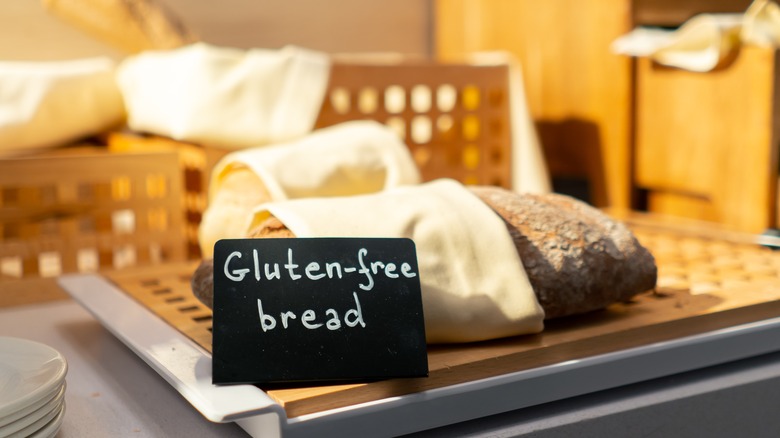
Anyone with an allergy or dietary intolerance knows that buffets can be a particularly dangerous place. Not only are allergen-containing foods and what you think are "safe" dishes sharing close quarters, but there's also a high risk for folks to accidentally cross-contaminate foods via silverware, dirty plates, and serving utensils. This isn't just a matter of making your buffet run smoothly and quickly; it can also mean life or death for someone with a severe allergy.
"If you must include known allergens in your buffet offerings, it is a best practice to label and identify food and include a designation if something has one of the nine federally recognized allergens: peanuts, tree nuts, eggs, dairy, wheat, soybean, fish, shellfish, and sesame," says Brandon Dorsky. He goes so far as to say that peanuts should be left off home buffets entirely.
For the safety of your guests, it makes a lot of sense to separate allergen-containing foods from safe ones. "Hosts should concentrate foods containing known and prevalent allergens in one area, and ideally eliminate common allergens, or at least keep food items containing common allergens segregated from all other foods to best manage potential cross-contamination risks," Dorsky says. If you don't have the space to separate the food, you may want to take Steve Ingber's advice and allocate an "allergen-clean" utensil for each dish.
Use your space wisely
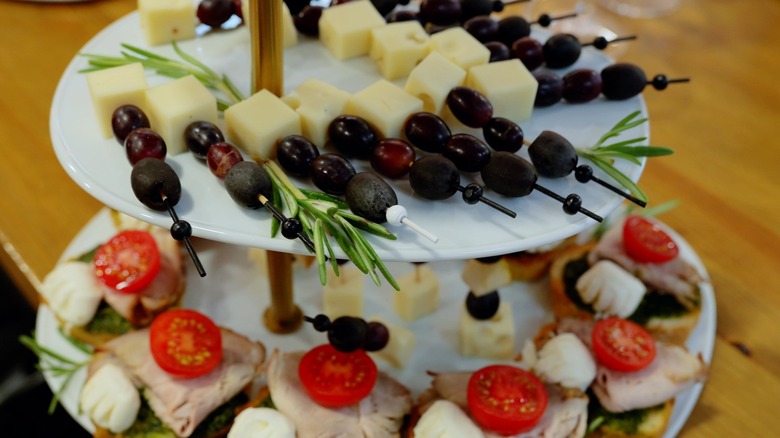
There are only so many things that you can keep on a buffet table. Hotel pans and disposable pans can take up a ton of real estate and make your entire spread look cluttered or messy. Instead of just using hotel pan after hotel pan, you may want to utilize uniquely shaped trays, risers, and vertical stands to display your buffet, which can add not only more visual appeal but also better organization. In fact, deep pans may not be preferable, as it's awkward to have to scoop out of the corners or angle your wrist just right to scoop up rogue tortellini.
"Buffet design and layout are an art," Joe Lilly says. "Get some fun crates or risers to add height, dimension, and texture to your display. Make it a showstopper!" Of course, you shouldn't sacrifice functionality for design. Heavy pans, especially ones made of flimsy, disposable aluminum, may not take well to being lifted off the table with weak supports. Use risers and funky stands to display small appetizers and light (physically and figuratively) bites so that your guests can easily grab them as they pass through the line. You can also use small pails or cups to hold silverware so that it stays nice and neat; just always remember to place it handle-side up (and label the container) to prevent hands from contaminating the part of the utensil that will touch the food.
Put the beverages somewhere else
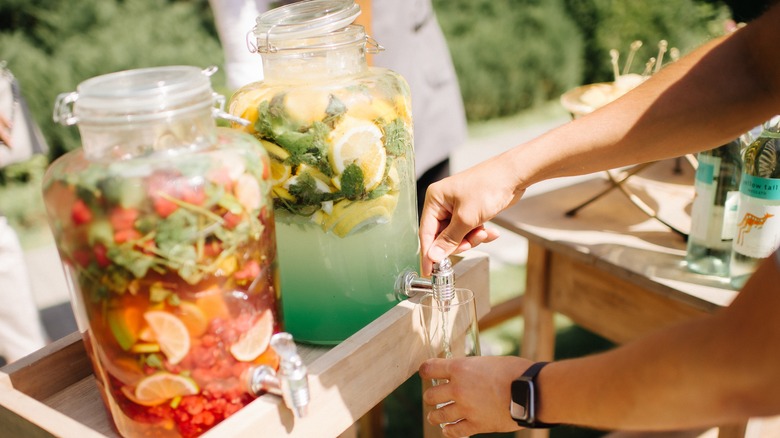
No proper buffet would be complete without drinks. However, it's always important to think about where your beverages are relative to the rest of the fare. "Drinks should always be a completely separate station," Laide Olambiwonnu says. "Nothing clogs up a buffet line like someone making a cocktail mix while everyone tries to squeeze behind that person." Vanessa Gordon recommends going a step further and separating alcoholic drinks from non-alcoholic options. To prevent people from trying to hold a plate and drink while spooning on more food, take Brian Strayer's advice and place the drinks at the end of the line.
Steve Ingber recommends abiding by the "beverage triangle:" water at the front of the room, cocktails and soda opposite that, and coffee and tea near the desserts. "Three small lines beat one long one," he says. Be sure to place cups and/or mugs near your drink stations so that your guests can easily fuel up before heading back to their table.
Make portions easy to grab
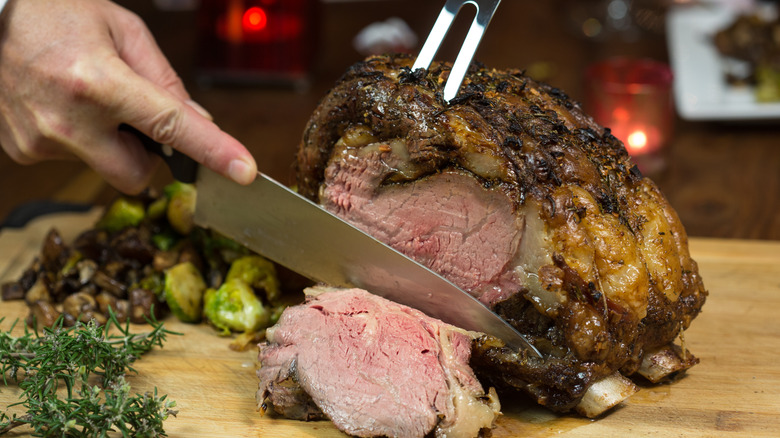
Not all foods are buffet-friendly. The last thing that you want is to have congestion in your line, so you should always opt for foods that are easy to plop on a plate instead of ones that require surgical-level precision to serve. Steve Ingber recommends pre-slicing foods, including proteins and breads, so that your guests can easily grab a piece as they pass through. If slicing the meat right before your guests' eyes is a big appeal of your buffet (like for a showstopping prime rib), you may want to make this an entirely separate station. You'll also want to slice cheese for a charcuterie board ahead of time; not only will this save time for your guests on the buffet line, but it's relatively easy for you, as a host, to implement.
In general, easy-to-grab bites, like tiny puff pastry appetizers, grazing and charcuterie boards, and single-serve sides (think little shot flights) are very buffet-conducive. However, some of these items are, frankly, a pain to assemble, so keep that in mind when you're considering your menu.
Keep extra serving spoons handy
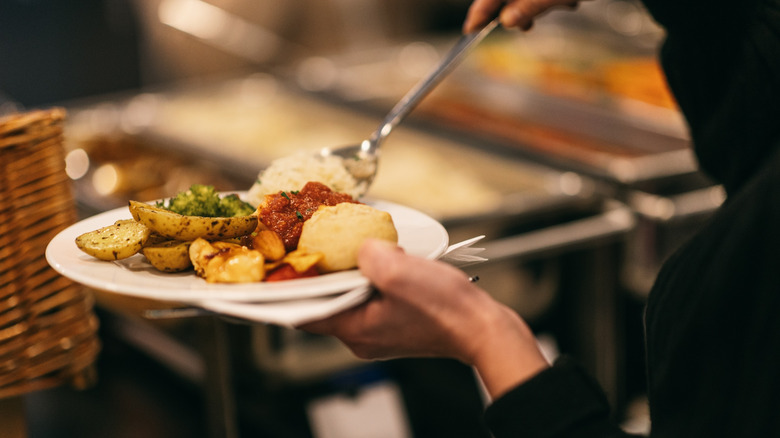
Serving spoons on a buffet line are like potato chips — you can never have just one. One drops on the floor, another gets submerged in a vat of mac and cheese, the other one seemingly grows legs and walks away. That's all to say that you can never really have too many serving spoons on hand. Moreover, it's important to stock the right kind of utensil for each food. A pair of tongs that doesn't open wide enough for a roll may discourage someone from using them entirely and cause them to resort to their grimy fingers instead. Steve Ingber recommends using tongs for solid foods and spoons for "saucy items."
"For hygiene, I often put out cocktail napkins next to serving utensils so people can grab the spoon without touching it directly," Laide Olambiwonnu says. If you want a more permanent fixture, you may want to invest in spoon rests. Take a walk down your buffet line as guests are grabbing food so that you can remove any spoons or serving utensils that have sunk into the food trays and replace those that have gone missing with new ones.