

White Vinegar Vs Apple Cider Vinegar: Which Is The Absolute Best For Cleaning Your Kitchen?

We may receive a commission on purchases made from links.
Although we love a good disinfectant, it's also great to liberate oneself from Big Bleach once in a while. Those harsh commercial chemical cleaners can pose respiratory risks, they can considerably irritate your skin, and, superficially, their stains are paradoxically rivaled by little more than red wine — before the potential club soda remedy. That isn't to say that what most folks consider more natural cleansers aren't without their downsides, but being that common swaps like white and apple cider vinegar are actually edible, we just feel a little more comfortable dousing some of our home's most vulnerable areas with the stuff. But that doesn't mean that these vinegar varieties are interchangeable for all of your scrubbing, buffing, and degreasing needs.
Although you can use both white vinegar and apple cider vinegar for cleaning your kitchen, you're probably going to have an easier time with the former. For one, it's clear, so, while you should still test it on unobtrusive parts of textiles you wish to protect, it's considerably less likely to stain than the sepia-hued botanical compound. White vinegar is also far from unscented, but its odor is arguably more neutral, and even more cleaner-coded, than the titular bouquet of an apple cider vinegar, astringent as it may be. And, fruit devotees aside, odds are that you likely have white vinegar kicking around the house already, so you can start using it today and save the apple cider vinegar for your homemade ketchup. And if you don't, it tends to be cheaper than its fruity counterpart, so literally pouring it down the drain is less likely to sting.
Cleaning with white vinegar at home
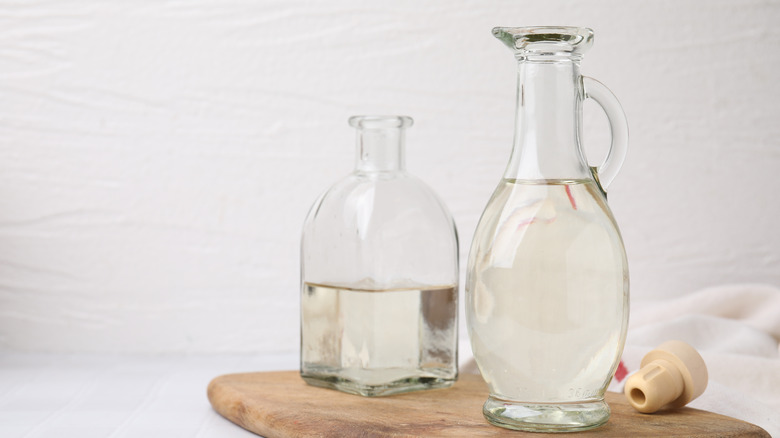
White vinegar is the food-safe way to slay some kinds of bacteria, such as E. coli, salmonella, and listeria, so it has obvious applications as a disinfectant in the kitchen. You should not, however, just start splashing it all over and hope for the best; that's called a mess. A one-to-one ratio of white vinegar and water is the easily recalled recipe for spic and span vinegar success. That means that you can portion something like 1 cup of water and 1 cup of white vinegar into a spray bottle, give it a good shake, and set to spritzing your stovetop, counters, sinks, and backsplashes. Some lemon juice can also improve its scent a tad. And you can, of course, also use the solution elsewhere around your space.
Mixing vinegar and water is pretty low lift in terms of household cleaning DIYs, but you can still introduce these ingredients to your regime even if you don't want to play amateur alchemist. We are repeat buyers of Aunt Fannie's multi-surface spray, which comes in lemon, eucalyptus, lavender, and fragrance-free editions. We've remained committed to the citrus blend, which admittedly starts out a little stronger on the vinegar, but ultimately fades to a scent that mostly reads as fresh and, most importantly, clean.