

How Long It Should Take To Make Pour-Over Coffee — And What To Do If Your Timing Is Off
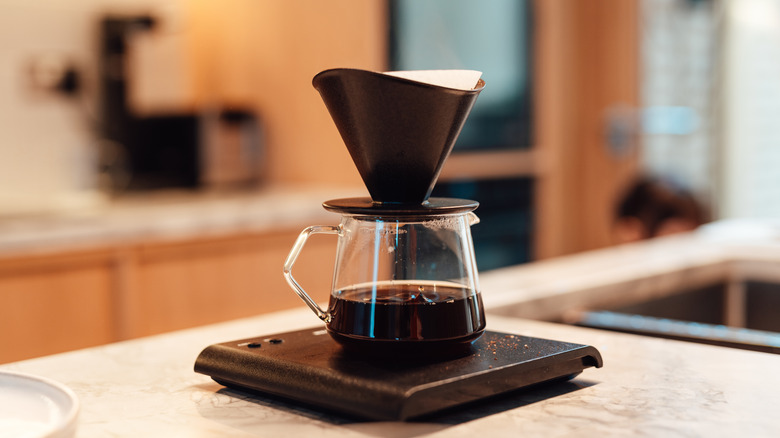
In a world of fancy lattes that are more milk and frothy foam than actual coffee, sometimes, you just want a good old fashioned cup of joe. And while there are many a method to produce said cup of coffee, pour-over is a preferred method for yielding a delicious, perfectly balanced cup. It utilizes a technique that's as basic as it gets, but demands some technique to get it right.
Pour-over, really, is just a by-hand replication of how an automatic coffee maker works, pouring hot water over grounds, letting the coffee drip slowly into a cup. When done by hand, you're in control of getting the timing down perfectly. And timing is everything, says Matt Woodburn-Simmonds, ex-barista and founder of Home Coffee Expert and Decoding Wine, who spoke with Chowhound about the importance of taking three to four minutes to make a perfect cup.
"Pour-over that is brewed too quickly will be thin and sour as the rich middle flavors and bitter later flavors that balance your coffee haven't been extracted from the grounds," explains Woodburn-Simmonds. On the flip side, "if you brew for too long, then the coffee will be very bitter." To slow down or speed up, you can adjust your pour rate, but the size of the grounds themselves are the primary driver speed. So pay heed to the size of your grounds, which can be make or break, as they impact how slowly or quickly water flows through the filter and into your mug.
Don't just pour in your water and hope for the best
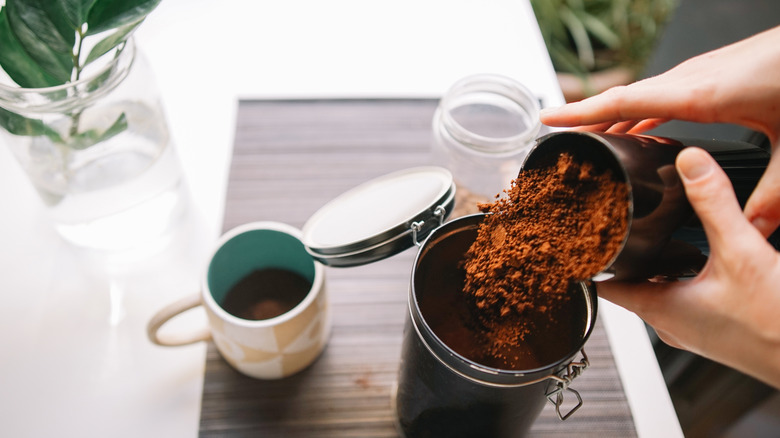
Pour-over sounds and may look simple — after all, it's just pouring water over your grounds, right? Not quite. Much goes into the perfectly balanced, delicious cup, and Matt Woodburn-Simmonds explains, "Finer grounds will create a more compact coffee bed that will take longer for the water to filter through," whereas "coarser grounds will produce a looser bed, meaning faster water filtering through." This matters because you still want to stick to the golden three to four minutes time range, which Woodburn-Simmonds emphasizes is key.
For a balanced cup worthy of a coffee shop's, first, "bloom" your grounds for less than a minute, which just means getting the grounds wet with a small amount of water — think of blooming as priming them for the main pour, and laying the foundation for the best balanced flavor. Then, fill the filter with the first pour of water. Once that passes through, Woodburn-Simmonds says, "Pour again when the hot water is nearly at the grounds' bed until you've used the correct amount of hot water."
Once your timer goes off though, remove the dripper and filter, even if the water hasn't finished flowing through. Your perfect cup awaits — balanced, smooth, neither acidic, bitter, nor weak.