

Anthony Bourdain's Advice For Finding A Chef-Quality Pan For Cheap
We may receive a commission on purchases made from links.
Anthony Bourdain's unique brand of advice on cooking and eating is brutally direct and incisive, not to mention unlike any other culinary insight one may glean elsewhere. While the late chef's primary expertise was cooking, his prolific lifestyle of exploring new cuisines gave us gems like Bourdain's 'Grandma Rule' for trying food when traveling. It's difficult to categorize all his wisdom into a specific philosophy. However, the one thing he was clear on was that expensive didn't necessarily mean good. This led him to regularly call out culinary trends that appeared to be pretentious or overhyped, like the time he referred to Kobe beef sliders as "A clear and present danger." Even when it came to cooking, and Bourdain was no stranger to kitchens churning out world-class fare, he insisted that spending a lot wasn't the way to go. And this doesn't mean compromising on quality. In quintessential Bourdain fashion, the late chef just had a better, dare we say sneakier, way of going about it.
A good pan, he rightly said, is essential for a kitchen. However, for someone who isn't a professional chef, finding a high-quality pan at a good price can be daunting. The solution? Buy one at a restaurant auction. In his maiden book, "Kitchen Confidential: Adventures in the Culinary Underbelly," Bourdain talked about how restaurants regularly go out of business, and one of the best places to pick up high-quality kitchen equipment is when these shuttering enterprises start auctioning their kitchenware. Since it's meant for a restaurant kitchen, the chances of the pan being of great quality are high. Even if you can't find an auction, buying new isn't necessary. You simply need to know what to look for.
What to look for in a chef-quality pan and, once acquired, how to treat it well
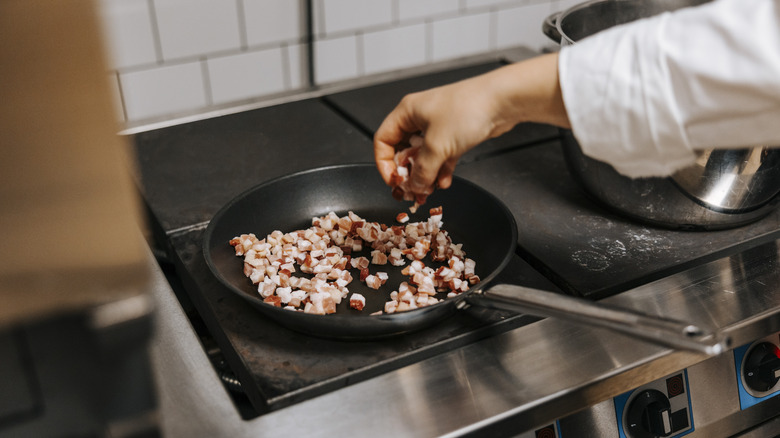
The first and most obvious quality to look for in a pan, be it a cast iron skillet or a sleek sauté pan, is weight. In his section on finding a good pan on the cheap, Anthony Bourdain pointed out that professional pans and household pans are different, with the latter often being quite flimsy. When a pan is heavy, it signifies that it is sturdy and thick-bottomed. Sturdiness is an obvious quality to look for. The pan's thickness dictates how well it retains and distributes heat. A thin-bottomed pan can have hot spots and heat up too fast, resulting in burnt, patchy results. Conversely, a thick-bottomed pan cooks evenly and holds heat for longer. In fact, you can even skip the oven and make delicious focaccia in a cast iron pan if your cookware is of good quality. Even if you use ingredients straight from the refrigerator or deglaze the pan to create a richer flavor, a thick-bottomed one will cool down less and give you better cooking outcomes.
In addition to a good non-stick pan, consider getting a cast iron or stainless steel one as well. While aluminum is also an option, it's usually quite light and is, therefore, susceptible to the faults of a thin-bottomed pan.
When you do find a good pan, remember that protecting its cooking surface is of utmost importance. The late chef advised his readers to stay away from flimsy non-stick coatings and only use wooden or non-metal cookware with them to avoid scratching the surface. He also recommended gently cleaning it with a paper towel and avoiding metal scrubbers.