

Why Is Kroger Suddenly Struggling? What To Expect
In August 2025, America's oldest grocery chain, Kroger, announced its plans to close about 60 underperforming stores across the United States by the end of 2026. The grocery chain's goal is to cut losses and boost profitability, but it's still a fairly small proportion of the company's locations. Kroger and other brands it owns, such as Fred Meyer, Ralphs, Dillons, QFC, and City Market, operate over 2,700 stores.
The full list of closures hasn't been made public, but some locations under the Kroger Co. banner have already been announced across the country. The Seattle, Washington, area has been hit hard with six closures (five Fred Meyer locations and one QFC). There are also smaller clusters of closures around Chicago, Illinois (four Mariano's stores), Milwaukee, Wisconsin (four Pick 'n' Save stores), and Washington, D.C. (four Harris Teeter stores).
It's not just stores that have been impacted. At the time of the announcement, Kroger also laid off around 1,000 corporate employees (that is, not in-store staff), although there are plans to hire more staff for in-store roles. One speculated reason for these cost-cutting efforts is Kroger's failed merger with Albertsons. The estimated $24.6 billion deal would've merged the two largest supermarkets in the country, and it was blocked by the Federal Trade Commission to maintain competition in the grocery industry. While Kroger reportedly held off on store closures during this time, recent events may be seen as a "catch-up" of sorts.
Kroger's strategy for winning over customers
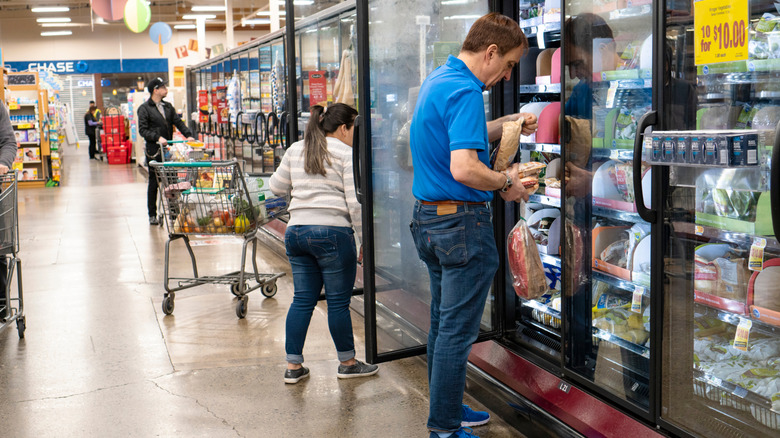
Kroger's 60 store closures are part of a broader cost-cutting and repositioning strategy. It's leaning into more store-brand products, such as its "Our Brands" line, to help with pressures on its sales margins. According to Kroger's 2024 Environmental and Governance Report, these private-label initiatives generated over $30 billion in the two previous years, and they generally allow the company to profit more than comparable products from outside suppliers.
With customers anxious over the increasing cost of groceries, Kroger seems to be trying to appeal to shoppers on the basis of price. In the second fiscal quarter of 2025, a Kroger earnings call confirmed that prices were lowered on around 3,500 items (transcript via Yahoo Finance). Kroger also revealed in this call that it plans to absorb price increases — a result of inflation and tariffs that would otherwise be passed on to consumers. The company also seems to be leaning into online sales more, although it has also taken a more analog approach to discounts, reintroducing paper coupons.
Despite the 60 closures, Kroger also aims to open around 30 more stores in 2025 and 2026, and the company isn't faring too badly, as it has overall increased sales in its stores. How strongly you feel the impacts of Kroger's store openings and closings may depend on where you live. Some closures could negatively affect consumers in more rural, low-income areas, while those in higher-density, higher-income areas may benefit from new stores selling items at more reasonable prices.