

Can Curing Your Salmon In Salt And Sugar Really Make It Safe For Sushi?
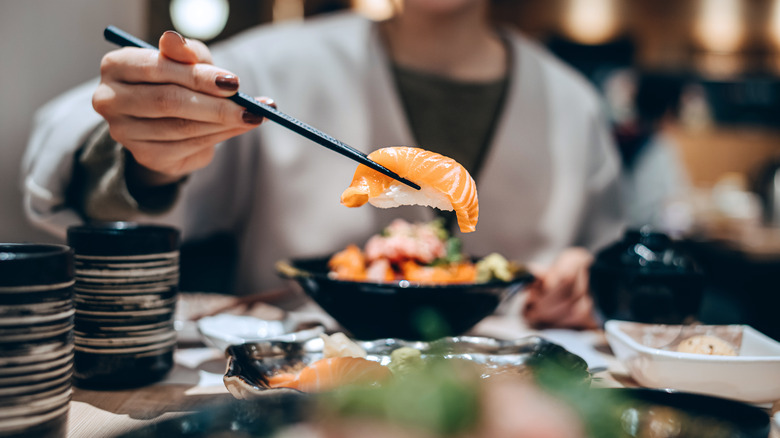
For around five million people in the United States, sushi has become a monthly indulgence. But because this Japanese dish is most often consumed raw, it poses its fair share of risks — like exposure to salmonella — which is why proper preparation is essential. Some TikTok videos show home chefs "curing" salmon with salt and sugar, but is that really enough to make this dish safe?
To find out, Chowhound spoke with Kantha Shelke, PhD — a certified food scientist, principal at the food science and research firm Corvus Blue LLC, and senior lecturer on food safety regulations at Johns Hopkins University. Her verdict? Curing usually isn't enough. "Relying on curing alone to make raw salmon safe is risky because curing does not eliminate all parasites or pathogens," Shelke said. "Because microbes like Listeria monocytogenes, Staphylococcus aureus, and certain species of Salmonella can survive in low water activity environments, curing must be done correctly and carefully to avoid cross-contamination, which is always a risk."
Curing with salt and sugar does reduce a fish's water activity from its original ~0.99 to about 0.95–0.97, which helps keep germs at bay. Still, the ideal environment where bacteria won't thrive is below 0.85. Adding more sugar and salt to achieve a hygienic condition will just ruin your salmon, which is why this process isn't enough. Knowing the foolproof ratio for curing fish at home can be important, but that's not all home chefs have to do to make raw salmon safe to eat.
How to make sure raw salmon is safe to eat

Most fish markets carry salmon labeled sushi or sashimi grade. While these demarcations are important, you shouldn't rely on them alone due to the lack of regulations around them. Make sure you're buying from a reputable supplier, and when in doubt, Kantha Shelke suggests going for a properly frozen fish — preferably something farmed or wild-caught. The frigid temperatures prevent the creation of conditions where parasites can thrive. "Freezing is essential for parasite safety for fish intended to be served raw or undercooked (e.g., sushi or ceviche or tartare)," she said. To really eliminate bacteria, establishments must observe special FDA Food Codes on properly freezing fish. This makes commercially-sold frozen fish a safe bet, and why frozen fish can be superior to fresh.
While frozen fish is usually best, expect a change in consistency in frozen salmon compared to fresh. This is where curing can come in again, as the process helps a fish's texture and flavors bounce back. "Salt denatures proteins and stabilizes fats, giving the fish a firmer, velvety texture. Sugar balances the saltiness and adds subtle sweetness, enhancing the overall flavor complexity," Shelke said.
Being aware of kitchen sanitation mistakes you need to stop making and avoiding cross-contamination between your tools and equipment is just as important for a safe and risk-free meal. When in doubt, you can always cook your salmon or head to a reputable restaurant where you can enjoy sushi with peace of mind.