

These Are Hands Down The Wildest Burgers Wendy's Has Ever Released
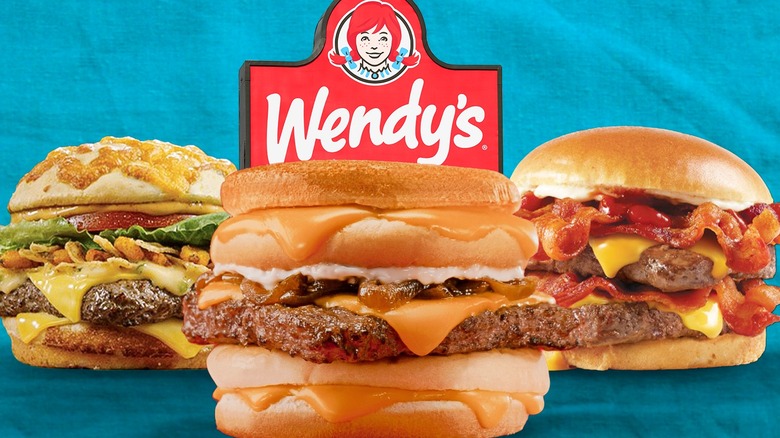
Since its founding by Dave Thomas in 1969, Wendy's has managed to establish a unique identity in a competitive fast food scene. The chain distinguished itself with a commitment to using fresh, never-frozen square beef patties; the square serving as a symbol that the company doesn't cut corners with its products. Beyond its iconically shaped burgers, Wendy's also stands apart from its competitors by offering a varied and unique menu that includes items like its signature chili and baked potatoes. The brand also allows for customization of its burgers with single, double, and even triple patties.
Fast food chains are constantly introducing new, often wild, limited-time offerings to generate buzz, attract new customers, bring back old customers, and keep the menu feeling fresh. Items will come and go based on popularity or cost, sometimes disappearing forever or being revived due to demand. For example, the Wendy's Chicken Cordon Bleu was discontinued permanently in 1992, one year after it was introduced. Despite being a popular menu item, it's believed to have been too expensive to produce. In contrast, the Pretzel Bacon Pub Cheeseburger was introduced in 2020 and spent one year on menus before disappearing. The cancellation only lasted until 2022, when it was brought back for a limited time.
The chain's willingness to experiment has led to some unusual burgers, both locally and abroad. From a towering Triple Baconator to the controversial Foie Gras Rossini burger in Japan, Wendy's culinary innovation knows no bounds. No matter how wild or bold, you can find comfort in knowing it will be served on the familiar square beef patty.
Triple Baconator
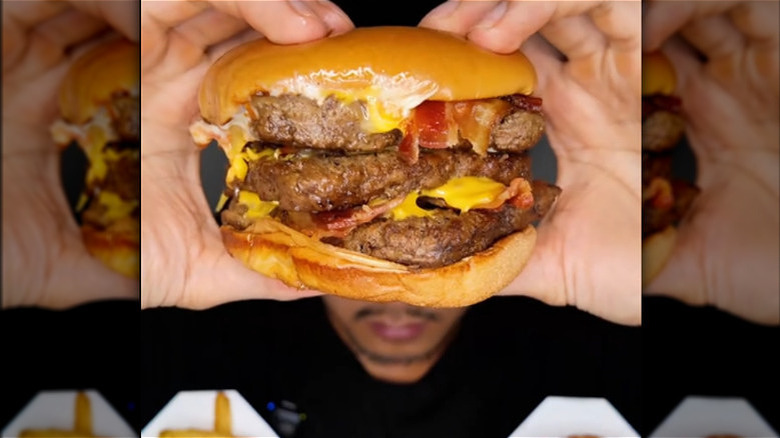
Though the Baconator seems synonymous with the Wendy's brand, it actually wasn't introduced until 2007. The burger was created in an effort to revitalize Wendy's menu and marketing after the passing of founder Dave Thomas in 2002. According to then-CEO Kerril Anderson, the Baconator was targeted to 18 to 34-year-old males, who at the time were labeled as the most common consumers of fast food. The burger was an immediate success, reportedly selling over 68 million sandwiches in less than one year. A smaller version, the Son of Baconator, was added in 2011, and a Breakfast Baconator was released in 2020 as part of a new nationwide breakfast menu.
The original Baconator consists of two beef patties, six strips of Applewood smoked bacon, melted American cheese, ketchup, and mayonnaise. The Triple Baconator features a whopping three quarter-pound beef patties, three slices of cheese, and nine strips of bacon. Unlike a typical burger, none of the Baconators come with vegetables like lettuce, tomatoes, or onions, but they can be added. Some reviews note that the lack of vegetables makes the flavor feel one-dimensional and dull after a few bites. Also, the height of the burger makes it hard to eat, with some joking that you have to unhinge your jaw like a snake to bite into it. Many reviewers praise the alternating layers of patties, cheese, and bacon, which helps ensure each bite has a balanced taste of components. Most agree the burger, though decadent, is delicious, proven by its enduring presence on the menu since its debut.
Grilled Cheese Cheeseburger
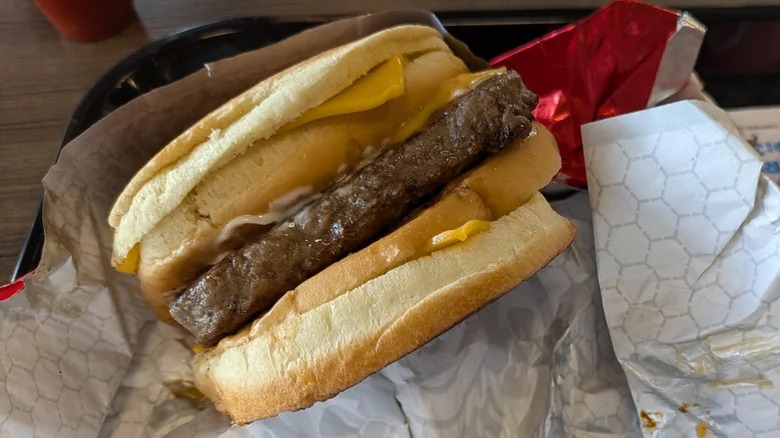
To celebrate 50 years of serving Canadian communities, Wendy's released the Grilled Cheese Cheeseburger across the country for a limited time in May of 2025. Unlike other grilled cheese burgers like those from Sonic or Five Guys, which are essentially patty melts served on a grilled bun or toast, Wendy's new burger contains not just one grilled cheese sandwich, but two. The unique creation features a quarter-pound of fresh Canadian beef, topped with caramelized onions, mayonnaise, and a melted cheese slice made with Canadian dairy, all served between two grilled cheese sandwiches as buns. According to a press release from Wendy's, the burger is designed to deliver maximum flavor and satisfy serious cheese lovers.
Reviews for the burger are mixed. Some critics point out an off-putting ratio, noting the double-bun construction offers too much bread. Others found the grilled cheese buns to be inconsistently toasted and under-melted. Many reviewers agree that the caramelized onions are a standout flavor and help cut through the richness of the layers of cheese.
While a burger served between two grilled cheese sandwiches sounds uniquely American, the menu item is only offered in Canada, a first for the brand. In the same press release, Wendy's International Culinary Innovation Manager Hayley Kianoff, said that Canadians are being given the first taste of the burger, leaving Americans to hope that the fast food item will work its way south of the border.
Lobster Surf and Turf Burger
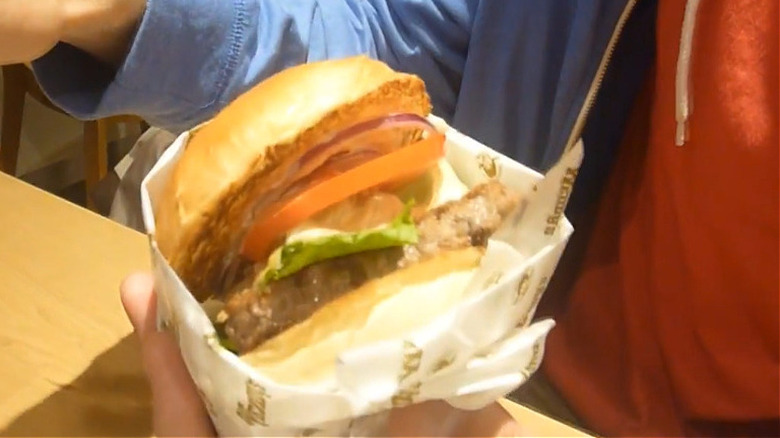
In 2011, Wendy's relaunched operations in Japan after temporarily closing in late 2009 in order to find a new franchising partner. To differentiate itself from other restaurants, Wendy's added innovative new menu options created exclusively for Japanese markets. In 2012, the brand launched exclusive menu items including the Avocado Wasabi Hamburger, the Lobster and Caviar Burger, and the premium Surf and Turf Burger. The burger featured a standard beef patty topped with large chunks of lobster meat and lobster salad, creating a true surf and turf experience. It was also topped with the usual burger toppings of lettuce, tomato, onion, and mayonnaise.
Despite the unique appeal of the concept, reviews of Wendy's Surf and Turf burger were mixed. While there were generous chunks of lobster added to the burger, many noted the shellfish struggled to make its presence felt. To maintain the lobster flavor, little seasoning was added to the lobster meat and as a result was overwhelmed by the taste of the beef patty. The lobster was mostly felt at the end of a bite, leaving reviewers with a slightly sweet aftertaste.
Ultimately, the burger was seen as an ambitious but successful undertaking, in part due to Japan's complex culinary landscape. Even with historically low lobster prices at the time, the burger alone cost 1,280 yen, which was around $16 USD, and was only available for a limited time.
Loaded Nacho Cheeseburger
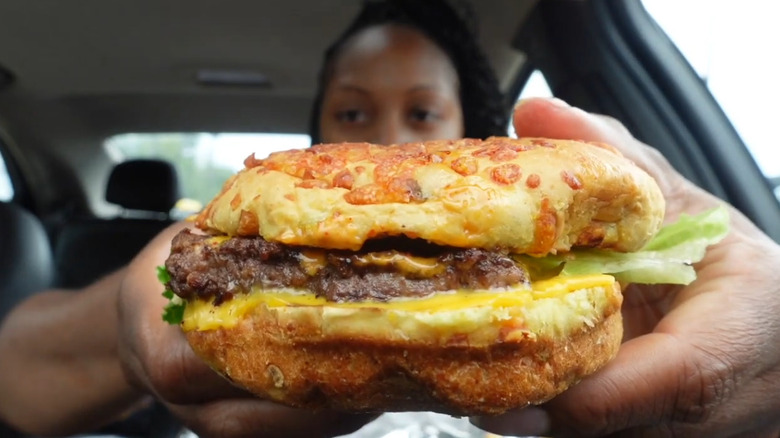
Wendy's launched a nacho-inspired menu in August 2023 just ahead of football season to take advantage of tailgating and watch parties. The Loaded Nacho Cheeseburger was released alongside the Loaded Nacho Chicken Sandwich and Queso Fries. The burger was designed to deliver the experience of a fully loaded nacho platter in a single bite. Its construction starts with a jalapeño cheddar bun with a hint of sweet corn, topped with a classic beef patty, poblano queso, spicy chipotle sauce, tortilla strips, crispy corn, lettuce, tomato, and American cheese.
Jay Drumm, Wendy's manager of culinary innovation, said that at the time of launch, the chain spent more than two years perfecting the burger. The time was well spent because the burger was well-received by customers. Fans on Reddit raved about the menu item, calling it "insanely good" and "absolute perfection." The burger didn't escape criticism however, with some calling it a gimmick and noting that all the sauces made it extremely messy and difficult to eat.
The Loaded Nacho Cheeseburger was originally introduced as a fall menu item, so it was likely never meant to be a permanent menu fixture. This was confirmed when just six months after its debut, the chain announced that the burger would be discontinued. What came as a shock to customers was unsurprising to employees, who admitted observing consistently low sales for the burger.
Foie Gras Rossini Burger
Wendy's strategic return to Japan in 2011 was marked by arguably one of its most controversial menu items: the Foie Gras Rossini Burger. The burger is a reimagining of the French dish it's named after, Tournedos Rossini, which consists of beef tournedos pan-fried in butter, served on a crouton, topped with a slice of foie gras, garnished with black truffle, and finished with a Madeira-based sauce. The Wendy's version features the traditional square beef patty, three slabs of foie gras, truffle butter, and vegetables. The burger was part of a menu called Japan Premium and was sold for 1,280 yen, or $16 USD.
Predictably, the burger was met with some pushback. If you're familiar with foie gras, you know the process to create the French delicacy is a widely disputed culinary practice due to animal welfare concerns. The method involves force-feeding ducks and geese with metal feeding tubes, causing the animals' livers to swell and become more fatty, resulting in a desired rich flavor and velvety texture. The practice is seen as inhumane and has been banned in several countries and certain U.S. states. Back in December 2012, PETA condemned the fast-food chain and called on Wendy's to stop selling the foie gras burger, but by then the item had already disappeared from Japanese menus.
Despite the ethical debate surrounding the burger's key ingredient, it still managed to draw curious foodies to Japan. According to a firsthand account from Marvel Comics' Editor in Chief, C.B. Cebulski, the verdict was that the combination of the luxurious ingredients created an overwhelmingly decadent experience. Cebulski described the product as too rich, managing only two bites of the burger before calling it quits.
Carolina Classic
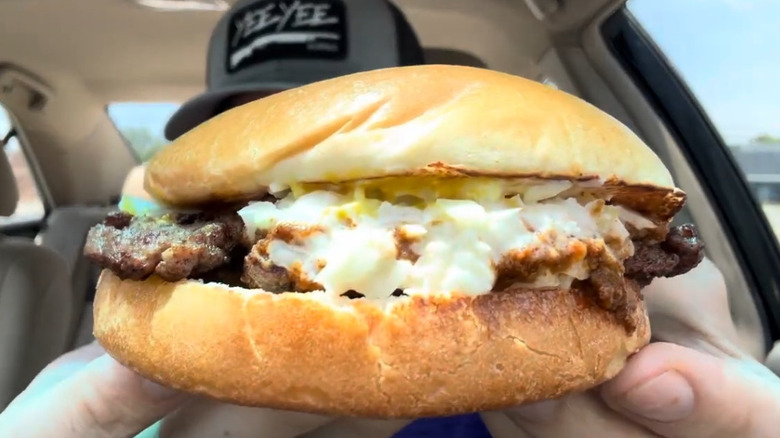
The Carolina Classic burger has been a menu staple for Wendy's customers in the Carolinas for decades. The product was first introduced at a location in Rockingham, North Carolina, in 1994, as a homage to some of the best flavors of the South. Carolina-style burgers and hot dogs come with an established set of condiments made up of chili, cole slaw, onions, and sometimes mustard (which can be added as a fourth item or used to replace the slaw). The Carolina Classic features Wendy's iconic quarter-pound patty, chili, diced onions, mustard, and cole slaw. The menu item was a hit with locals and across the country when it was offered during a limited-time run in 1995. In 2019, the burger made a return to Wendy's menus for a limited time, but was only available at Wendy's restaurants within North and South Carolina, before disappearing again in 2020.
The consensus among those who have tried the Carolina Classic burger is generally positive, with many praising the unique flavor profile. Reviews on Reddit say the burger is tasty, and that the tang of the mustard serves as a nice contrast to the meatiness of the patty and chili. Others wished there had been extra slaw on the burger to provide more of a much needed crunch.
Takoyaki Burger
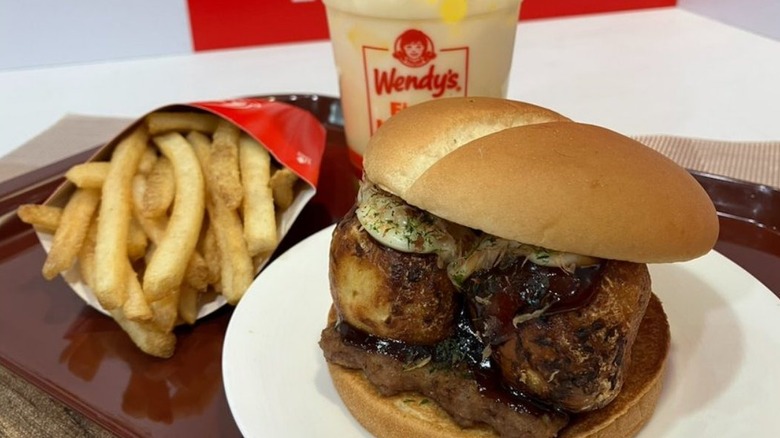
Wendy's Japan once again showcases its unique approach to fast food with a limited-time menu inspired by local Osakan cuisine. The menu was released in March 2025 to coincide with the Osaka World Expo and capitalize on the influx of visitors to the city. The promotion featured four menu items, including takoyaki-flavored fries, a mixed juice tapioca milk, a sparkling tapioca drink, and the Takoyaki Burger. Takoyaki, translating to octopus balls, are a ball-shaped snack made of a wheat flour batter, filled with chopped octopus, tempura scraps, pickled ginger, and green onions. The burger itself features a standard all-beef patty, three takoyaki balls, and is topped with mayonnaise, dried bonita flakes (tuna), aonori seaweed flakes, and takoyaki sauce.
While the concept of placing takoyaki on a burger seemed unusual even to local residents, initial reviews were generally favorable. Many highlighted that the trio of takoyaki was a delightful balance to the rest of the burger, standing out nicely against the beef patty and allowing the taste of octopus to come through. Others praise the teriyaki-kewpie sauce blend as the standout factor that ties all the components together. The nori was lauded for enhancing the seafood taste, making the burger a surprisingly coherent and distinctly Osaka take on the fast food offering.
Truffle Tsukimi Mocchi Baconator
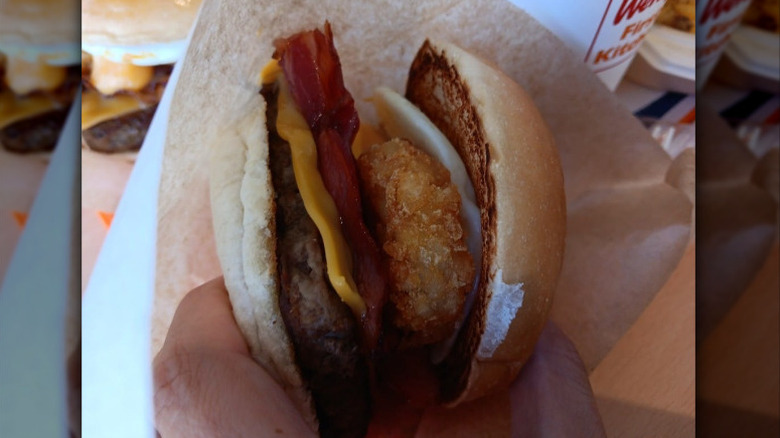
September marks the beginning of Tsukimi, a traditional Japanese moon-viewing festival that wraps up the summer season and celebrates the harvest moon and the transition into autumn. In honor of the 2025 celebration, Wendy's Japan unveiled a special seasonal lineup featuring burgers with ingredients like fried eggs and mochi rice cakes. The most ambitious of these offerings is the Truffle Tsukimi Mocchi Baconator, which reimagines the classic Baconator by adding a chewy mochi rice cake, black truffle-infused teriyaki sauce, and a fried egg to a beef patty topped with cheese and bacon.
The burger draws inspiration from Japanese culinary and cultural traditions. The fried eggs mirror the dish, tsukimi udon, in which a raw or poached egg symbolizes the full moon resting atop a cloud-like bed of noodles. Meanwhile, the inclusion of mochi references Japanese folklore, which tells the story of rabbits pounding mochi on the moon. Another tradition includes stacking tsukimi-dango (mochi balls) in a pyramid shape on a plate as an offering to the moon in appreciation of the autumn harvest and to bring good fortune. By combining these elements into a single burger, Wendy's Japan creates a dish that is both a seasonal celebration and a tribute to Japanese traditions.
BBQ Brisket Cheeseburger
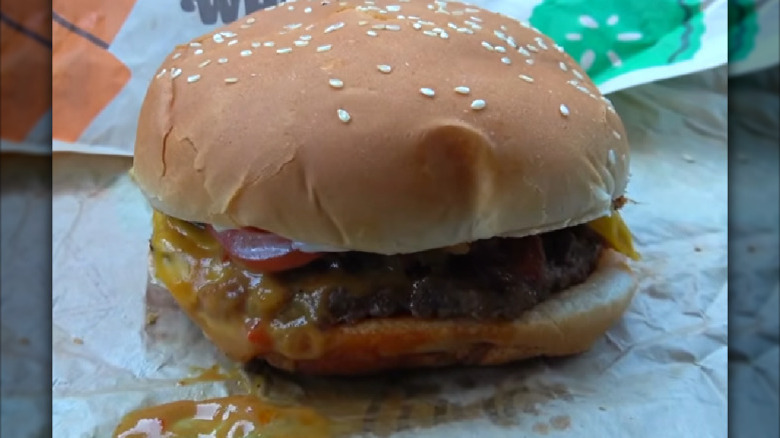
In 2014, Wendy's tested a BBQ Beef Brisket Cheeseburger in Jacksonville, Florida. The sandwich was made with strips of premium tender beef brisket strips smothered in barbecue sauce. It was topped with melted cheddar cheese, crispy fried onion rings, all on top of a Wendy's pure beef patty. The most notable feature of the burger was its bun, which was made from cornbread instead of the traditional wheat. At the time of release, it was priced at $5.99 for the sandwich alone, positioning it as a premium item on Florida menus.
The burger received positive feedback from customers in Jacksonville who tried it, with one reviewer praising it as "amazingly good," but others bemoaned the high price. Ultimately, Wendy's decided not to launch the burger nationwide in America. Instead, in a surprising move, a version of the BBQ Beef Brisket Cheeseburger appeared on the menu at Wendy's locations in the Middle East.