

How Thomas' English Muffins Was Involved In A Legal Precedent That Affects Job Searches To This Day
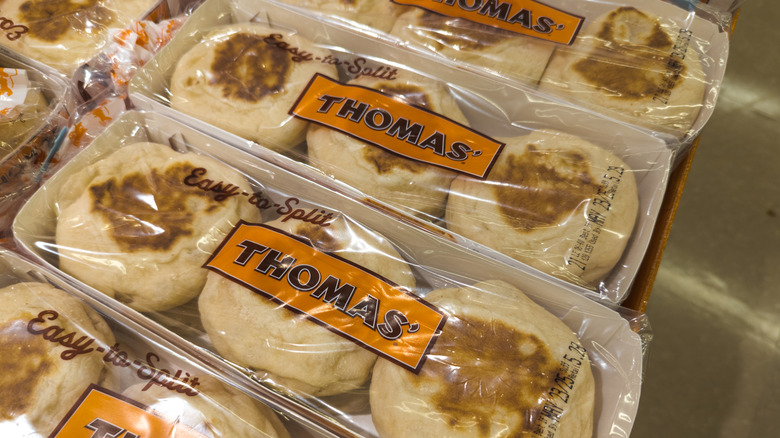
If you've ever tried Thomas' English Muffins, you may well remember a light, fluffy bread disc with nooks and crannies to soak up anything from butter to pizza toppings. But what's less known is how those nooks and crannies drew two gigantic baking corporations into a federal courtroom in 2010. That year, Bimbo Bakeries, the multinational company behind Thomas', sued one of its top executives, Chris Botticella, after he accepted a new job at Hostess, known for products like Ding Dongs and Paul Hollywood's least favorite snack, Twinkies, alongside plenty of other discontinued snacks. The issue wasn't just that Botticella was switching teams — it was that Botticella had access to closely-guarded trade secrets. He was one of seven executives that knew the full recipe for making Thomas' English muffins crisp outside and soft inside. Thomas' English Muffins alone brought in around $500 million a year for Bimbo, so protecting the brand's intellectual property was serious business.
Even though Botticella signed a confidentiality agreement at Bimbo, he hadn't signed a non-compete agreement, which would have blocked him from jumping ship to a direct competitor. However, Bimbo discovered he delayed telling them about the new job — and during the time when they didn't know, Botticella allegedly accessed files that included Thomas' trade secrets, copying them onto a private device. So, Bimbo asked a federal judge to grant a preliminary injunction to stop Botticella from starting a new job at Hostess, based on the risk that he might share secrets on how to replicate those nooks and crannies.
Why the case matters, even if you're not a corporate executive

A district court eventually granted an injunction to block Botticella from taking the job at Hostess, with the court noting that his explanation for why he had copied confidential files was "confusing at best." When Botticella appealed to a higher court, that court agreed, in spite of Botticella's concerns that the Hostess job would not be held for him.
What makes this case so important is how it shaped the way courts think about trade secrets and employee mobility. Before Botticella, Pennsylvania law usually required companies to prove it would be basically inevitable that a departing employee would share trade secrets like a muffin recipe in their new job in order to stop the job switch from happening; anything short of that proof, and the job change would be okay. But in this case, the Third Circuit Court of Appeals said companies only need to show a serious risk that secrets could be shared. That made it easier for employers to stop workers heading to competitors.
Theoretically, this same situation could apply to other food workers, not just executives — if you have access to a trade secret recipe from an old workplace that could be useful to a competitor, you could get in legal trouble. But the old employer has to prove they made a serious effort to keep that recipe secret — if lots of staff have access to that recipe (including those who don't need to know about it), the employer might not have a case. Of course, if you find yourself in that position, consult professional legal advice.