

How Japanese Crystal Candy Achieves That Jewel-Like Finish
We may receive a commission on purchases made from links.
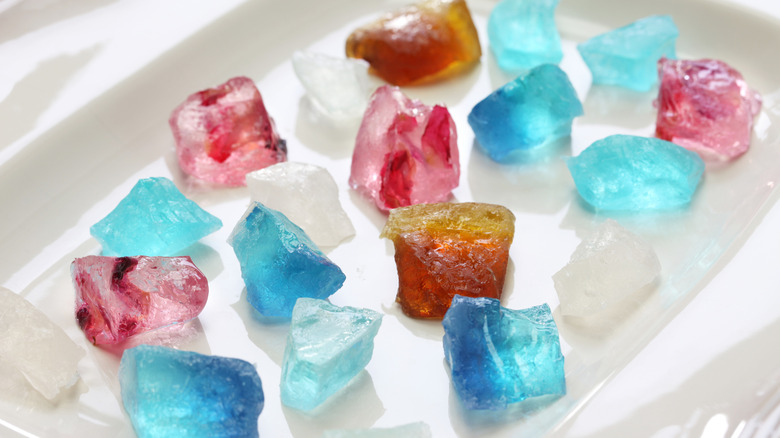
Have you ever heard of "kohakutou" (it translates to "amber candy" in English), otherwise known as Japanese crystal candy? If this is the first time you're hearing of its existence, you're about to get all the sweet details that may inspire you to gather all the ingredients and make yourself some colorful batches of eye-catching candy.
While they might look too pretty to eat, there's a reason why they are a beloved Japanese sweet treat that ought to be added to our list of unique Japanese desserts to try. The texture features a crisp exterior with an interior that is reminiscent of chewy candy. Upon first glance, you might mistake these candies for gemstones, but what makes the candy pieces appear so much like jewels? The secret ingredient is agar-agar, a derivative of red algae.
When agar-agar powder, such as Telephone agar-agar powder, is combined with a liquid and high heat, it thickens into a jelly-like consistency. As it cools down, the mixture becomes firmer while still yielding to the touch. Adding to its merits, kohakutou is vegan- and vegetarian-friendly since the desired consistency is achieved without gelatin (which is made from animal cartilage, bones, or skin). Whether you want to enjoy kohakutou as is or use them as a topping for your baked treats, these Japanese crystal candies bring a unique texture that should have you and your taste buds craving more.
How agar-agar is made (and where you can find it)

The origins of agar-agar can be traced to China, where Gelidium, a genus of red algae, was commonly used in cooking. It wasn't until the 17th century that a Japanese innkeeper reportedly and fortuitously discovered the jelling properties of seaweed in a bowl of leftover seaweed soup. Over time, its culinary use expanded across Asia, where agar-agar is a mainstay in making jellies, puddings, and a variety of desserts. It became a novel discovery in the West as an animal-free replacement to gelatin. It's now used in a variety of vegan-friendly confections, such as marshmallows, and even in foamy cocktail toppings. But how is a humble, seaweed-derived product showcasing such diverse culinary potential made in the first place?
The Gelidium and Gracilaria species of red algae are the common sources for agar-agar. The product is made by boiling the seaweed into a gel that's then pressed and dried. The dried agar-agar can either be ground into a fine powder or crushed into agar-agar flakes. The powdered form is usually more potent; a little goes a long way for a firm block of jelly. If you are new to cooking with agar-agar, the flakes make it easier to control the consistency; remember, it's always easier to add more than it is to undo overdoing an ingredient. You can usually find agar-agar powder or flakes in health food stores, Asian grocery stores, and sometimes in the international aisle of grocery stores alongside other seaweed products. If all else fails, you can always get your supply online.