

The Once-Popular Shellfish You Might Never Get To Eat Again
If you've ever tried abalone, you've experienced a seafood delicacy that's becoming increasingly rare in the United States. All seven species native to the West Coast — red, white, black, green, pink, flat, and pinto (northern) — are endangered, with all but pinto abalone considered critically endangered, according to the International Union for Conservation of Nature. The reasons for this endangered status vary by species: Several have been overfished to near-extinction, while black abalone fell victim to a bacterial disease called Withering Syndrome. Red abalone have been starved out by vanishing kelp forests. These were consumed by sea urchins, whose population exploded after a heatwave killed off their main predator, the sunflower sea star. Repopulation is also slow, as the remaining population is believed to be too spread out to breed easily, at least in the case of the pinto abalone.
As a result, it's now joined the pantheon of meats that are banned for hunting/fishing and consumption (with an exception, which we'll get to). Since 2018, it's illegal to harvest any red abalone in California until 2026 (and that will likely be extended), while Oregon has an indefinite ban. Pinto abalone fishing has long been banned for commercial purposes in Washington (no other species live off the Washington coast). Abalone in the U.S. only live off the West Coast, so there's no option to look east to find them. This means your chances of finding wild abalone on a menu are effectively nonexistent. If you do find it, it's probably illegal: Police in California have made numerous arrests for abalone poaching, and the perpetrators have faced large fines or sometimes even prison time.
A sustainable future for abalone?
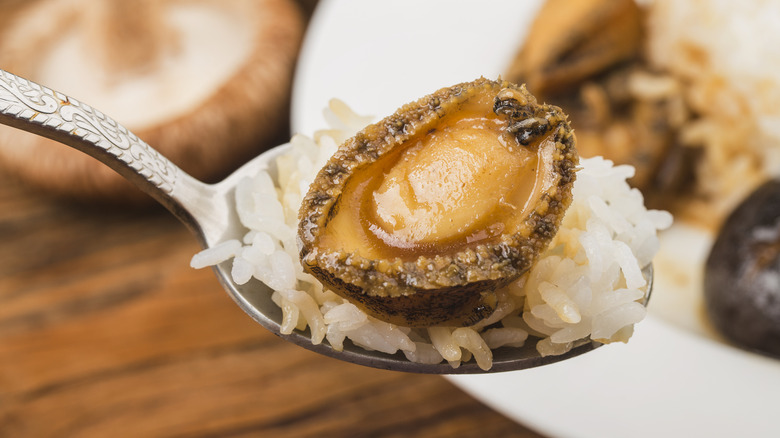
While wild abalone is off the menu, there may be a path forward thanks to sustainable abalone farming. It can be cultivated in tanks or cages in the ocean that mimic natural conditions. In California, abalone are fed kelp harvested from the sea, and farms that grow them must obtain permits and follow strict rules so that the kelp harvesting is sustainable. But even then, farms don't keep abalone safe from disease, as the aforementioned Withering Syndrome and a now-eradicated worm that lives in abalone shells have made reliable abalone farming a tricky task. Plus, they grow seriously slowly: It takes four years for them to reach a size where they can be sold.
So why all the fuss over such a difficult-to-grow shellfish? It's arguably due to its unique flavor, which is both quite umami and lightly sweet. When cooked, it has a rich, calamari steak-adjacent taste and texture; eat it raw (for example as sashimi or sushi), and it has a buttery quality to it. This means it's been compared to something between foie gras and scallops. Its status as a luxury food likely also makes it appealing to some people, with prices going over $50 per pound, meaning it's the kind of thing you'll find at a three-star Michelin restaurant, and certainly not at Red Lobster. If you see it on a menu, consider yourself lucky — but be sure to check that it's farmed, not (illegal) wild abalone.