

Gordon Ramsay Never Cries When He Cuts Onions — Here's His Secret

Gordon Ramsay has developed quite the reputation for making people cry throughout his career, even though he's softened up over the past few years. On the flipside, outside of an incident with Marco Pierre White and when he loses Michelin stars, we don't really hear about Ramsay himself crying that often — not even when he's cutting onions. As it turns out, the chef has been using an easy trick to prevent that: He simply avoids cutting the roots. This makes it so that the compounds that make you tear up barely ever form in the first place.
Contrary to popular belief, onions don't directly contain any tear-inducing compounds. Instead, the culprit is the product of a series of rapid chemical reactions that occur when the vegetable is damaged. When you cut through an onion, it releases the sulfur-containing amino acid S-1-propenyl-L-cysteine sulfoxide, the enzyme alliinase, and water. The combination of these three compounds results in the formation of propanethial S-oxide, which irritates the eyes and causes your tear ducts to try to flood it out.
Because the roots of onions contain the highest concentration of its sulfuric compounds, keeping the structure intact like Ramsay teaches can significantly reduce the amount of propanethial S-oxide produced, resulting in fewer tears. Given the mechanisms at play, there are two main ways to avoid tearing up while cutting onions: You can either prevent the production of propanethial S-oxide, or you can prevent it from getting in your eyes. You can also try a combination of both, if you feel that your eyes are particularly sensitive to onions.
How to reduce the tear-producing compounds in onions
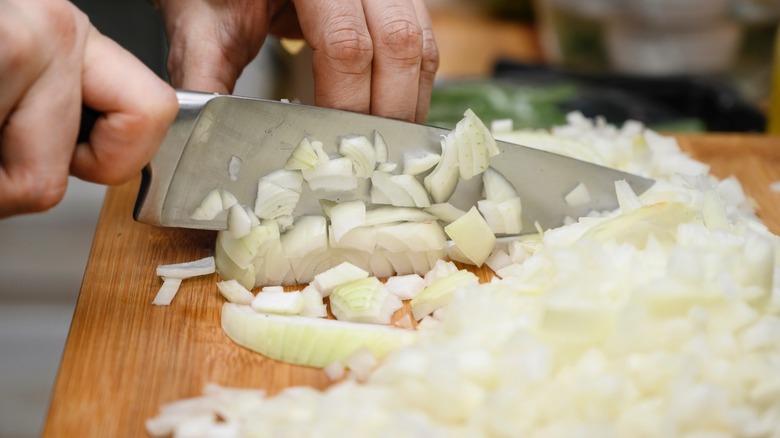
Since damage to the onion's cell walls is what triggers the chemical reactions that lead to crying, one of the best things you can do to prevent it is by minimizing the damage caused by cutting. This can be as easy as working with an adequately sharp knife (the duller a knife is, the more damage it does to the onion). If you're not too sure about the knives you have at home, try out the knives Gordon Ramsay recommends. You can also slow down the chemical reactions that produce propanethial S-oxide by chilling your onions at least half an hour before slicing. This can slow down the enzymatic processes that contribute to propanethial S-oxide production. Since freezing onions makes them more flavorful, you might as well hit two birds with one stone and store them in the freezer.
It's also important to know that the many varieties of onion can contain different amounts of sulfur. Therefore, some types naturally produce less of the crying compound. Sweet onions, for instance, are less sulfurous than white, yellow, or red onions, so they're more eye-friendly to work with. Life sciences company Bayer has also produced tear-free Sunions, a selectively bred variety developed to reduce propanethial S-oxide formation.
Tips for keeping the tears out of your eyes
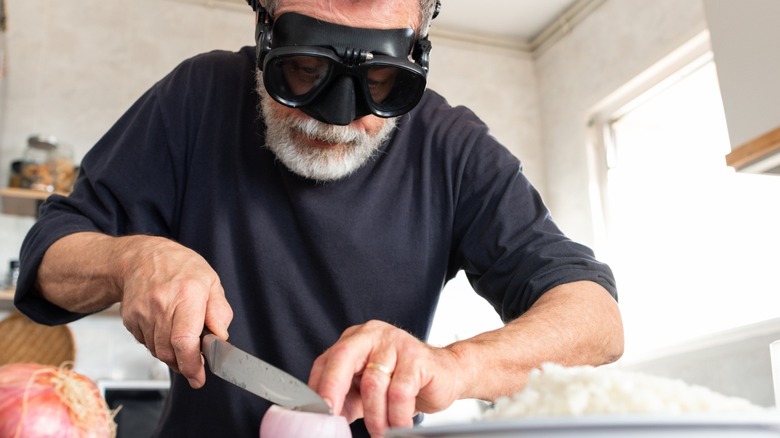
If you'd rather quit crying over onions by keeping the propanethial S-oxide out of your eyes, there are several foolproof ways to do that. You can, for instance, cut your onions near a fan that's positioned below eye level. This helps blow any of the compound away before it gets anywhere near your eyes, and has been found to be a fairly effective method. If you don't mind looking a little silly, some people swear by holding a slice of bread in your mouth — not against both ears like "an idiot sandwich," as Gordon Ramsay might say (via YouTube) — while cutting onions. The idea is that the bread soaks up the propanethial S-oxide floating its way up, so keeping it at mouth-level effectively prevents it from reaching your eyes.
For a more equipment-oriented solution, wearing a diving mask can help, or you can try using onion goggles. This extremely specific piece of eyewear uses a foam layer to block the tear-causing compound from reaching your eyes. The only catch is that, as with any other types of goggles, some pairs don't fit well over eyeglasses, making this tip more reliable for the 20/20-vision set. Whichever method you choose, it should help stop the tears from flowing so you can make food, such as Gordon Ramsay's espresso-caramelized onions, in peace.