

Why Fried Okra Is Better When Cut Like Fries And Not Circles
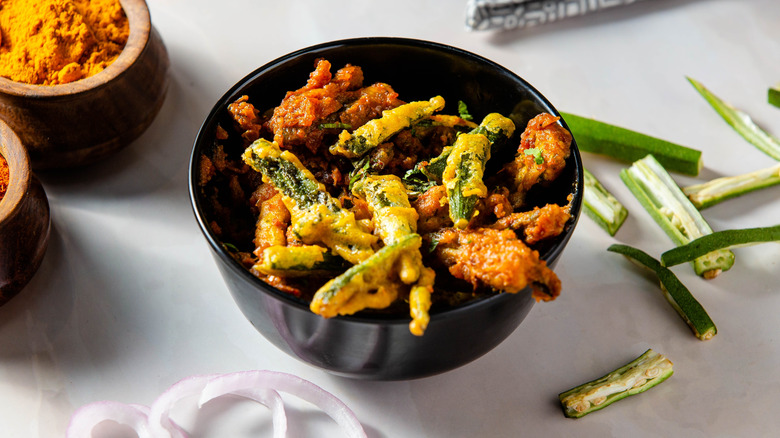
Fried okra is a Southern dinner table staple for a reason. It's crisp, flavorful, and super-easy to make at home. Best made fresh and consumed immediately, it requires minimal prep and seasoning. Eat it plain or serve it with a simple creamy sauce with a bit of zing, like a good rémoulade, comeback sauce, or the best store-bought ranch you can buy. Really, the most important decision comes before you even preheat the frying oil.
How you cut okra is one of the main factors that influence how the dish turns out. The most popular option seems to be slicing it into circles or coins, but you can also slice it lengthwise like fries — and that might actually be your best option. Bob Bennett, head chef at Zingerman's Roadhouse in Ann Arbor, Michigan, tells Chowhound exclusively why certain shapes of okra are more suited to frying than others. "I am a fan of long strips, as you get a good amount of skin and it turns into easy finger food," he says, before delving into the details of making the perfect fried okra.
Why you should be cutting your okra lengthwise
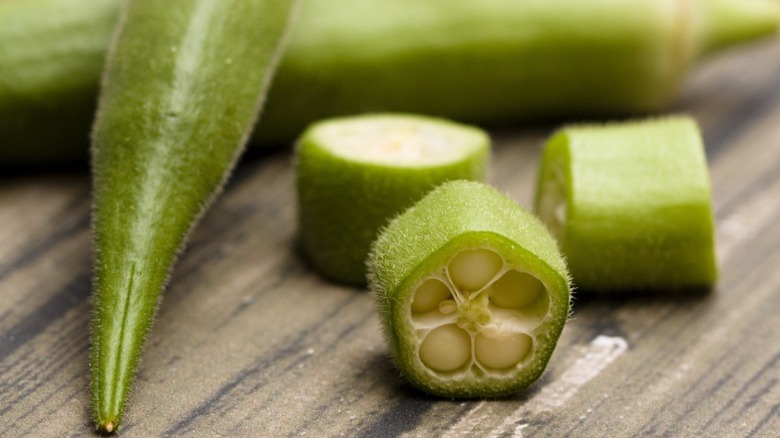
Traditional discs work well enough as a plain side dish, but strips are easier to pick and dip, making it a fantastic finger food for Southern-style potlucks too.
The shape also significantly influences the texture. When cut into rounds, fried okra has a soft interior since nothing crispy is able to stick to it, which is exacerbated if you ever try to fry okra whole. However, this issue disappears when frying okra that's cut into strips, and you get evenly crunchy pieces as long as the strips aren't too thick. Cut slim okra down the middle into halves, but thicker ones should be cut multiple times to make thinner strips. Again, the goal is to create as much surface area as possible for crispy crumbs to stick to.
But when you're talking about okra, there's another issue you have to bring up: sliminess. "I do feel like [cutting them lengthwise] helps to ease up some of the film that comes from the inside of the okra," said Bob Bennett. That's an important point since the slightly slimy film inside okra can put some eaters off the vegetable. Frying lengthwise cuts is the best way to eliminate the slippery texture.
Pro tips to make perfect fried lengthwise-cut okra
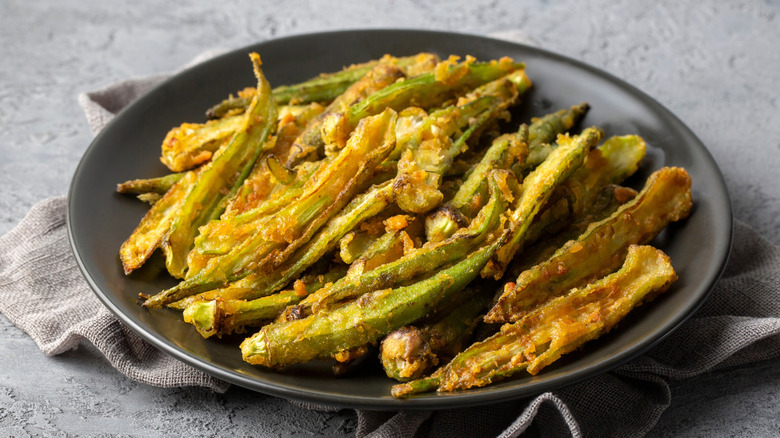
The process of crumb-frying okra is just as important as the direction you cut it. "I recommend cutting it right before you fry it. Letting it sit will let the inner film release," advises Bob Bennett. For maximum crunchiness, Bennett says cornmeal is a must. In fact, to fry it the Southern way, the dry breading mixture should be predominantly cornmeal with only a little bit of flour to bind everything together and help the cornmeal adhere. And don't forget to season the dry mixture to infuse flavor evenly.
After that, a dunk in either egg wash or buttermilk followed by a toss in the dry mixture of cornmeal and flour, and a dip in a 350-degree Fahrenheit fryer is all that's needed. But frying okra requires a careful eye since the vegetable cooks slowly but burns quickly. Here, too, cut is important. The thicker the piece, the longer it takes for the insides to cook and subsequently crisp up. If it takes too long, the outside might start burning before the inside cooks. Remember to fry in batches so every piece cooks evenly and the temperature of the oil doesn't fall too much when you add more okra.