

Mark Bittman's Chicken Tenderizing Hack Starts With A Boozy Twist

Renowned food journalist and cookbook author Mark Bittman knows an inordinate amount about an inordinate array of foods. As a weekly New York Times food columnist for over a decade, his expertise runs the gamut of the home cooking repertoire. His most popular coverage ranges from blending gazpacho to cooking steak to frying doughnuts at home. His encyclopedic food knowledge is showcased in an acclaimed line of cookbooks entitled "How to Cook Everything," which are modern primers for the home cook.
When it comes to the endless ways of cooking chicken, Bittman's advice is to poach your protein in white wine for moist and juicy results. This trick is perfect for preparing a meal with any leftover white wine, and you don't need anything fancy to do it. What matters is the flavor you're going for in your chicken. The type of wine used will shift the flavor notes of the chicken, and the acidity will help tenderize the meat as it cooks.
Give your chicken the white wine treatment
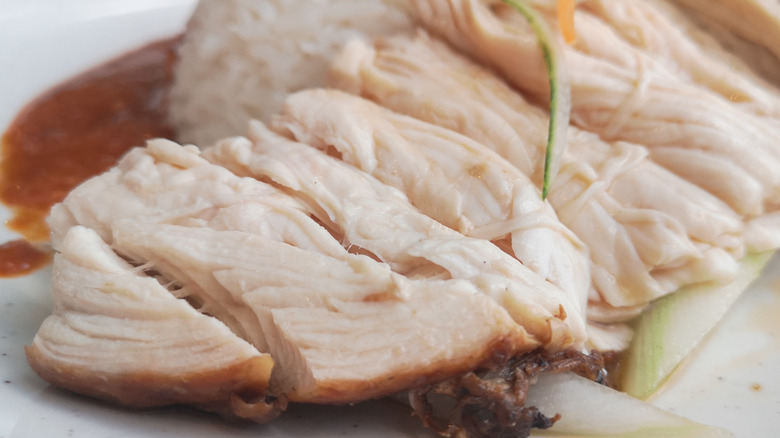
While it is fairly common to deglaze a pan with white wine when building a sauce, poaching chicken that tastes good may be more unfamiliar territory. Thankfully, all this technique entails is bringing your ingredients to a simmer. Cover the chicken in white wine, and allow it to simmer on the stovetop until the thickest part of the meat reaches an internal temperature of 165 degrees Fahrenheit. Avoid letting it boil on high heat. Instead, set the stove's heat to medium-low or lower — this is the key to poaching chicken without it becoming rubbery.
It may take a lot of wine to coat an entire chicken, so you may want to add broth to the mix. White wine with either chicken broth or water makes sense here, but red wine and beef broth create rich flavors as well. Poaching chicken on the stovetop also allows you to easily introduce aromatics like garlic and herbs into the equation. In addition to virtually guaranteeing tender meat, the poaching liquid can be used as the base for soups or to cook grains like rice or quinoa. Poaching is not labor-intensive, and it results in juicy, tender meat that is easy to shred for casseroles, slice over a salad, or serve with roasted vegetables. However you intend to put Mark Bittman's chicken poaching tip to work, the uncooked chicken in your fridge (and your resulting weekday meals) will have him to thank.