

What Cleans Your Kitchen Better: Lemon Juice Or Vinegar?
We may receive a commission on purchases made from links.
Finding the right kitchen cleaner can be tough. When Chowhound ranked 10 all-purpose kitchen cleaners, they ran the gamut from overtly chemical-smelling (hello, Fabuloso) to more subtle (and sustainable) options like Mrs. Meyers. However, for a 100% all-natural cleaner, many people turn to lemon juice or vinegar to keep their kitchen sparkling.
Chowhound asked Alexis Rochester, chemist and creator of Chemistry Cachet, for her take on which one is the better kitchen cleaner. After confirming that both lemon juice and vinegar are viable options, thanks to their natural acidity (lemon juice contains citric acid, while vinegar is primarily acetic acid), Rochester cautioned, "Lemon juice also contains natural sugars, which can leave a more sticky residue compared to vinegar when used for cleaning." For this reason, Rochester says, lemon juice is best for areas you intend to rinse after cleaning, like faucets or cutting boards. But for most other applications, from stove tops to sinks to glass, she recommends vinegar.
Of course, there are several cleaning products you should never mix, like bleach and ammonia. And in fact, you should avoid mixing both lemon juice and vinegar with bleach, as this can produce chlorine gas. However, it's totally fine to mix lemon juice and vinegar. In fact, Rochester says, "I use a DIY mix of lemon juice and vinegar to tackle hard water buildup on faucets, and it works even better than using either one alone." Because the two contain different acids, she explains, they have different, complementary strengths when it comes to cleaning.
When to avoid lemon juice and vinegar
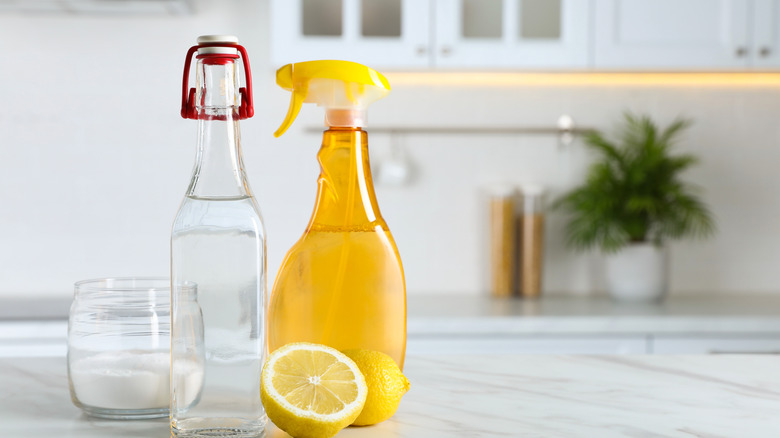
We've established that lemon juice and vinegar can be effective cleaning agents, but that doesn't mean they are helpful in every situation. In fact, they can do a lot of harm if you use them on the wrong surface — like natural stone. "Materials such as marble, quartz, and granite are sensitive to acids, which can etch, dull, or permanently damage their finish," says Alexis Rochester. Marble in particular is high-maintenance, as it is prone to both scratching and staining. If you do have natural stone countertops, look for a cleaning product that is specifically intended for stone, like Granite Gold Daily Cleaner.
You'll also want to keep your lemon juice and vinegar away from grout, says Rochester, explaining that repeatedly exposing grout lines to acids over time can weaken and erode them. A better way to clean grout is with either a specific grout cleaner like Clean-eez Grout-eez or a DIY blend of baking soda, hydrogen peroxide, and dish soap. That said, don't forget the undeniable cleaning power of old-fashioned lemon juice and vinegar for many other kitchen applications.