

Miyazaki Mangoes Might Be Some Of The Most Expensive Fruit In The World
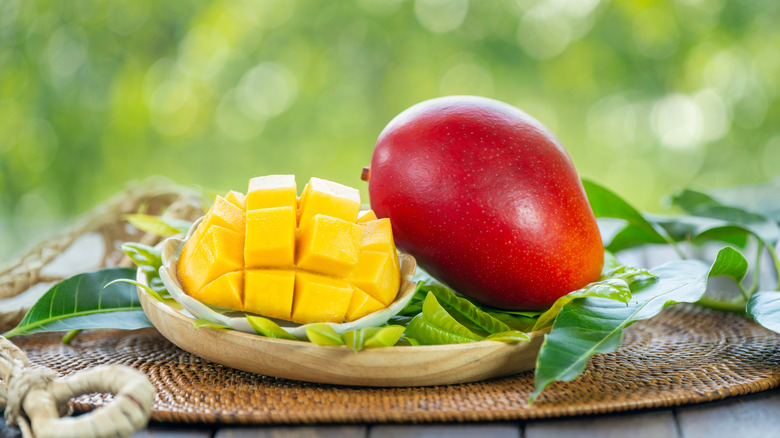
If you thought dropping $19 for a single strawberry at Erewhon was absurd, we've got some news that might have you clutching your pearls. Behold, Miyazaki mangoes hailing from the Miyazaki region of Japan's Kyushu Island that sell for nearly a whopping $4,000 a pair! What exactly are Miyazaki mangoes, you ask? They are a mango of the Irwin variety, a category that stemmed in sunny Florida in the mid-1900s and now flourish across the globe. Once perfectly ripened, the skin of Miyazaki mangoes turns bright red and encloses a vivid orange flesh that is reportedly very sweet and juicy, offering a creamy mouthfeel without being fibrous like some other varieties can be. What's not to like? Besides the price point, that is.
The good news is that not all Miyazaki mangoes cost more than a month's rent. It's particularly the Taiyo no Tamago (translating to Egg of the Sun in Japanese) mangoes that are elegantly packaged and presented as a luxury product, available for $4,000 a pair. For a slightly more budget-friendly option, you should still expect to spend about $50 for a single non-Taiyo no Tamago Miyazaki mango.
To get a close enough taste of a Miyazaki mango, you can buy Irwin mango trees in the United States. However, they technically wouldn't qualify as Miyazaki mangoes unless grown in that prefecture. The region is particularly suited to support fruit production, owing to abundant sunshine, warm weather, and optimum rainfall. Some of the most popular fruits from the region include sweet lychees and citruses like kumquats. It wasn't until 1984 that mangoes started to be produced, which have now garnered status as a luxury item far beyond the means of most.
What makes Miyazaki mangoes stand out and how to enjoy them
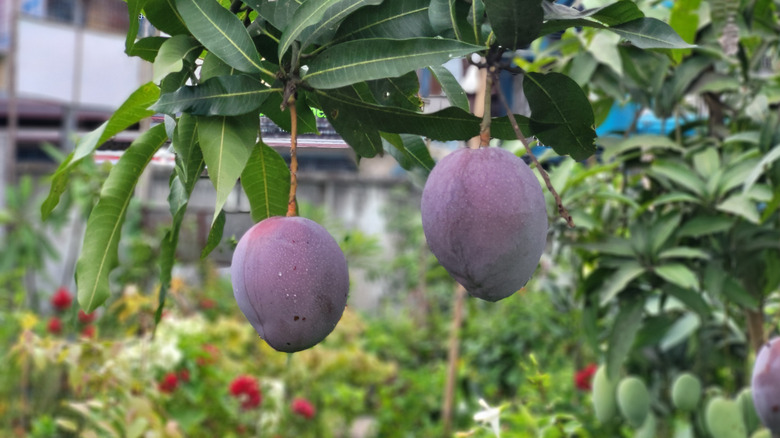
Your mind might be boggling over why a pair of produce costs thousands of dollars. Better believe you're not alone. It is an exorbitant price to pay, but perhaps that warrants a brief pause to delve into what makes Miyazaki mangoes so special. Nailing down the production method of these mangoes took multiple attempts, and the tried-and-tested approach of growing Miyazaki mangoes is a deeply involved process wherein every fruit receives bounds of tender loving care.
They are grown in greenhouses where each fruit is secured by strings close to the ceiling to receive maximum sunlight. The individual fruits are also wrapped in a mesh to protect the fruit from falling and bruising in case its increasing weight causes breakage. Some growers even attach a reflective material to the bottom of every mango to ensure uniform ripening and color. That's not where the attention to detail stops. Despite the meticulous efforts, not all Miyazaki mangoes will meet the standards for being sold for thousands of dollars. To qualify as a prized, bank-breaking Taiyo no Tamago, there is a specific set of criteria to be met, including its visual aesthetics, size, weight, and sugar content.
If you happen to be in Japan and decide to splurge on a pair, these mangoes are easy to peel and cut. Save the peels to make the tangy condiment that is chutney, and cut them using your preferred method to relish the golden glory of Miyazaki mango in its purest form. You could also whip up a three-ingredient mango sorbet that will put all other mango sorbets from the most elite, gourmet restaurants to shame. Whatever you do, just make sure to savor every little ounce of the fruit.