

10 Unique Types Of Watermelon You'll Want To Taste This Summer
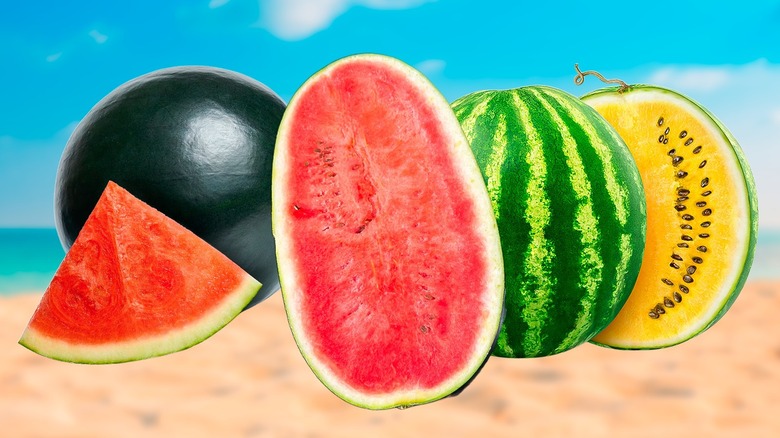
Nothing says summer like a juicy slice of watermelon. If you've only ever had a store-bought watermelon, it's time to check out some of the unique and tasty varieties you can find at farmer's markets around the world. From traditional bright red to orange to yellow, there are limitless watermelon varieties. Some are seedless, while others are full of seeds. Some, like the Citron Red Seeded watermelon, have seeds you can roast like pumpkin seeds.
While a traditional red watermelon is sweet and juicy, yellow watermelons are known to be even sweeter, offering a honey-like flavor. Some of the watermelons on our list come in small, round sizes, while another variety is in the Guinness Book of World Records for being the largest watermelon in the world. We've even included the ancestor of today's watermelons that dates back to ancient Egypt.
You probably won't find these sitting on store shelves at the local supermarket. You'll need to check out small local farms, farmers' markets, and farmstands. If you have a green thumb and plenty of space, you can try your hand at growing them yourself. All of the seeds from the varieties on our list can be bought online.
1. Lemon Drop Watermelon
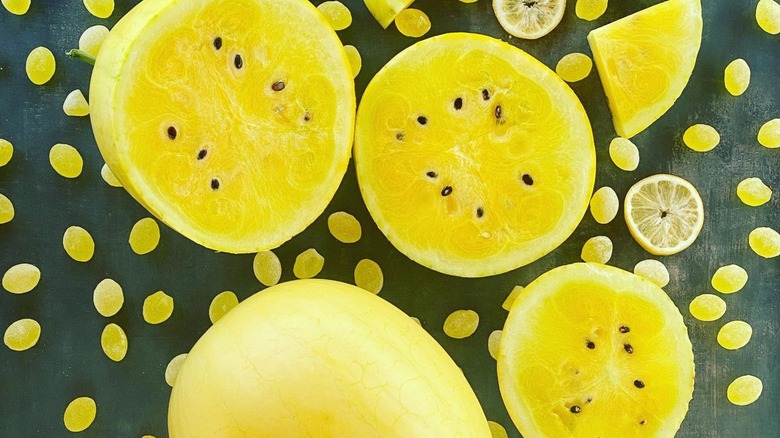
Lemon Drop watermelon is unique in that other watermelon varieties may have yellow flesh, but still retain a green rind. In this variety, both the flesh and the rind are yellow. Not to be confused with Lemon Drop melons, which are a variety of muskmelon, this variety is a golden watermelon. Lemon Drop watermelons get their name not only from the vibrant yellow color, but from their sweet and almost candy-like taste.
This variety is a small watermelon, only reaching about one to two pounds. In addition to its small size, it's a shocking bright yellow. Yellow watermelons lack lycopene, which makes plants like watermelons and tomatoes red. Yellow watermelons tend to be sweeter than red varieties with a hint of honey flavor. You may not be able to find lemon drop watermelons in your local supermarket or big box store. Look for them at farmers' markets and farm stands. If all else fails, you can buy seeds and grow your own.
2. Moon and Stars Watermelon
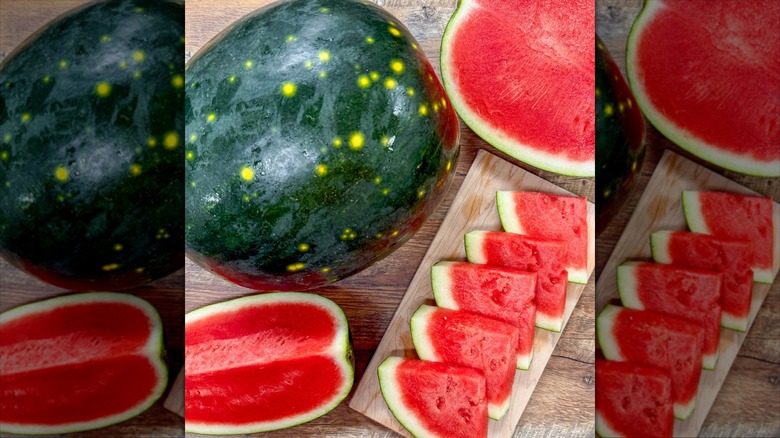
Moon and Stars watermelons are named after their dark green rinds that are speckled with a pattern of different-sized yellow spots, making them appear like the night sky. This heirloom variety can get pretty big, ranging from 20 to 50 pounds, and about 15 inches in length. There are several variations of the Moon and Stars watermelons, and depending on the variety, the flesh can be red, dark pink, or yellow. It's a very sweet watermelon, containing high levels of sugar. The variety first showed up in 1920, released by the seed company, Peter Henderson & Company. It almost fell into obscurity until seed preservationists revived it in the 1980s.
Today, it may be hard to find at the grocery store, but it's popular among small farmers and home gardeners. If you'd like to try this sweet and juicy variety, keep an eye out at your local farmers' markets and farm stands, or try growing it at home from seed. Home gardeners have reported success with this gardener on Reddit saying, "My first Sun, Moon & Stars Watermelon ripened in December! Delicious, delicate flavor. 10/10 will grow again."
3. Orangeglo Watermelon
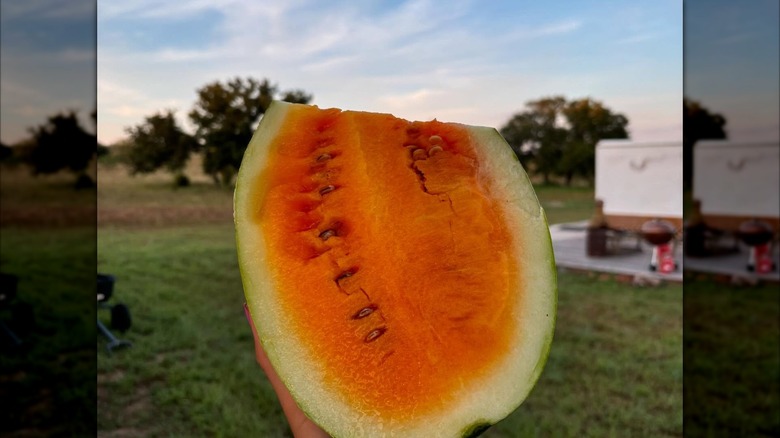
Neither red nor yellow, this unique watermelon variety has bright orange flesh. Orangeglo watermelons are an heirloom variety that was first introduced in Poolville, Texas, by the Willhite Seed Company. What does an orange watermelon taste like? According to Mother Earth News, it depends on the person tasting it: "Some say it tastes like cantaloupe, others claim mango, and still more will insist that it is a combination of pear and papaya." Mother Earth News also described it as pumpkin colored with a "sorbet-like texture." This Redditor said the Orangeglo variety was "the best watermelons I have ever tasted. They were growing in the Arizona sun, which they loved ... they turned out very sweet and tasted like a watermelon crossed with some of the floral aroma of butternut squash."
Yet another flavor profile comes from the seed company, Hoss. Its description says it's "not as sweet as some," but that it has "an extremely refreshing, almost tropical flavor that we've never tried before." You'll probably only find this heirloom variety at farm stands and farmers' markets. Your other option is to buy a seed packet and grow your own. According to Hoss, this is a pest-resistant watermelon that's great for beginners.
4. Black Diamond Seedless Watermelon
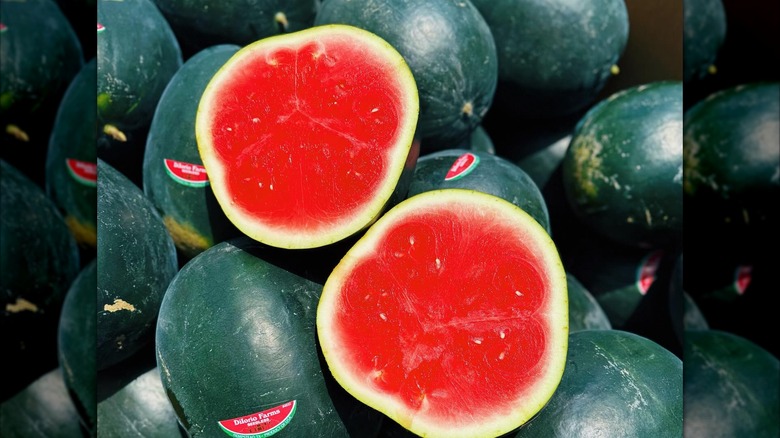
Unlike some of the other unique varieties on our list, you might be able to snag a Black Diamond seedless watermelon at your local supermarket. We were able to find them for sale at our local grocery store for $6.99 each. Although the ones we saw at the grocery store were smaller, this variety can get enormous, growing 20 feet long and weighing up to 50 pounds. It's named for its dark rind, which, it's not true black, but has a striking greenish-black hue. When you cut open the dark rind, you will find a bright red interior.
These heirloom watermelons are popular for both home gardeners and commercial farms alike for their large size and sweet taste. You can start looking for black diamond watermelons grown locally towards the end of summer. They have a long growing season and don't mature early. One person on Reddit also spotted the variety in their local store, with one commenter saying, "Black diamond is THE BEST watermelon. Hard to find so grab it while you can."
5. Buttercup Yellow Melon
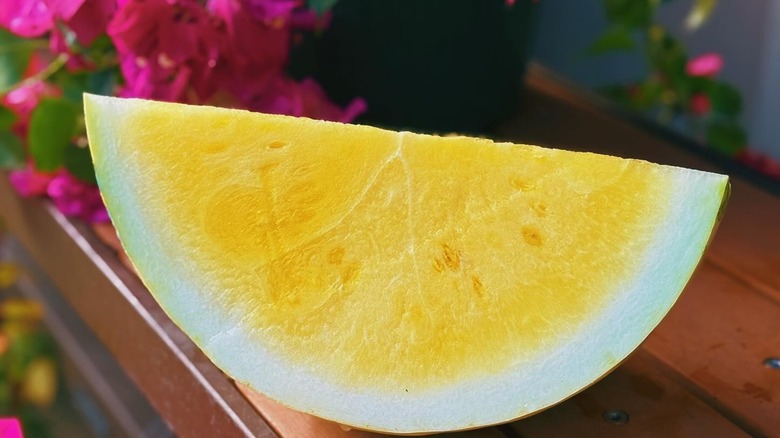
The Buttercup Yellow Melon has a lemon-yellow flesh with a green rind. This seedless variety has been around since Dr. Warren Barham used hybrid seed production to introduce it in 1999. The gardening website, Gardening Know How, describes the watermelon as "crisp and extremely sweet." Buttercup Yellow Melon is going to be sweeter than your average red watermelon. The melons are round and weigh about 14 to 16 pounds.
This is one of the rarer watermelons, but worth it if you can find it. You can look for buttercup yellow melons in farmers' markets and farmstands. However, you may need to grow it from seed to have one for yourself. Like all seedless watermelons, Buttercup Yellow Melons need to be grown with a pollinator, which should come with the packet of seeds. If not, you can purchase it separately. A yellow watermelon's extra sweetness makes it perfect for savory recipes, such as in a watermelon salad with feta. Although these tips for a watermelon salad were meant for a red watermelon, this yellow variety would be a great substitute.
6. Allsweet Watermelon
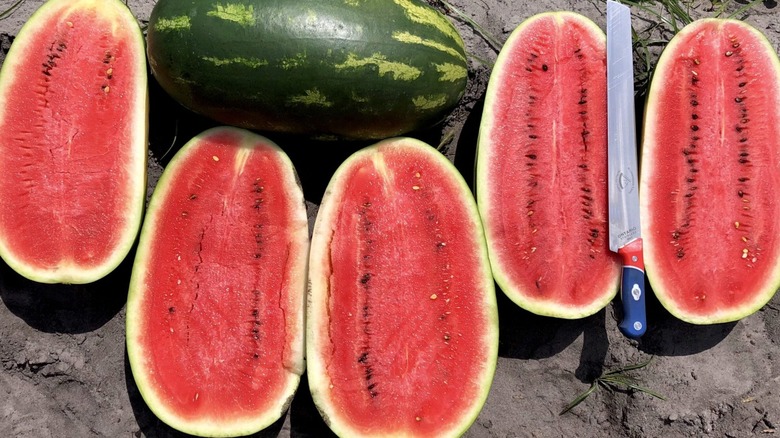
These are large oblong-shaped watermelons that can get up to 30 pounds. Allsweet watermelon is an heirloom variety that contains small, black seeds. Heirloom seeds are typically passed down from generation to generation, providing a quality and consistent fruit. The flesh is a traditional, bright red, and the rind is dark green. Although it contains seeds, they are said to be very few.
Like the other unique varieties on our list, you can be on the lookout for Allsweet watermelons at farmers' markets and farmstands. However, to be sure you get to taste one this summer, you may need to grow it yourself. Since this watermelon contains seeds, you wouldn't need a pollinator to grow it. One seed reviewer said of the Allsweet, "I've planted this melon the past two years. Seeds have a high germination rate. Vines are healthy, deep green color, and produce many heavy melons. My largest weighed 28lbs. The flavor is incredibly super sweet. I will be planting this variety again this coming season."
7. Carolina Cross Watermelon
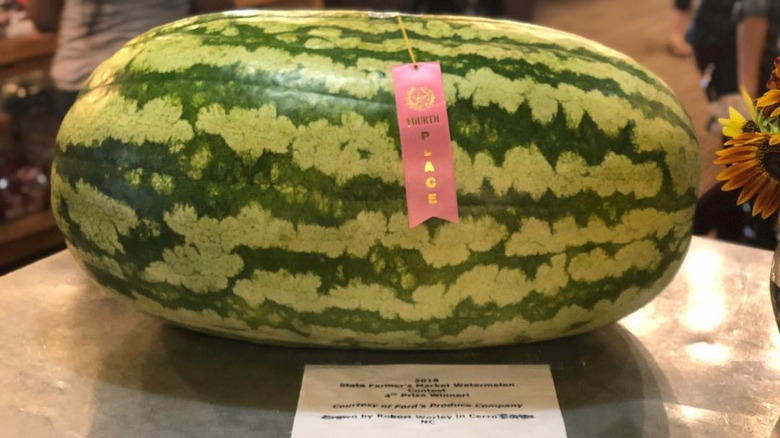
The Carolina Cross watermelon is a massive variety. This watermelon is one of the impressive melons you might see at a state fair competition. It can reach anywhere from 50 to 200 pounds. It's possible it can get even larger than the seed sellers' report. One gardener on Reddit showed off his Carolina Cross, which was a whopping 225 pounds. However, that's not the limit — the Carolina Cross has the distinction of being in the Guinness Book of World Records. It was grown by Chris Kent of Sevierville, Tennessee, and weighed an unbelievable 350.5 pounds.
Look for this variety at farmers' markets and farmstands if you want to feed a crowd. You'll likely have enough leftovers for watermelon salads, soup, or other watermelon recipes. You aren't likely to find a Carolina Cross at your local supermarket. Carolina Cross watermelons are described as having a very sweet flavor with a thick rind. The thick rinds make it easy to transport if you're off to the state fair competition.
8. Jubilee Watermelon
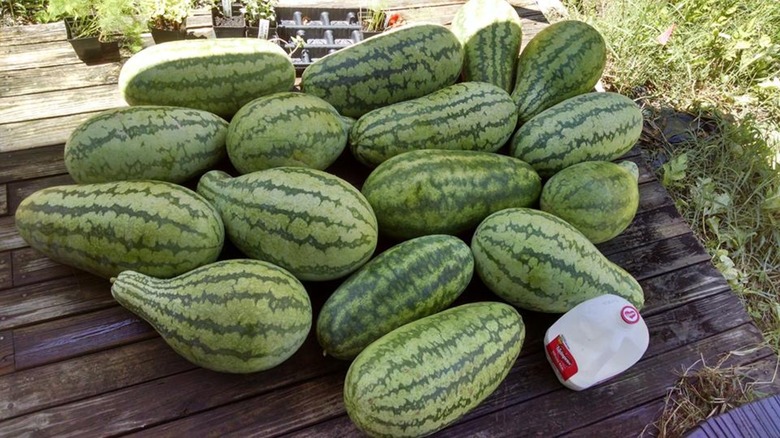
The Jubilee watermelon is a traditional picnic watermelon that comes in an oblong shape. The flesh is bright red, and the rind has dark green stripes on a lighter green background. Jubilee is known as a sweet and flavorful watermelon. You might be able to find a jubilee in your local grocery store, although it's not as common as some of the other seeded, oblong varieties. Jubilee watermelons can get pretty big, growing 2 feet long and weighing around 40 pounds.
This heirloom variety was developed in 1963 by the Florida Agricultural Experiment Station. The Southern Idaho Landscape Center describes the Jubilee as "finely-textured" with "bright pink-red flesh and deliciously sweet taste." If you'd like to try growing the Jubilee from seeds, look for the "improved" variety, and be sure you have plenty of growing space for the vines. The improved seeds have been developed to be disease-resistant to Fusarium Wilt and Anthracnose. These are both fungal diseases that can destroy watermelon crops.
9. Desert King Watermelon
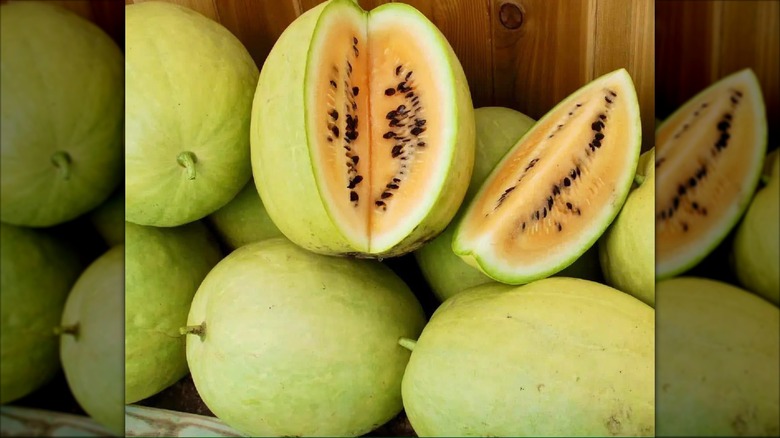
The Desert King watermelon is named for its ability to resist drought. The light green colored rind is also resistant to sunburn, and the plant can tolerate much drier environments than most watermelon varieties. The flesh is a yellow-orange, and it is said to be very sweet and juicy. The Desert King is an heirloom variety and grows to about 20 pounds with a round to oblong shape. You might be able to find Desert Kings in farmers' markets and farmstands, especially in dry and hot regions, but you're probably better off growing your own from seeds.
One issue with harvesting the Desert King from your garden is knowing if the light green rind is ripe or not. One gardener on Reddit explained, "This one happened to be a little bit overripe, so it was sweet but a bit mealy. Previous ones that were ripe were crisp and delicious, some of them a bit more sour than a standard watermelon. Biggest issue with this variety however is it's hard to tell when it's ripe so a significant amount were like cucumbers."
10. Citron Red Seeded Watermelon
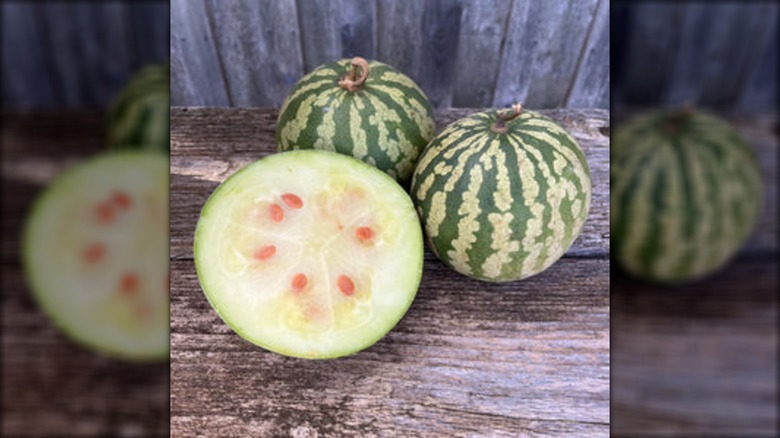
This unique watermelon is much older than many of the newer varieties on our list. Citron Red Seeded watermelons are native to Africa and thought to have come from the Kalahari Desert. This early watermelon variety has been traced back to early Egypt. Don't expect traditional, flavorful and sweet flesh if you bite into a slice of a Citron Red Seeded watermelon. It may look like a typical small watermelon on the outside, but the flesh is pale with almost no flavor. However, the Citron Red Seeded watermelon is made for pickling, and making jams or jellies. They have high amounts of pectin, which gives jelly and jams their gel-like consistency. The flavor of the watermelon is said to be enhanced with cooking.
One gardener on Reddit described their experience with growing this variety, "The cooked melons have a texture very similar to the apples in apple cobbler and take on the flavor of whatever fruit or spices you add to them (I used lemon juice). There's a lot of sugar in this stuff, so I'm thinking the next batch will get turned into pickles or used in stir fry." The person went on to say that they also tend to produce several seeds, which can be saved for planting or roasted for eating.