

The Highly Desired Vintage Collectible That's Probably In Your Grandma's Kitchen
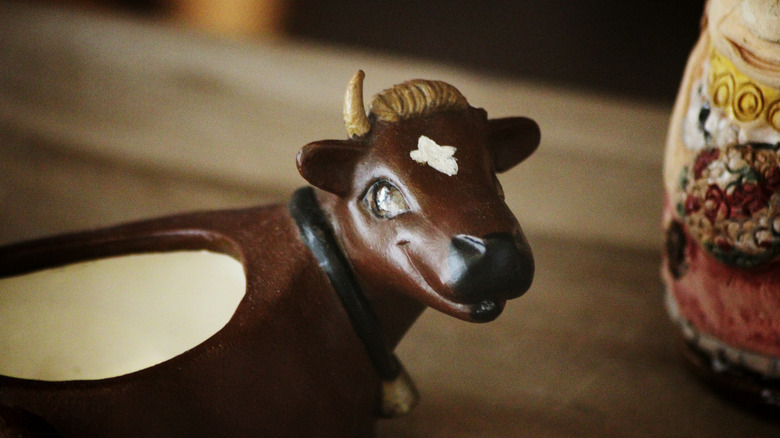
The plot of P.G. Wodehouse's comedic novel, "The Code of the Woosters," revolves around a silver cow creamer. While side characters and silver collectors battle it out for a chance to own the piece, protagonist Bertie Wooster fails to see the appeal. And yet these whimsical collectibles have endured since their invention in mid-1700s England. If you're unfamiliar with the cow creamer, it's more or less what it sounds like: a creamer shaped like a cow. Pour your cream into a hole in the cow's back, then tip it when you're ready to add the cream to your cup so that the cream streams out the bovine's mouth.
While some cow creamers were made of silver, they are more commonly made of porcelain (no doubt in part because porcelain is easier to clean), and can be either painted or plain. They are, in the words of the Culinary Institute of America, "udderly charming" either way. And no matter what your kitchen decorating style may be, whether you can't wait for vintage trends to come back or prefer sleek and chic, you can find a cow creamer to suit your taste. From the hand-painted, realistic beauties produced in Staffordshire, England, over a century ago, to cartoonish, bug-eyed creamers from the 1950s, to the minimalist ones sold by Williams-Sonoma for just under $40, there is a cow creamer for you. In fact, there are enough to start a collection.
Collecting cow creamers
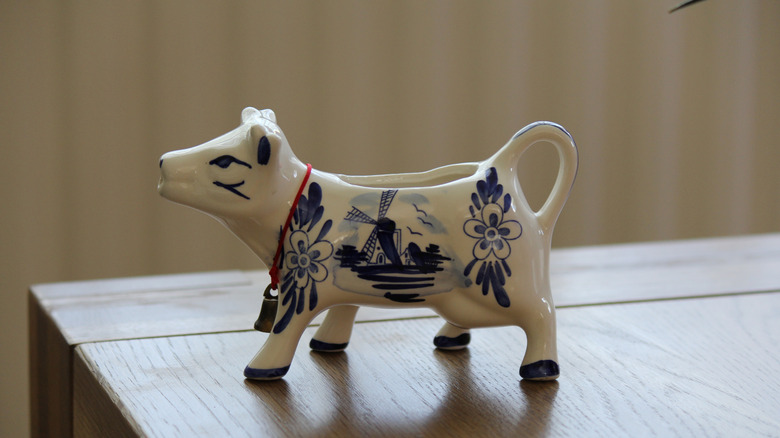
When it comes to collecting, there are a few things to keep in mind, whether you're collecting vintage lunch boxes or you found yourself with some valuable salt and pepper shakers; Or, in this case, cow creamers. First, consider the purpose of your collection. Are you hoping to amass a truly valuable collection? The most rare cow creamers you can find? Or just ones you find amusing?
Of course, maybe your grandma already has a cow creamer, or even a collection. Take the opportunity to ask about her creamer(s) and share a pot of tea together. Even if you aren't lucky, you'll have spent a pleasant afternoon. Then, if you are on the hunt for widely-acknowledged treasures, you'll want to make sure your purchases are truly of value. You don't want to end up on Antiques Roadshow someday convinced you've got a cow creamer worth thousands of dollars, only to find out it's a deceptive knock-off.
The first thing you'll want to do before purchasing a piece is to check for its maker's mark. Do a little research into figuring out who made it and how expensive their other pieces are. If it's vintage items you're collecting, you probably won't be buying them from the original maker. If you're purchasing an item from a site like eBay or Etsy, check the seller's rating and reviews. You don't want to end up with a fake on your hands.