

Sushi Looks A Lot Different In Australia
CORRECTION 8/12/25: A previous version of this article stated chef Eric Rivera operated a Japanese restaurant. Rivera had plans to open an izakaya-inspired restaurant, Coqui, serving Puerto Rican cuisine.
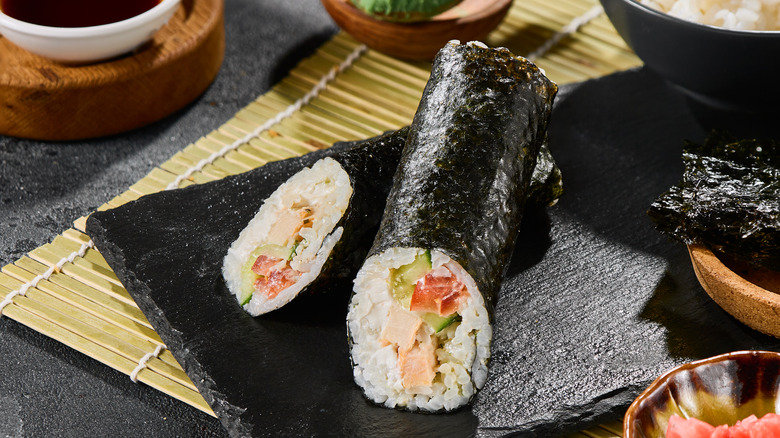
If you're visiting Australia and in the mood for sushi, the restaurants you'll find and the rolls they serve might feel a bit different to what you'd get in the United States ... or Japan. Australian sushi commonly takes the form of a hand roll (a type of maki roll). This is because the rolls aren't usually sliced, they're served as a single long piece of sushi, with a larger piece of nori encasing the rice and fillings. There's an emphasis on the "hand" in "hand roll" here, since you wouldn't eat these with chopsticks; it's very much a grab-and-go bite that you'd chow down on as a handheld snack. If you're wanting soy sauce, no problem: It's served in a small plastic fish-shaped bottle for you to drip onto the sushi roll as desired.
A second key difference with Australian sushi compare to Japanese or American style is that their fillings come in a different range of options. Sure, you can get the classic salmon or spicy tuna, but fillings that go well beyond traditional sushi options are just as common. These can include elements of other Japanese dishes like sweet, saucy teriyaki beef or chicken, tempura shrimp, or even decidedly non-Japanese ingredients like Peking duck.
Is Australian sushi real sushi?
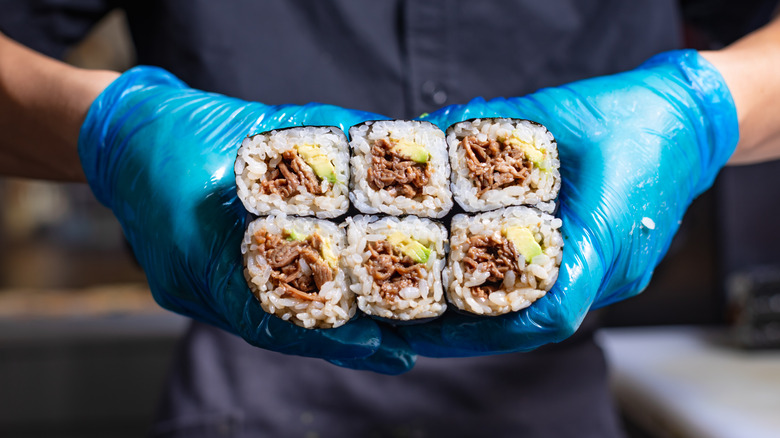
In Australia, this type of long, handheld sushi roll is fairly normal. While handheld rolls do exist in Japan (mostly as convenience store food), Australian sushi is pretty far removed from what would be considered sushi in Japan. So naturally, the Aussie take on the dish has caused some controversy.
The most notorious case of this went down in New York, where an Australian woman, bothered by the lack of grab-and-go sushi options in the city, decided to open an Australian-style sushi spot named Sushi Counter. While the owner noted that her offerings were well-received, especially by Australians living in the city, she was blasted on social media. One critic, chef Eric Rivera, accused her eatery of engaging in cultural appropriation. She was then hit with online hate and fake 1-star reviews.
The menu at Sushi Counter resembles that of Australian equivalents, with teriyaki, cooked tuna, and miso eggplant among the rolls served. Australian-style sushi represents a form of cultural diffusion, as it organically traveled to Australia and then evolved into another form. In that light, Australian sushi isn't "authentic" Japanese sushi, but its own separate thing.