

This One Simple Step Will Make Your Pasta Dough Much Easier To Roll
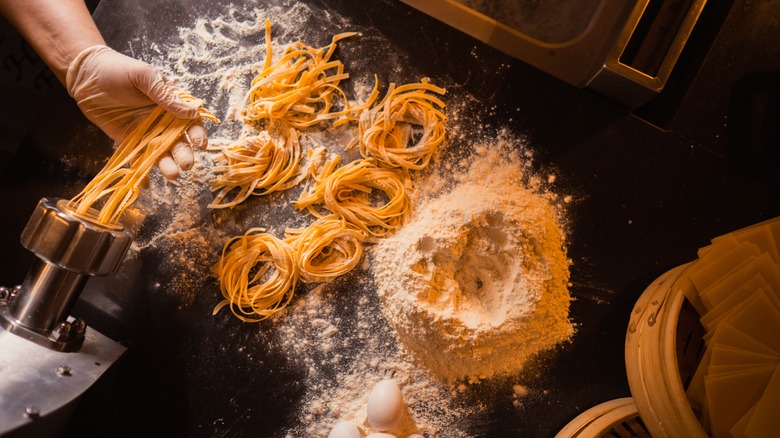
If you've ever been half through trying to roll out pasta dough and your arm suddenly feels like it might fall off, you're going to want to keep reading. It turns out, the secret to silky and rollable dough isn't just in the making of the flour or how you knead it — it's in the wait time too. Chowhound spoke exclusively with Derek Piva, executive chef at The Restaurant at Tu Tu' Tun in Oregon, who explained that resting your dough is not only good practice, it is "essential." It's the important step you can't skip when making homemade pasta, no matter how eager (or hungry) you are.
If you skip the important rest period between making and rolling your dough, the gluten in your will stay tight, and then when you go to roll it, it'll just spring back uncooperatively. "Letting it rest allows the gluten to relax," Piva says. It makes the dough more elastic, smooth, and much easier to handle.
According to Piva, just 30 minutes at room temperature should be enough to do the trick, just make sure it's tightly wrapped so it doesn't dry out. And if your kitchen's very hot or you're making the dough ahead of time, you can chill it in the fridge, but it's important you bring it back to room temp before rolling. The truth is — this resting time isn't exciting nor will it make you look particularly skillful (so if you were looking to impress, you'll have to pull something else out of the bag for 30 minutes) but it is a very important step.
How to roll pasta like a pro
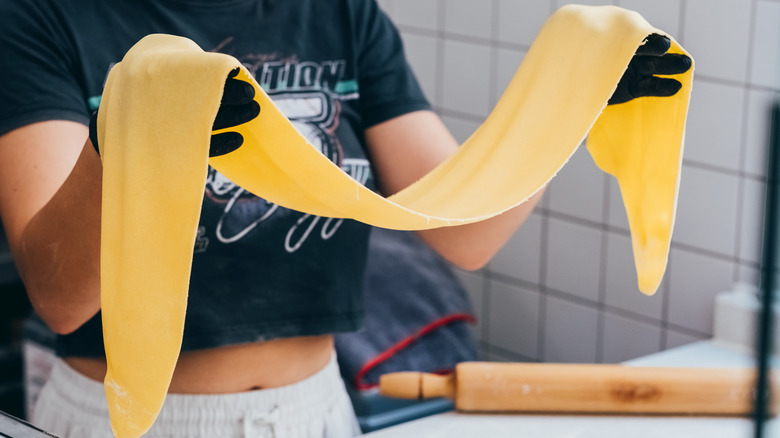
Once you've given your dough the time it needs and deserves, roll it out with precision and care. The key here, Derek Piva tells us, is to start off slow with thick dough, then gradually thin it out. "Don't rush the process," he says. "Start on a thicker setting and work your way down gradually. The dough should feel elastic but smooth."
If you're using a pasta machine, resist the urge to jump to the lowest setting right away, because that's just begging for a lasagna with uneven sheets. Instead, take it down one notch at a time, dusting with flour only if it starts to stick. And if instead you're rolling by hand, flip it occasionally to keep things even, and again, use flour to stop sticking only when it needs it. There are many rolling pin mistakes that could ruin pasta night, so don't fall victim to them. Remember what you're doing here is slowly coaxing the dough to get it thinner and thinner, so it's meant to be a process, not a result you'll see right away. Patience is key.
And yes, you should absolutely make pasta dough from scratch, it's easier than you think and will lend to much better results. And one last tip: If you're kneading by hand, consider giving your dough a head start by mixing it in a food processor, which will help distribute the egg and flour evenly and will save your wrists. Trust us, you'll need them for rolling.