

The Sparkling Booze You Should Be Using In Desserts

We may receive a commission on purchases made from links.
Champagne and dessert are no strangers to one another. Whether served with a spare but delicious plate of strawberries, or as a complement to a sumptuous cake, the sharp, bubbly taste goes well with most anything sweet. So why not remove the barrier between sweet and fizzy by bringing alcohol to your next dessert? The bubbly beverage makes the perfect addition to many desserts, from truffle to sheet cake. You just need to know how to properly utilize this sharp, sparkling ingredient –– otherwise your attempt at a boozy, sweet fusion may go flat.
Luckily, Chowhound was able to get the scoop (or pour) on how to best incorporate bubbles into baking from Renato Poliafito, author of "Dolci!," a cookbook that centers on the craft of Italian-American baking, and co-owner of Pasta Night, a neon-bright Brooklyn eatery. Poliafito is all for baking with Champagne as long as it has "meaning and purpose" within your dish. So what are the basics of adding this boozy delight to sweets?
Let's start with picking the right bottle. For starters, you might not actually want to reach for an actual bottle of the expensive stuff. As Poliafito says, "Cava or Prosecco will do just fine –– save your Champagne budget for drinking. Preferably in a bubble bath, with regrets." However, there are two caveats for this rule. One, if you're preparing this dish for a particularly fussy and high-brow recipient and two, if you're making "something where the flavor stands out." So dishes where the most prominent flavor is Champagne should actually include the real thing. Still, this is only the beginning of Poliafito's boozy bonafides, so let's crack into the intricacies of sweetening up your booze.
Which wine to use and when

So, let's say you want to add some wine to your cake or whipped cream: What wine should you add to your dish? That all depends on the flavor profile you're hoping to achieve. While on the crisp, pale surface sparkling wines like Cava, Prosecco, and Champagne seem near identical (at least to those unfamiliar with the world of wine), they are quite different. As Renato Poliafito describes it, Champagne is "your elegant, sharp-tongued aunt." The wine variety, which is actually made from black grapes originating from the Champagne region of France, is renowned for its often dry flavor profile, with notes of citrus. It's refreshing but also assertive. It's distinctive and refined. It therefore pairs well with refreshing, simple, distinctive dishes. Think of infusing it into pastry cream for use in a strawberry tart, this will play on the classic fruit and booze combo.
Meanwhile, Prosecco is, according to Poliafito, "the friend who hugs for an awkward length of time –– sweeter, peachy, carefree." For this reason, it will pair well with more indulgent desserts, particularly ones that incorporate stone fruit. It also makes a less expensive alternative to Champagne if you want a similar flavor profile in a dessert. Cava, on the other hand, is a bit more complex. As Poliafito says, Cava is like a "Spanish cousin –– zesty, earthy, smokes clove cigarettes." If you're making a fruity Champagne cake, don't reach for this wine. If, however, you're looking for a wine that adds a little extra oomph to a dessert (think a crisp green apple tart), go for it.
Some sweet ideas for your Champagne dreams
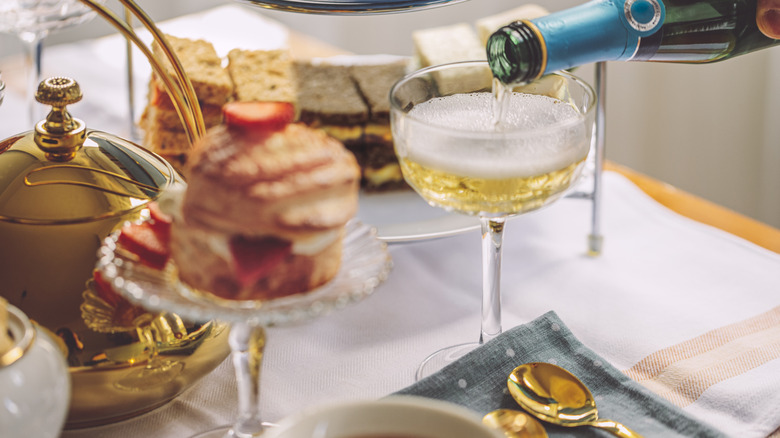
Now, we've thrown out a few, spare ideas for bringing Champagne into your next dessert endeavor, but you may still feel a bit stumped as to where to start. Renato Poliafito suggests "[folding] it gently into whipped cream or sabayon." A wine-infused whipped cream works wonderfully with strawberries for a simple but delicious use for the wine. However, if you have not heard of sabayon before, simply put, it's a sweet, whipped dish made of sugar, egg yolks, and wine. It doesn't have to be made with Champagne, but the sparkling wine will definitely add a distinctive flare.
You don't have to stop there either. You can also add the wine to other dishes, such as cakes, frostings, and truffles. In these cases, when you need a concentrated flavor, you'll want to first simmer your wine until it's reduced by half. This will give you a more distinctive wine flavor without risking the balance of wet to dry ingredients in your recipe. You could also use Champagne extract instead of, or in conjunction with, actual sparkling wine to produce a more definitively "Champagne" flavor. However, it should be noted that this extract won't give you a true-to-life wine flavor. Use it with caution, and remember that for some dishes, you simply must use the real thing.