

This McDonald's Burger Failed So Hard, It Earned The Name 'McFlopper'
The year is 1991. Everyone is doing jazzercise and everything is "low-fat." So naturally, McDonald's thought it'd enjoy a piece of that pie by serving up a new burger: the McLean Deluxe. It was a fat-free, seaweed-and-water-infused "healthy" beef burger that was meant to be revolutionary. But it was not.
The McLean Deluxe came in with massive claims, only to fall short with an underwhelming experience. In fact, McDonald's spent a reported $50 million in advertising trying to convince the world that this thing tasted as good as the regular burgers. Unfortunately, the world had a bite, then staunchly disagreed. It has been described as mild, and almost entirely flavorless. Sales quickly made it apparent that people didn't actually want to feel conscious of health when they're eating fast food, they're just looking for a greasy and fun experience. So not only did the McLean Deluxe flop, it flopped so hard it's now considered one of the worst mistakes in McDonald's history.
Today, the McLean Deluxe only lives on in the roundups of some of the discontinued McDonald's items we're not getting back, alongside other failed icons like Onion Nuggets (yes, really) and the Hula Burger. But the downfall of the McLean wasn't just about its bland taste. It failed because it tried to solve a problem that nobody asked McDonald's to solve.
Lean, mean, and completely forgotten
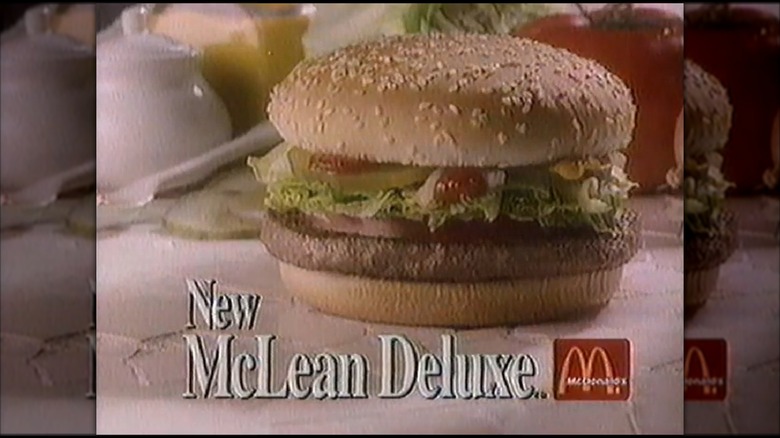
The saddest part of it all is that it wasn't even a terrible burger, not on paper anyway. Despite being a "diet food," it used real lean beef and managed to be a burger that had fewer calories than your average lunchtime salad, which is quite impressive. But ultimately, none of that mattered, because the flavor never worked. With every bite, people were reminded they could've just ordered the best McDonald's burger, according to our ranking: the classic hamburger, and been a lot happier.
By 1996, just five years after appearing on menus, the McLean Deluxe was gone, having earned the unfortunate title of the McFlopper. The fact that McDonald's had thrown its entire marketing muscle behind it with ads running during prime time and magazine spreads praising its almost-fat-free brilliance made the flop even harder. McDonald's had even gone so far as to enlist the help of food scientists at Auburn University to assist with its initial development. It's safe to say that when the McLean was finally pulled, there were no tears. Because this wasn't really a burger — it was a salad in a sesame bun disguise, and it was fooling no one.