

Why SnackWell's Cookies Vanished Completely
We may receive a commission on purchases made from links.
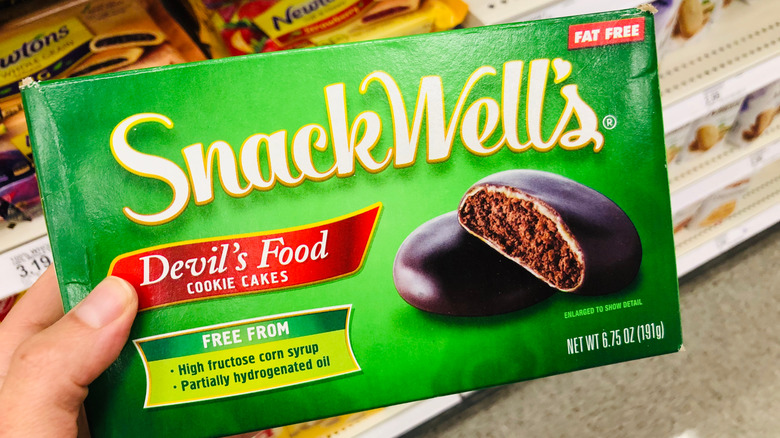
The graveyard of discontinued '90s snacks and sodas is vast and sprawling, but tucked far behind the resting place for OK Soda, the long-forgotten Hubba-Bubba soda, and the beloved but discontinued Dunkaroos are SnackWell's cookies. Consisting of several low-fat cookies, crackers, and snacks, the line is perhaps best known for its devil's food cookie cakes. These snack cakes are iconic, at least to anyone who lived through the 1990s. The shiny, rounded, dark brown surface covered a dry cake interior that was lined (thinly) with marshmallow. During the decade of Nirvana, grunge, and the internet revolution, SnackWell's cookies were not just popular; they were inescapable.
Nabisco first introduced the SnackWell's brand in 1992. Its offerings included snack foods such as crackers, pudding mix, cookies, and snack cakes, which were either fat-free or low-fat alternatives to similar full-fat products. This came as a result of a growing trend towards low-fat diets in the 1990s, which were based in the idea that fat intake was linked to harmful health effects and weight gain. However, by the late 1990s, SnackWell's popularity began to wane, and many products in the line were discontinued over the next decade. But SnackWell's devil's food cookie cakes endured, switching ownership from Nabisco to Back to Nature foods in 2017. The new company changed the cookie's recipe to no avail, and the SnackWell's brand was discontinued in 2022.
SnackWell's products were part of a fat-free craze

In the 1990s, low-fat diets were all the rage, spawning a whole new landscape for food and drink, including the briefly popular SnackWell's cookies. But how did the low-fat craze come to be? Well, for that, we'll have to travel to the 1970s, when concerns over high-fat diets began to rise. One senator, a Democrat from South Dakota named George McGovern, was particularly concerned over the rate at which his colleagues (and other Americans) were dying of cardiovascular issues. In response to this, a set of dietary guidelines was developed and released in 1980. These guidelines pointed to one key problem: high-fat diets. After fat was labeled as the nutrient non grata, companies were quick to develop snack foods that either reduced or eliminated fat entirely.
Still, people craved fatty snacks. And so companies began making snacks that mimicked full-fat products by pumping up the sugar content or using alternative ingredients. One particularly infamous case of this work-around was Lay's WOW chips, which contained an ingredient called olestra, a manufactured fat substitute. However, this ingredient had an unfortunate side effect that caused certain accidents in consumers who had eaten large amounts of the snack. Soon, the chips became a punchline, and they were discontinued by the 2000s. Even so, olestra is still legal in the United States, despite being banned in Europe.
The SnackWell's Effect and the downfall of an iconic cookie
Though SnackWell's devil's food cookie cakes endured into the 2020s, the product line's popularity was all but irrelevant by the late 1990s, as many consumers found that the cookies weren't as healthy as they first appeared. Plus, by the end of the 20th century, the ever-swinging pendulum of diet fads was beginning to move towards the high-fat, high-protein, low-carb and low-sugar Atkins diet, which made all of those carb-heavy '90s diet foods virtually irrelevant.
Before SnackWell's seemed to evaporate from store shelves and public consciousness writ large, those dry, super-sweet cookie cakes managed to carve out some impact. Have you ever heard of the SnackWell's Effect? It describes the phenomenon in which consumers are more likely to eat more of a food if it is described as being low-fat or low-calorie, essentially negating its reduced fat or calorie content.
This term was made popular by Michael Pollan, an author of books on food and human behavior including "In Defense of Food" and "Cooked." He first mentioned this effect in a 2008 speech, and it quickly gained traction as a fun, if not slightly troubling, glimpse into human behavior. However, the existence of the SnackWell's Effect has been debated and, at least in part, debunked. At the very least, it is an oversimplification of larger, more ingrained factors that lead to overconsumption. However, this possibly untrue phenomenon has cemented the snack cake's place in history and in our shared cultural canon. Still, some say there are those who yearn for the return of the once beloved, complicated, and slightly stale cookie cakes.