

This Is What Pearled, Semi-Pearled, And Whole Farro Mean
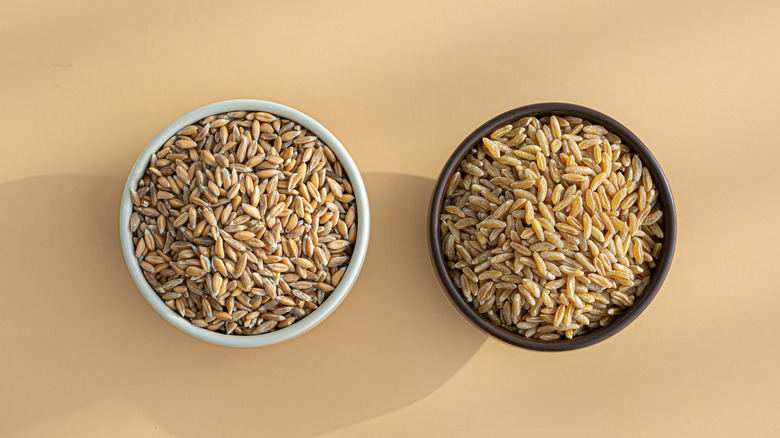
Ancient grains such as barley, quinoa, and kamut have enjoyed plenty of attention over the years, but there's one grain that has flown under the radar in the United States until recently. Robust and nutrient-dense farro has origins that can be traced back to the Fertile Crescent and has been a staple in Middle Eastern and Mediterranean diets for thousands of years.
Farro is actually an umbrella term for three different types of grains. They include farro piccolo (einkorn), farro medio (emmer), and farro grande (spelt). Emmer is the type sold in grocery stores, so to keep things simple, that's what we will refer to as farro for the rest of this article.
Farro can be found in stores in one of three forms: semi-pearled, pearled, or whole. Whole farro is when the grain remains completely intact. This means there are more nutrients and fiber, but it also takes the longest to cook (30 to 40 minutes). It needs to be soaked overnight as well. Semi-pearled has a portion of bran removed from the grain, which results in the loss of some of its fiber content. The tradeoff, however, is a quicker cooking time (20 to 30 minutes). Finally, pearled farro, as you've likely already guessed, has all of the bran removed but has the shortest cooking time (15 to 20 minutes).
Which type of farro should you use?
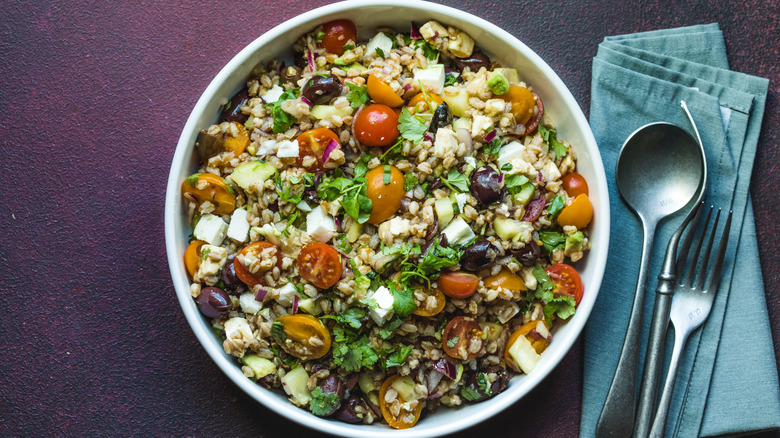
The type of farro you choose to use will depend on a variety of factors, including what you are cooking, how much time you have to prepare, and how concerned you are with maximizing the health benefits of the grain. While it's true that whole farro is the only version that retains all of its nutrients and fiber, that's not to say the semi-pearled and even pearled varieties don't have a high nutrient profile. A cup of cooked farro provides 6 to 8 grams of protein. So, even if compared against the types of rice with the highest amount of protein, it packs quite a bit of a punch.
If you have time to soak it overnight, whole farro is probably what you want to reach for when you are making a salad. The reason it works so well for salads is that the taste of whole farro is nutty and the texture is firm and chewy, making it the perfect complement to vinegar-based dressings and acidic vegetables like tomatoes. It works so well in a salad that it is reported to be in Ina Garten's favorite side dish from Charlie Bird Manhattan. Whole farro is also one of the most versatile ingredients for meal prepping. Its firm texture will hold well and not get soggy as the week unfolds.
Semi-pearled or pearled farro, on the other hand, may be used when you are looking for a lighter, less chewy option, or if you are simply short on time. Pearled farro, because of its slightly softer texture, is an excellent option for a quick breakfast cereal, such as a sweet farro pudding.