

Is It Possible To Remove The Silver Membrane From Ribs After They've Been Cooked?
We may receive a commission on purchases made from links.
It's the stuff of nightmares: after spending hours on the very best method for cooking fall-off-the-bone ribs, you flip the meat over and see that you've forgotten to trim off the silverskin. It's a common cooking mistake that ruins your pork, making it tougher and less flavorful. Thankfully, the situation is salvageable. You can still remove the silver membrane after cooking your ribs; it just might be a little more difficult.
This is because silverskin — known scientifically as the epimysium — is a tough layer of connective tissue that helps the muscle retain its general shape and protect it from friction. The epimysium is made of collagen and elastin, the latter of which is what helps muscle groups stretch and contract. Elastin doesn't tenderize with heat, which means it'll stay rubbery no matter how long you cook it. There's also a chance it toughens or adheres more strongly to the meat as it cooks, making it harder to remove.
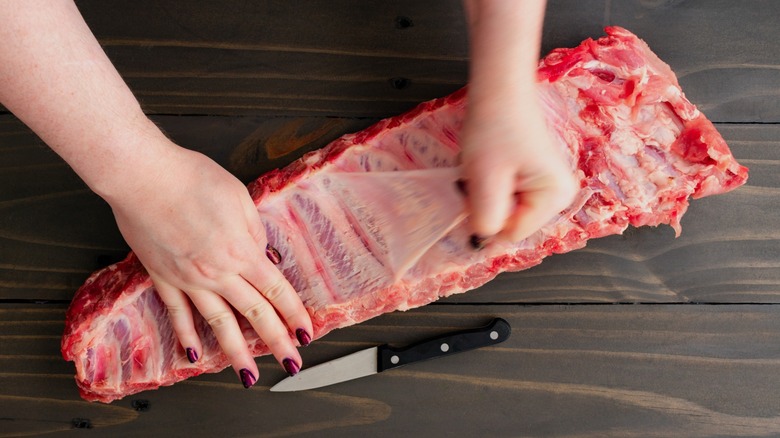
That said, it's not impossible to strip off the silverskin after your ribs are done. You can pretty much follow the same easy way to remove the silver membrane from your ribs as though they were raw. It may take a little more effort, and the juiciness of the meat might make it a bit harder to get a grip on the membrane, but it can be done. You could also just choose to leave it there, since it may not be the problem it's made out to be.
Good news — you might not have to remove it in the first place
People have been experimenting with keeping the membrane on for years, and many say that it doesn't make much of a difference. Even pitmaster Aaron Franklin, founder of the famous Franklin Barbecue in Texas, considers removing the silverskin to be optional (via Masterclass). It doesn't seem to affect the meat's ability to absorb any flavor, and any difference in texture appears to be negligible.
It might be because most of the silverskin is made of collagen, which starts to break down into gelatin at 160 degrees Fahrenheit. When you're going low and slow at the temperature ribs should be cooked to, the collagen actually ends up making your meat more tender and moist. Any elastin that remains in the epimysium might be too little to really matter. In fact, some taste tests suggested that ribs that kept the membrane on were slightly juicier; the popular theory is that the silverskin actually locked in some of the moisture during cooking.
All this is to say that if you forgot to trim the membrane off before cooking your ribs, don't sweat it! It might not even matter in the first place, and any energy you might spend trying to scrape it off is probably better put to use just enjoying a hearty plate of juicy, fall-off-the-bone ribs.