

The One Dish Anthony Bourdain Said Everyone Should Be Able To Cook With Ease

We may receive a commission on purchases made from links.
If you already have a dish or two that you can whip up like a pro — whether it's a classic, no-frills grilled cheese, or an elaborate tomato sauce or gravy — then you're already well on your way to many home cooking achievements to come. With a few recipes under your belt, it's also fun to look to past and present food world luminaries to see what foodstuffs they most prized. For Anthony Bourdain, this must-master meal required some everyday ingredients, plus patience and skill.
"Everyone should be able to make an omelet," Bourdain wrote in his 2011 book "Medium Raw: A Bloody Valentine to the World of Food and the People Who Cook." Omelet-making builds character, he claimed. "One learns, necessarily, to be gentle when acquiring omelet skills: a certain measure of sensitivity is needed to discern what's going on in your pan — and what to do about it," Bourdain wrote. Unlike, say, a scrambled egg, which even inexperienced home cooks can more or less recognize as finished, an omelet can be trickier to negotiate. But with a little knowledge and experience, you can figure out its ideal doneness and, sure, why not, catch some useful new qualities in the process.
Making omelets at home for a meal or a personality test
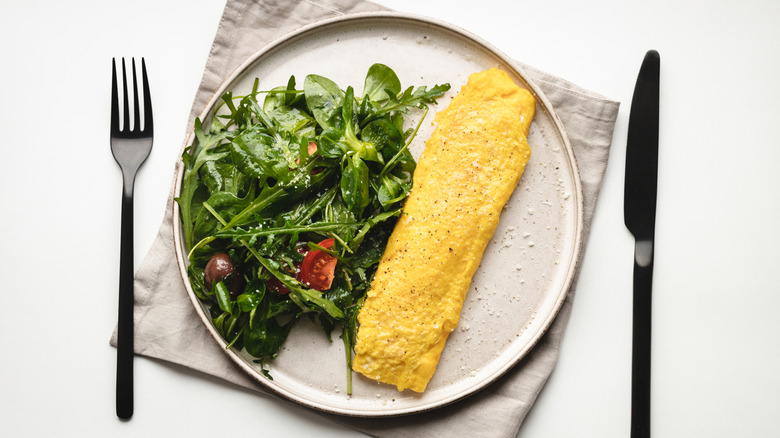
Once you're in the kitchen, "you either can — or can't make an omelet," Bourdain wrote later in the book. Fortunately for the home cook, there's a lot of space between that can't and can; eggs are often among the more affordable proteins in spite of their headline-making fluctuations, and you can still always eat your mistakes. Plus, once you brush up on the common omelet mistakes you don't want to make, you'll have perfected the golden folded dish in no time.
Bourdain was known to fork-beat his eggs with salt and pepper alone, which might be worth a try if you've been incorporating dairy to less than thrilling results. Butter would instead go into the pan before the egg was poured in to form a shallow pool, moving the liquid around in infinite patterns so that it all approaches firmness without ever crisping. Bourdain also did not flip the omelet over the heat, but rather ultimately angled the pan toward a plate so that, with a few flicks of the wrist, it folded onto the dish. This is, of course, just one approach on your road to omelet mastery. Julia Child and Jacques Pépin's omelet-making technique involved a lot more egg shaking. And, although we might not exactly tell any culinary icons, you can even make an omelet adaptation in a mason jar.