

How To Use Your Wok To Impart A Smoky Essence Into Dishes
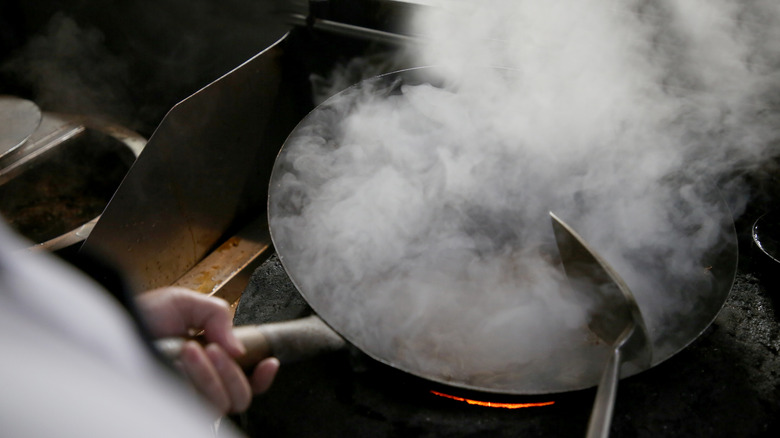
In use for several thousand years, few cooking vessels are more versatile than the wok. You likely first think of the pan as the best way to stir fry vegetables, proteins, or noodles; a task it accomplishes terrifically. You can also employ the unique design for a range of further applications from deep-frying to braising. A method worthy of special consideriation is smoking.
Picture the typical smoker setup and a wok seems like quite a leap. However, its quintessential curved shape is actually predisposed to the technique. The convex flooring intensely heats your designated smoking component while the wider top distributes the aromatic smoke. In fact, due to the wok's generous surface area, you actually get more cooking space than most indoor smoking setups. Not to mention, setting up the wok for smoking isn't difficult if you have an ideally fitting lid. Otherwise, there's ample length of foil involved.
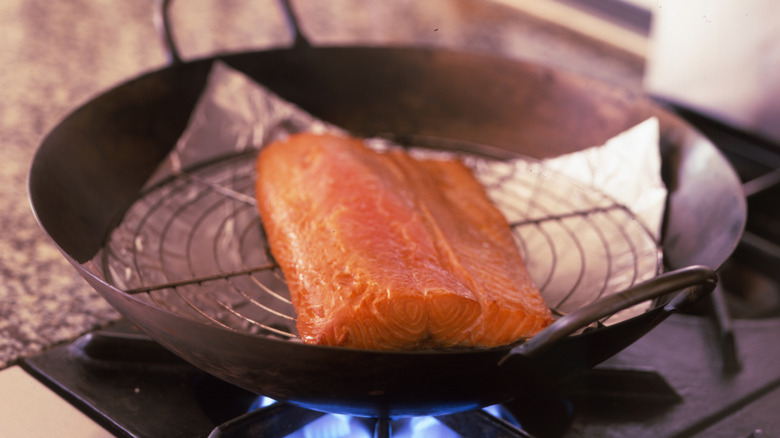
Start by securely encasing the smoking material in a foil pocket, thereby ensuring no unwanted pan adhesion. Then, line the entire wok with foil to the point that the metal overhangs the sides. Follow this by placing a wire rack that props up near the wok top; it's where you actually cook the food. To finish, wrap a layer of foil on top to capture the smoke. Sure, you don't quite get the perfectionism of the best electric smokers; yet, for a pan that accomplishes a manifold of other tasks, the trade-off is worthwhile.
Attune a wok to indoor smoking
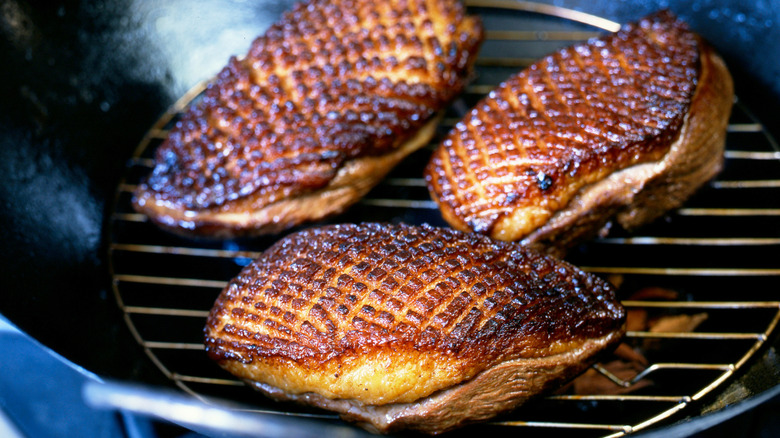
However you assemble a wok smoker, the aim's the same: To leave only a slight draft amidst smoking. Abundant exposure to outside air amidst preparation massively dips temperature and dissipates the smoke, so tightly secure the foil and don't unwrap during cooking. Since you're probably working indoors, you also need to consider kitchen ventilation, so turn on the vent and open the door; while the smoke shouldn't be too excessive, it's best to avoid accumulation. In fact, once everything's completed, consider unraveling the setup outside.
All the while, even on a stovetop, smoking entails patience and uniform temperature application. As a result, keep a close eye on the gas burner intensity; woks respond rapidly to fluctuations. By way of its thin composition, contents heat up and cool rapidly, which is a detriment to elongated smoking sessions. Let the setup first rise some degrees on moderate heat, then lightly dampen the intensity. Cook precisely, utilizing both a timer and thermometer. With delicate proteins, such as fish, you only need 10 to 15 minutes of preparation time, and you should note durations to the minute. For added assurance, integrate the thermometer into the setup by nestling a slender wire probe into it or creating a small hole atop to lodge a thermometer inside. Such extra care pays off with consistent smoking applications.
A wok easily melds smoke flavor into a variety of dishes
Converting a wok into a smoker takes some effort and a few rolls of tin foil, yet once you've built your setup once, there's an exciting array of applications to explore. For one, the relatively small amount of necessary smoking fuel lets you flavor with varying aromas. Classic wood chips present an excellent starting point: They're easy to find and translate with especially bold flavor. Feel free to experiment with the best types of wood to use for smoking. Mesquite and applewood are common options. Furthermore, don't rule out other smoking bases. Feel free to throw in spices, leaves, citrus peels, grains, tea, and even sugar as a smoking base. Since the process is brief — running under 20 minutes — you can imbue flavors before these foodstuffs start to burn. You could even form a blend, creating some incredibly intricate aromas to imbue.
Last but certainly not least, there's the food itself to consider. Fish, especially salmon, trout, and mackerel, is an excellent candidate. It's quick to cook, succulent, and readily picks up smoky flavors. Alternatively, consider root vegatables, mushrooms, or even tomatoes. While this smoking setup isn't sustained enough to cook through heftier proteins, such as beef, pork or chicken, you can use it as a finishing step. From chicken wings to pork tenderloins, use an oven or grill to first cook through, then baste in wok smoke for a wondrously aromatic touch.