

The Vintage Spiced Cake That Early Voters Got As A Reward For Showing Up
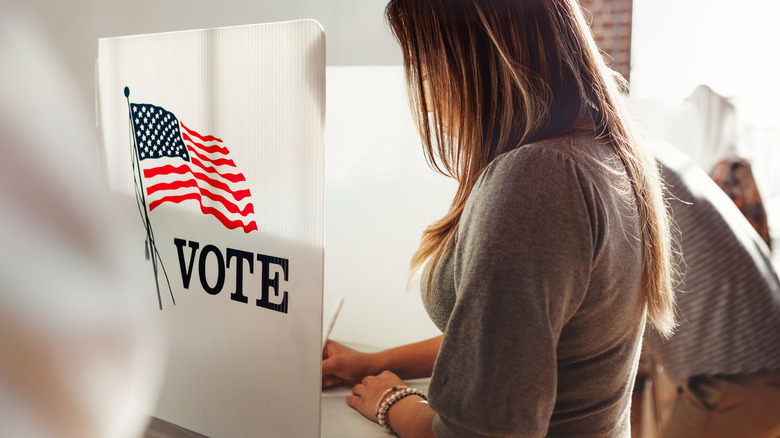
If you could time travel back to Election Day in the late 1700s, you most certainly would not have received an "I Voted" sticker (sadly, stickers weren't invented yet). But you might have received something even better: free cake! Fittingly, some polling places served "Election Cake." This phenomenon surfaced in New England, both as a way to encourage voters but also for the women who baked the cakes to nudge male voters towards their preferred candidates. (Bear in mind that women were not allowed to vote then, so this was one of the limited ways that they could influence the outcome.)
Election Cake is believed to have emerged from Hartford, Connecticut, although it's sometimes described more generally as a New England tradition. The cake is a fruitcake made with yeast, similar to classic (albeit divisive) English fruitcakes in terms of ingredients, but with a lighter texture.
The first recorded mentions of Election Cake date to 1771. In the pre-revolutionary times, the few colonists with the right to vote had to travel to larger cities and towns, where the cakes would be served to them. And since they had to feed a crowd, these were seriously big cakes — one recipe from 1796 called for 30 quarts (that's around 33 pounds) of flour, with dozens of eggs and a quart of brandy.
What goes into an Election Cake?
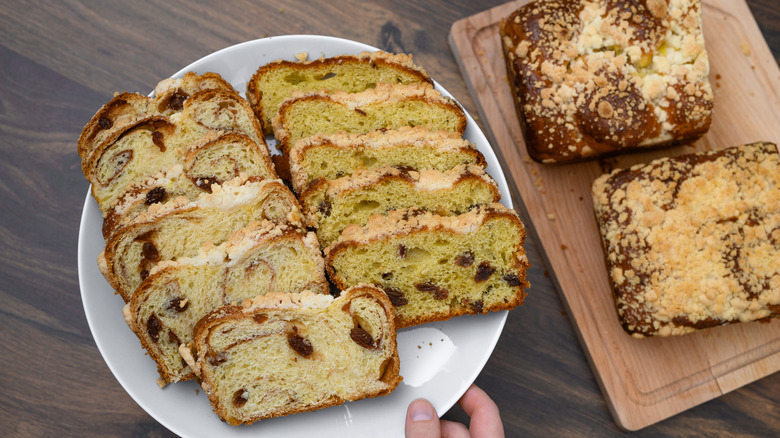
Election Cake features plenty of dried fruit and nuts, as well as spices like nutmeg, cloves, cinnamon, and allspice. It's a boozy cake, too, as recipes usually call for grape-based spirit brandy (some recommend rum or whisky). As with its classic English counterpart, the dried fruit is soaked in the alcohol, and this helps the cake to keep moist and edible for a longer period — and can even be revived after years of storage.
If you make Election Cake the traditional way, you'll need some time, as the cake needs to be left to rise twice. Firstly, the yeast mix needs anywhere from six hours to an entire night. Later, the prepared batter needs a shorter proofing period. That said, modern day takes on the cake tend to call for fast-acting yeast. They may also recommend a glaze, which is absent from the old-school recipes.
Election Cake's biggest moment was probably in the 18th century, since it was already considered passé by the early 1800s and has unfortunately become an outdated dessert that no one makes anymore. However, it had a revival in recent years. In the lead-up to the 2016 election, two North Carolina bakery owners, excited by the prospect of the first woman president, started selling it and drew media attention. As a result, it's not hard to find updated versions of the recipe, tweaked for modern kitchens and tastes.