

What Makes Martha Stewart's Cutting Boards Stand Out From The Rest
We may receive a commission on purchases made from links.
Martha Stewart has certainly chopped up enough of everything you could think of to know what makes a great cutting board. Spoiler alert, it's no different than what makes all her other home goods great: functionality and style. Her diverse cutting board collection has gained a following over the years, and with good reason. A reliable cutting board, like a high-quality chef's knife, is one of those items a serviceable kitchen really cannot go without. In fact, the two go hand in hand, as certain cutting board materials will ruin your kitchen knives.
Wooden cutting boards are the clear winners when it comes to sustainability, style, and food safety, and it's no different for Martha Stewart's cutting board collection. More and more consumers reach for wood instead of plastic these days due to the growing body of scientific research that shows plastic cutting boards emit microplastics into both the environment and our bodies. Not only that, but plastic cutting boards are more likely to harbor bacteria inside grooves left by knives. These are some pretty solid reasons to get rid of your plastic cutting boards, but the Stewart collection doesn't jettison plastic altogether. Whatever kind of cutting boards you decide to use, it's best to have at least two: one for fruits and vegetables and one for meat. This will prevent cross-contamination.
The cutting board details that make a difference for Martha Stewart
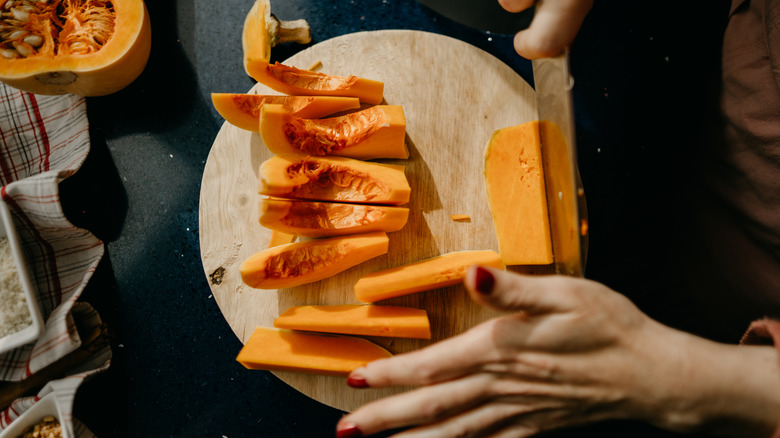
Many of the wooden boards in Martha Stewart's collection are so pretty they can easily double as serving trays when you are entertaining in true Martha Stewart style. The acacia wood paddle cutting board and the mango wood round cutting board are both perfect for a charcuterie that pops. Her Lochner beechwood cutting board is an excellent all-purpose board that looks lovely with its pale cream color and light brown hues, and has built-in handles to make it easier to use as a serving platter. It also has a juice groove that wraps around the inner perimeter of the board — a must-have for cutting vegetables, fruits, and meats that release a lot of liquid. The groove allows the juice to pool up, preventing it from making a mess on your counter.
The added bonus is that wood is a renewable resource and can last a lifetime if you know how to season and maintain your wooden cutting boards. If you still can't part with the ease of having a dishwasher-safe plastic cutting board, Martha Stewart's collection boasts some made from durable plastic that has been designed with daily use in mind, is less prone to nicks from knives, and is BPA free. Though this does not eliminate the possibility of microplastics in your food, the intentional design does its best to mitigate the risks. Of course, in addition to your basic white and gray, Martha Stewart's set of two BPA-free plastic cutting boards also come in a very pretty shade of "Martha Blue."