

Why You Should Really Get To Know Your Oven And How To Do It
We may receive a commission on purchases made from links.
Baking is as much an art form as it is a science. You have to get all your measurements correct and your timing has to be perfect. You also need an oven that works like it's supposed to, or all your hard work could still be an epic failure. In other words, it isn't just about knowing the right temperature for baking chicken. You also need to make sure the temperature in the oven is actually what it says. Dorie Greenspan, author of "Dorie's Anytime Cakes" (out October 2025), knows the importance of an oven that works the way it should.
Like many bakers, Greenspan has dealt with ovens that aren't consistently accurate, so she shared some helpful, exclusive insight with Chowhound on why it's so important to know your oven (and how to figure out its idiosyncrasies). "About ovens," she says, "each seems to have its own personality, its own quirks, and it's the job of us bakers and cooks to get to know our ovens and to help them be their best selves." While there are sneaky hacks, including using sugar to check your oven's temperature, Greenspan's number one tip is to invest in an oven thermometer that stays there at all times. She also encourages bakers to have their ovens professionally calibrated if possible, and warns that some ovens may be correct at one temperature but not another, so it's important to test it at different settings. Once you know in what ways your oven is off, you can figure out how to compensate accordingly so your bakes come out perfect each time.
Calibrating the temperature isn't the only concern
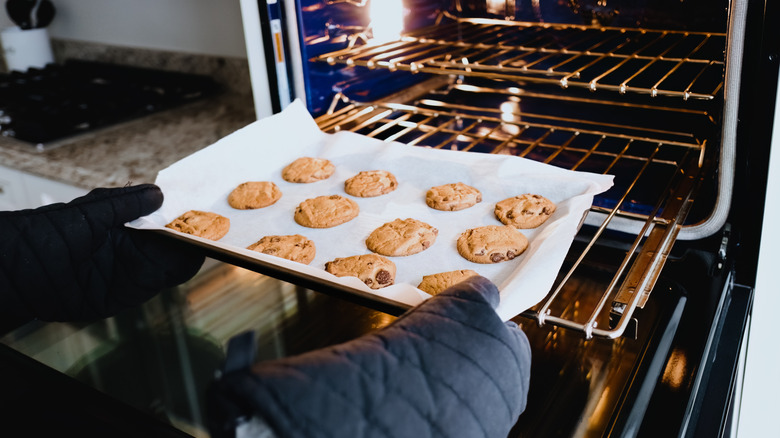
Dorie Greenspan also shared some helpful advice she once received from an oven repairman: Give your oven plenty of time to come up to temperature. It's a matter of making sure the entire oven cavity fully heats up, so Greenspan suggests giving the oven another 15 minutes once it has reached the desired temperature before you place your food inside. This helps compensate for opening the door (which releases some of the heat you've gathered inside), and "[helps] the oven more quickly recover to the temperature you set."
Greenspan has also perfected a great technique for identifying hot spots, or places where the oven cavity tends to get hotter than others. "If you get to know where those spots are in your oven," she says, "you can work around them." She recommends finding them by lining a baking sheet with parchment paper or a thin layer of shredded coconut, which you then put in a heated oven to see which parts of the pan color fastest and darkest. "Those are your hot spots," she says, and suggests rotating your pans midway through their cook time to make sure those hot spots don't get the best of you. Once you've gotten to know your oven and learned how to work with its distinct personality, you can get to mastering techniques such as cooking recipes with different temperatures in the same oven. Now you can handle any cooking challenge that presents itself.