

The Best Flour For Bagels With The Perfect Texture
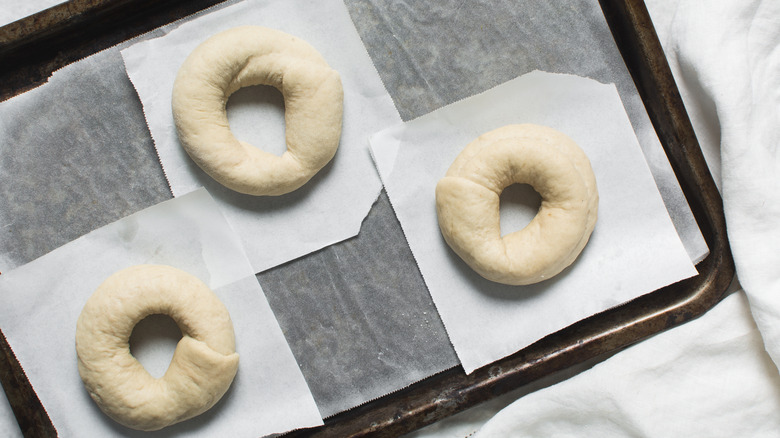
If you're taking on the task of baking your own bagels at home, be warned: There are a lot of potential mistakes people make with homemade bagels, especially for inexperienced bakers. Perhaps one of the biggest ones is bakers not using an appropriate flour; it's far from ideal to just reach for whatever white flour is in your pantry. Josh Small, CEO and managing director of DoughCo Bagels, which pops up at various New York City area farmers markets, has some major advice.
"The best flours for bagels will have a higher protein percentage, which will contribute to the chew that is needed for bagels to have their authentic mouthfeel," he said to Chowhound in an exclusive chat. His recommendation is to aim for flours with more than 14% protein; you will typically see these described as high-gluten flour on the label. (Gluten is a protein found in wheat, rye, and barley.)
"We have found that King Arthur Sir Lancelot high-gluten flour delivers great results, with the King Arthur Bread flour also providing just enough protein to give bagels some chew," added Small, in case you're looking for specific brands. He also notes that these are unbleached and unbromated flours.
"Unbleached" means that the flour is produced without the chemicals that are often used to age commercial flour (it's also considered the better flour for bread baking). "Unbromated" refers to the addition of potassium bromate to the flour. This chemical compound makes for fluffier baked goods, but there is scientific debate about whether it may have negative effects on human health when consumed in typical quantities.
What else to know about bagel flour
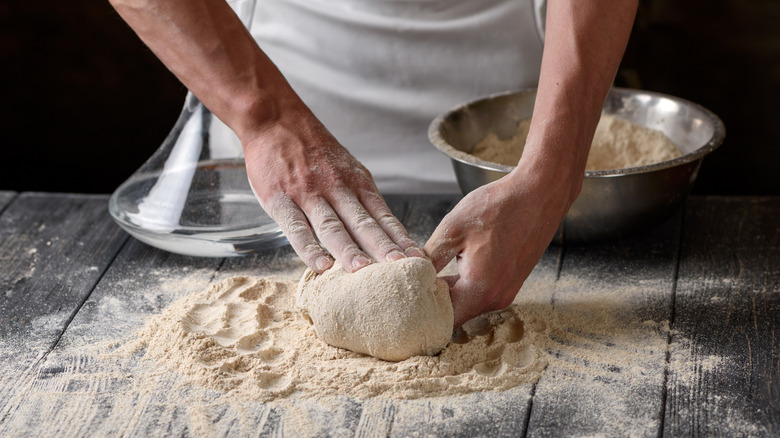
It's really all about the gluten when it comes to bagel flour. As Josh Small noted, it gives that chewiness. The reason for this is because once liquid is added to flour, its gluten particles start to form bonds with each other. This is also why kneading is key for bagels and other breads: The kneading process prompts more gluten bonds to form. This results in an elastic dough, and when baked, gives that chewy texture — the same happens with other doughs like pizza. For this reason, you wouldn't use high-protein flour for cakes, as it would probably result in an overly chewy bite — you want lower-protein flour (sometimes called cake flour) that makes for a softer final product.
If you can't find 14% protein flour, you can still make bagels with bread flour (which is around 12% protein). It'll be softer and less chewy than a New York bagel, but it'll still work (it may even be preferable if you're aiming for a softer style, like Jerusalem bagels). Depending on who you ask, some people will say all-purpose flour can work; others will dispute this. Either way, you do need to be sure to mix and knead the dough thoroughly so the gluten develops, and this is extra important if you're using lower-protein flour. This can mean over a half-hour of kneading by hand (less — but not too much less — with a stand mixer). So that's one final advantage for high-gluten flour: You'll save time and effort.