

Test Your Garden's Soil With Ease Using A Mason Jar. It's Seriously So Easy
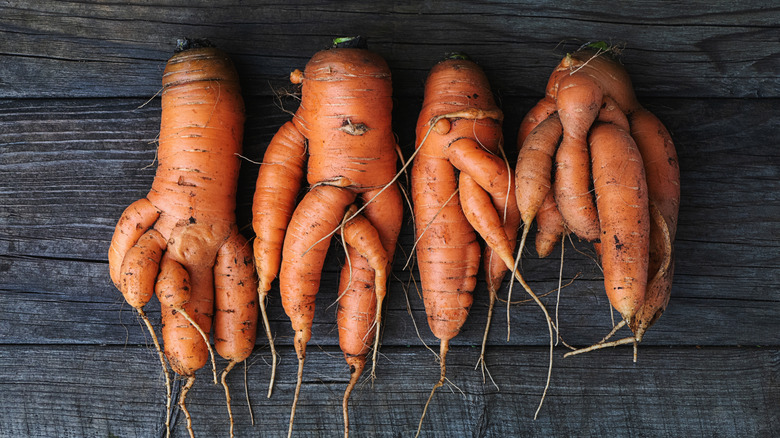
Ever wonder why you end up with funky-looking misshapen carrots in your garden? The answer, more often than not, is the type of soil that they grew in. There are good reasons why you can't just use dirt from your backyard to grow a vegetable garden: Compacted and impermeable soil can make it difficult for the roots of vegetables to stretch out and grow freely underneath the ground. Too much density impedes the flow of water and nutrients to the roots of plants, causing problems that could easily be avoided by knowing the texture of your garden soil. But how do you figure out if the texture of your soil is a favorable environment for growing?
Ideally, it should have the right percentages of three components that make up soil: Sand, silt, and clay. The Mason jar test is an easy way to know if you have too much of one of these three key ingredients in your garden. It's as easy as filling a Mason jar with soil, adding water, and waiting for the particles to settle and let you know. Taking care of your soil is one of the best gardening tips to remember if you're a beginner. Even if you're not a beginner, it's all too easy to overlook what's happening underneath the ground as you carefully tend to other tasks.
How to use a Mason jar to test soil
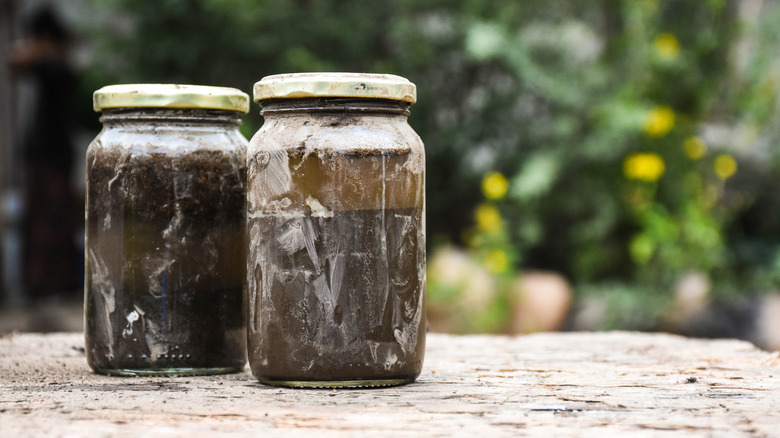
To test the texture of your soil, begin by sifting some of it through a colander over the top of a bucket. Once you have enough soil ready, use it to fill a Mason jar about half-full. Add water and leave enough room to be able to shake the mixture well. Next, add a spoonful of powdered dish detergent, borax, or calgon (this helps the clay and silt separate) and shake for at least one minute (ideally up to four or five minutes).
Let your jar sit. After just 60 seconds, the first layer you should notice settle is the sand because it's the heaviest. Use a sharpie to mark the height of this layer. Next, after about two hours, you should see the silt layer. Mark it as well. The clay takes the longest to form a layer, so you have to wait at least a day or two to mark it. Once everything is marked, you're ready to calculate percentages.
First, measure the height of the total amount of soil in the jar. Next, measure each layer separately so you can work out the percentages, then divide the height of each layer by the total height. For example, if you have 70 millimeters total and 45 millimeters of sand, the percentage of sand you have in your soil is 64.3%. The ideal combination is 40% sand, 40% silt, and 20% clay. Once you have adjusted your soil to make sure it's healthy, you can start focusing on other things, including 16 hacks for getting rid of pests in your vegetable garden.