

12 Iconic Canadian Desserts Everyone Should Know About
We may receive a commission on purchases made from links.
Canada is known for maple syrup, vast plains filled with snow, and overtly polite people. But desserts? As it turns out, the Great White North is home to some iconic Canadian desserts, both those that arrived from other countries, and those that were locally developed. And we're here to tell you about the best among them.
As a Canada-based recipe developer and food blogger who's lived in two provinces and travelled extensively across Canada, I'm personally familiar with, and have tried, nearly all of these desserts. From date squares to something that looks like a spotted dick — the British dessert, that is — there is no shortage of finger-licking sweets across Canada's 10 provinces and three territories. Unsurprisingly, many of these contain copious amounts of maple syrup.
Some classic Canadian dishes have French roots, while others are firmly based in British culture. Other prominent foods are influenced by the American Midwest, Ukrainian cuisine, and, of course, Canadian Indigenous cuisine. All of these are exceptionally delicious. Read on to discover 12 iconic Canadian desserts everyone should know about. We betcha didn't know about these, eh?
1. Nanaimo bars
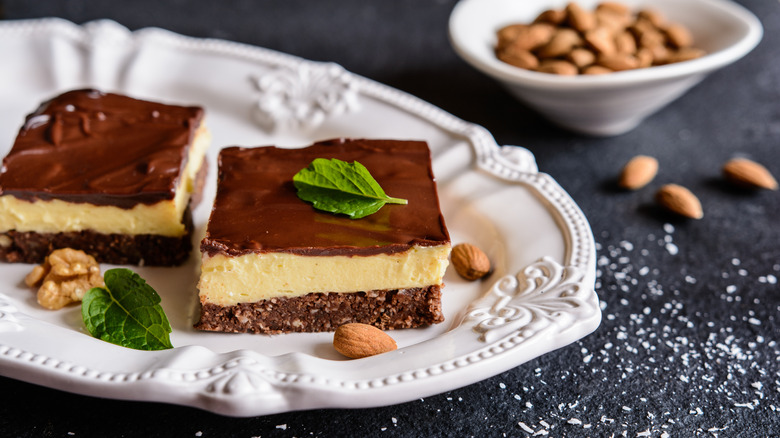
One of the most iconic Canadian sweets requires no baking, is filled with nuts, coconut, cream and chocolate, and can satisfy a serious sweet craving with just one bite. Meet the Nanaimo bar, a decadent layered creation that hails from British Columbia.
Named after the small city in which it was invented, the Nanaimo bar has a bottom layer of graham crackers, nuts, and shredded coconut, all pulsed in a food processor and then packed in the bottom of a pan. Canadians strongly feel that this layer should be the thickest one of the three, and this topic was the subject of fervent debate over perceived misrepresentations of the Canadian bar by the New York Times in 2021, and Canada's postal service itself in its 2019 stamp collection.
After the nutty coconut base, a thick, vanilla-tinged custard follows. This creamy filling is made once again without turning on an oven, which is a definite boon in Canada's surprisingly hot summers. The custard is sealed by a pouring of chocolate ganache made in the simplest manner, by melting together semi-sweet chocolate chips and butter. Together, the layers combine to create a perfect bite of crunchy and creamy textures.
2. Butter tarts
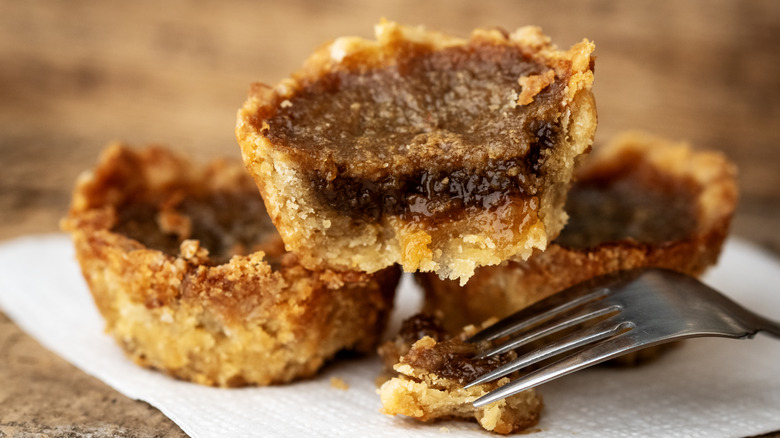
It's hard to imagine a Canadian Christmas without butter tarts. Imagine a miniature pie shell, buttery, flaky dough and all, with a custard-like filling made with brown sugar, eggs, and vanilla. As soon as you bite into it, the filling comes oozing out, covering your fingers with a cool, sweet coating that you can't stop yourself from licking off. Canadian butter tarts are like a cross between pecan pie and sugar pie, except without pecans.
Every Canadian family has its own prized, special recipe, but all are essentially similar to the classic recipe in "The Complete Canadian Living Cookbook" by Elizabeth Baird. The main difference is whether or not you add fillings to your butter tarts, and the options range from raisins to nuts. All are decidedly controversial, and families argue about them in a very genteel, Canadian manner.
While the everlasting debate rages on over whether or not raisins belong in butter tarts, any Canadian will continue munching on these little confections to their heart's content. And I'll take mine with raisins, thank you very much.
3. Sugar pie (tarte au sucre)
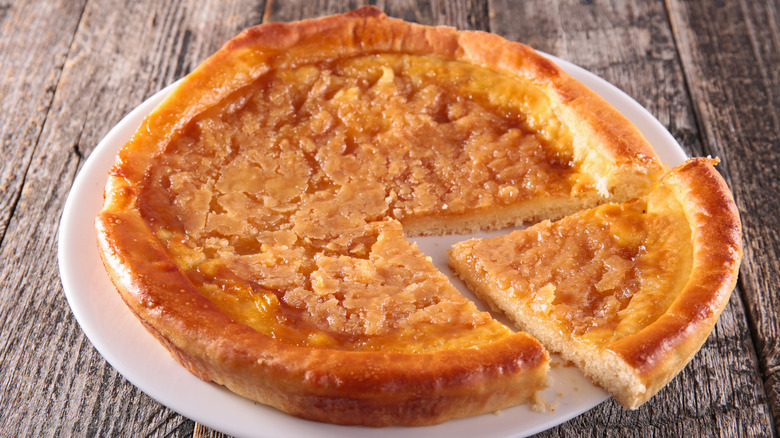
Sugar pie is a Quebecois dessert that brings with it a proud French Canadian heritage. Everyone knows Quebec's main contribution to the culinary world is Canada's most famous dish, poutine. But not everyone knows Quebec's favorite dessert, sugar pie. And they really should.
Known as tarte au sucre in French, this popular dessert makes appearances from Christmas to maple harvest time, from March to May. With a typical pie crust, the filling in sugar pie is decidedly sweet, made mostly from brown sugar and eggs. It's similar in taste to a few iconic American desserts, like Pennsylvania's shoofly pie, Indiana's sugar cream pie, and chess pie from the South.
Sugar pie originally came to Canada with the French settlers from northwest France, but it has become entirely Canadian in the hundreds of years that passed. Every Quebec child knows sugar pie, and with good reason.
4. Saskatoon berry pie
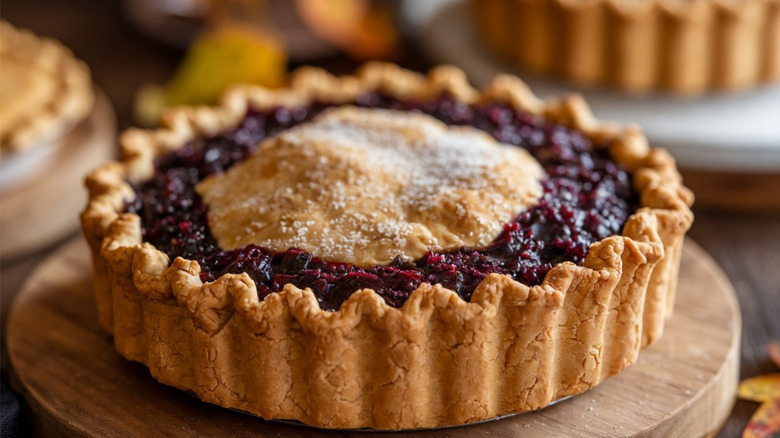
Few people outside Canada know what Saskatoon berries are, let alone what a pie made with them tastes like. To be honest, though, few Canadians outside the Prairies know them, either. But let me tell you, they're missing out.
Saskatoon berries are named after a city in Saskatchewan, a prairie province famous for wheat, being the birthplace of public health care, and having no access to a coastline. Saskatoon berries look like blueberries but taste entirely different — they're nuttier, tarter, with a hint of almond flavor, and have a slightly thicker skin. Indigenous to the Canadian Prairies, these berries have been harvested by First Nations people for centuries before European settlers arrived in the region and decided to turn the berries into jam and pies.
Saskatoon berry pie looks a lot like blueberry pie, made out of two layers of pie crust with a thick, jammy purple filling on the inside. The filling is made with sugar, a bit of lemon juice for sharpness, and occasionally cornstarch for thickening. When baked, the filling becomes rich, velvety and syrupy, so if you're lucky enough to source some Saskatoon berries, stock up on napkins before digging into this pie.
5. Maple taffy (tire d'erable)
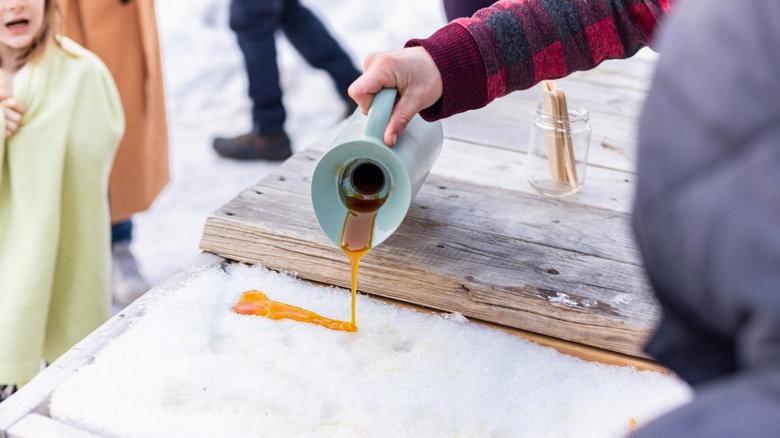
Imagine pouring boiling hot maple syrup on a pile of freshly fallen snow. As the steam rises and the syrup slowly cools down and hardens into a pliable, gooey caramel strip, a checkered-shirt-clad handler sticks a wooden popsicle stick onto one side of the strip. He then gently, slowly rolls the taffy onto itself, forming a maple sucker on a stick. He hands you the candy with warm, calloused hands sticky with maple sap. As you proceed to lick the candy, it begins to melt onto itself and your clothes, leaving a warm, tacky trail in its wake.
Congratulations, you've just met tire d'érable, or maple taffy, the quintessential Canadian winter treat. Found at sugar shacks, called cabanes à sucre, across Quebec and other maple-producing regions, this confection is one of the best things to look forward to as Canadian winters begin to turn to spring.
The tradition of making maple taffy in the snow dates back to early Indigenous practices, which were later adopted by French settlers. What's special about this caramel sucker is that it can only be made when conditions are just right: Cold enough for snow, but during the spring thaw when maple sap is running. For a fleeting moment, maple taffy captures Canada's most iconic ingredient in its purest, most joyful form.
6. Blueberry grunt
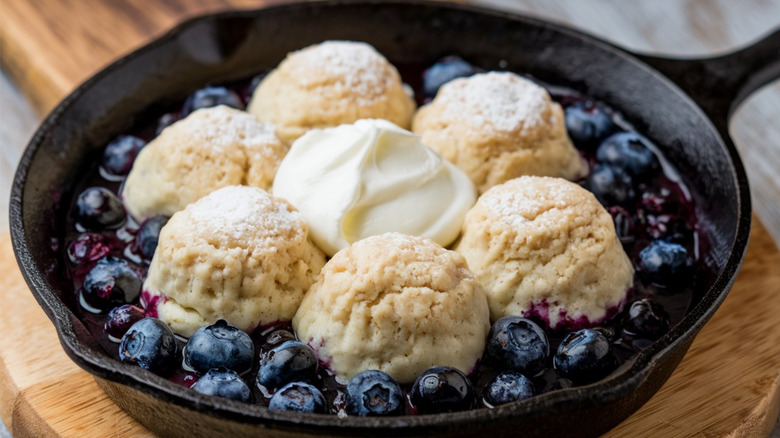
While American states have state desserts, Canadian provinces don't follow suit. If they did, though, blueberry grunt would be Nova Scotia's official dessert. Mostly a blueberry jam with drops of biscuit batter on top, blueberry grunt is similar to a cobbler but is a whole lot more rustic.
However, unlike a cobbler, which is baked in the oven, blueberry grunt is cooked entirely on the stovetop. The filling is made when fresh wild blueberries, which grow abundantly in Nova Scotia and New Brunswick. They're simmered with sugar and spices until they burst and release their juices. Then, soft biscuit dumplings are dropped on top and the pot is covered, allowing the dumplings to steam until they're puffed and fluffy.
This no-fuss dessert dates back to early colonial times, when British settlers made simple dishes from what was easily found around them. Nowadays, a grunt is traditionally served warm with a dollop of cream or ice cream, and just to add to the confusion, this dessert can also be called a "slump" or a "fungy".
7. Date squares
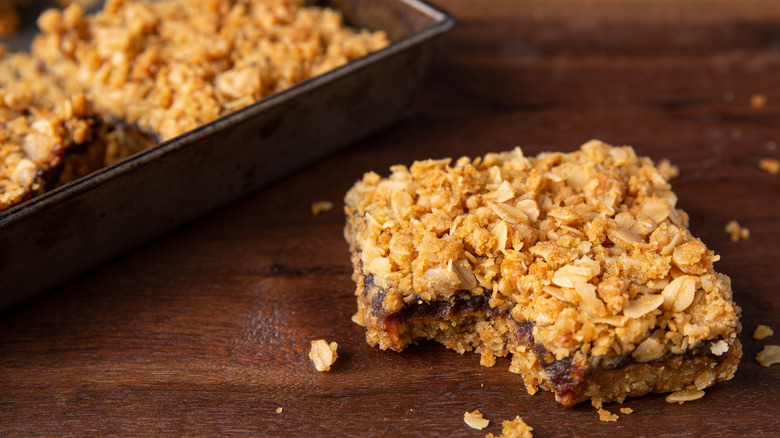
There are few things as Canadian as heading to your favorite bakery on a Saturday morning, and sitting down with a cup of coffee and a date square, alongside a cinnamon bun to share. Somehow, date squares developed a reputation of being the healthy choice for desserts, and socially and environmentally-conscious Canadians have adopted them with fervent zeal heretofore reserved only for composting. Despite this idea, date squares are actually packed with oats and brown sugar, alongside the heaps of sugar-laden dates — but they taste darn good, so who are we to judge?
Date squares feature two layers made out of a crumbly oat mixture that sandwiches a thick, gooey date filling. The dates are slowly simmered with water until they break down into a sticky, sweet paste that's often fragranced with vanilla or lemon zest.
The humble date square has been a staple in Canadian homes since at least the 1930s, when these treats began appearing in community and Mennonite cookbooks across Manitoba and Saskatchewan. The squares are also known as "matrimonial cake" in parts of the Prairies, and theories abound as to why, such as the idea of the squares being broken over the heads of newlyweds, that they're two layers stuck together, or that their shape represented marriage because they have a solid foundation and a sweet centre.
8. Queen Elizabeth cake
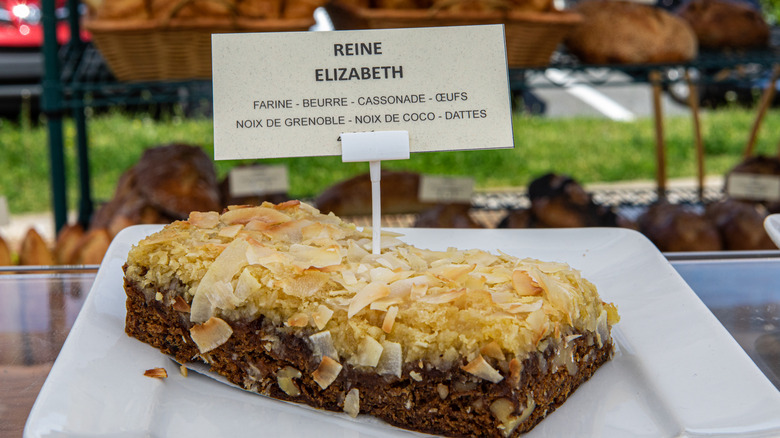
Theories about Queen Elizabeth's favorite cake abound, from a dark ganache chocolate cake to an ice cream bombe cake with coffee flavor. But one thing was never mentioned: A cake with a chocolate biscuit layer that is covered in coconut and dates. Somehow, that's the cake that bears the late Queen's name in Canada.
The reason behind the name of this cake may see mystifying, but it's not too deep. The story goes that the cake became popular in the 1950s, when Queen Elizabeth was having her coronation, and the cake was likely just named in her honor — similar to a Victoria Sponge, which also bears no connection to Queen Victoria. But no matter. This cake is still delicious.
So what's in this cake, you ask? The cake itself is relatively humble affair, with a moist date cake layer at the bottom. What makes it special, and a bit unusual, is the broiled coconut and brown sugar topping that creates a crackly, caramelized crust. After the cake is baked, a mixture of brown sugar, butter, cream, and shredded coconut is cooked, then spread over the top and briefly broiled until bubbly and golden. Once cooled, the cake becomes a sweet interplay of layers and textures that's still popular today.
9. Flapper pie
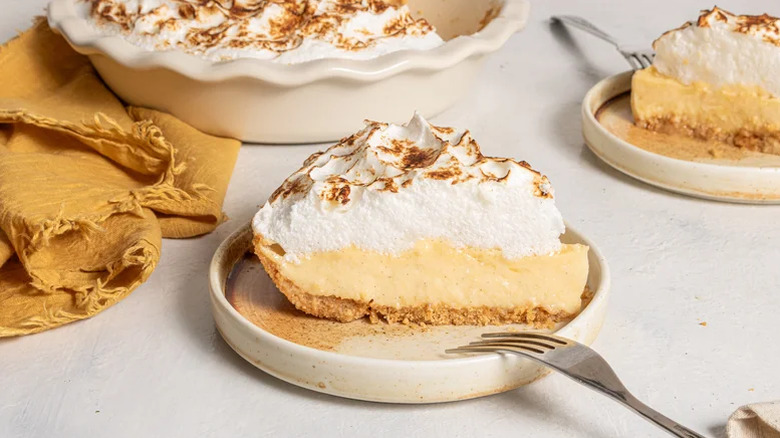
A long-forgotten dessert that was popular around the Canadian Prairies, flapper pie deserves a return to the international baking canon for its quaintness, affordability, and of course, flavor. This dessert is essentially a custard pie made with a graham cracker crust, topped with a heavy layer of meringue. The meringue gets broiled in the oven, and serves as both a decoration and a flourish in this otherwise humble tart.
The name of the pie comes, as you might have guessed, from the flappers on the 1920s, which is when flapper pie became popular. Emboldened by the new idea of the modern woman, home bakers began experimenting with fancy desserts that prioritized pleasure, much like the flappers of the jazz age. The pie is a modification of the vintage British custard pie, which involved making a finicky shortbread crust — and who has time for that when there's gin to be drunk and jazz to dance to, anyway?
Cooks all over the Prairies began making a simple layered pie that looked fancy and tasted divine, and required less work than similar desserts. And if anyone can get behind emancipation through cake, sign us up.
10. Beaver tails
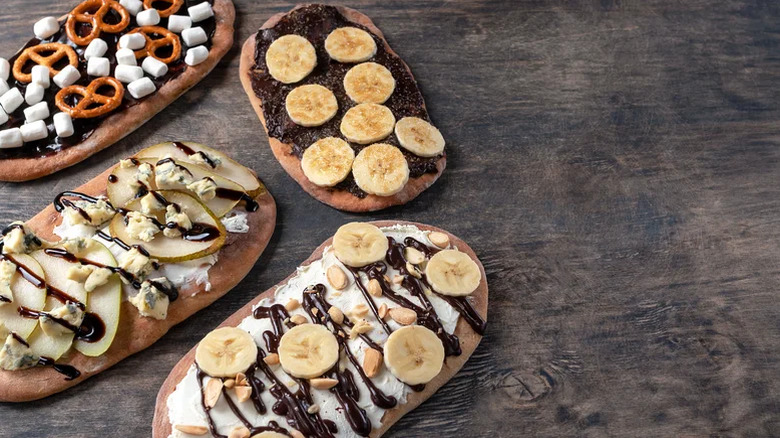
If many Canadian desserts seem to belong at the State Fair, then beaver tails should be the first to get scooped up. The dessert, which is essentially an elongated fried doughnut piled with toppings, is named after its oblong shape which resembles a beaver tail. Just like a traditional fried doughnut, the beaver tail is made with a yeast dough that gets shaped and then fried. Unlike a doughnut, the toppings don't get piped into the pastry, but rather arranged on top, much like an open faced sandwich.
Typical toppings for beaver tails begin with a humble cinnamon and sugar mixture, but can get as fanciful as Nutella and bananas, apple-caramel topping, or even a super-sweet spread of cheesecake cream, Skor candy, and caramel syrup. If you're preparing to eat one, then bring your appetite and stretchy pants.
11. Pouding chomeur (Maple pudding)
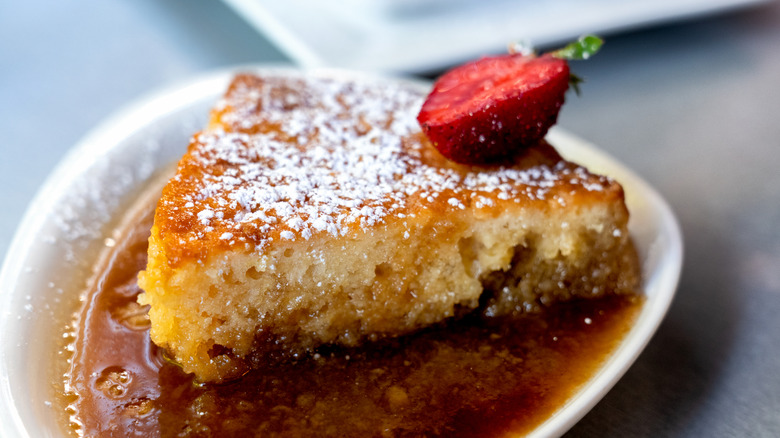
Another Quebecois dessert that dates back to the Great Depression era, pouding chomeur has a frugal appearance and origin story. What is essentially a fancy bread pudding has swept an entire province, and then a country, and remains a national dish decades after its inception. Not bad for a simple worker's dessert.
Legend goes that during the 1930s, many across the province of Quebec found themselves unemployed. But French Canadians are not ones to abandon creativity or good food when times get tough. Instead, factory workers developed a recipe for a dish called pouding chômeur, meaning "unemployed-person pudding," which relied heavily on flour, butter, and Quebec's main contribution to the world, maple syrup. It's unclear how much maple syrup or cream was in the original, rather cheap dessert, but today's pouding chomeur is a celebration of the liquid gold that the province produces; 91% of Canada's maple syrup comes from Quebec.
12. Figgy duff
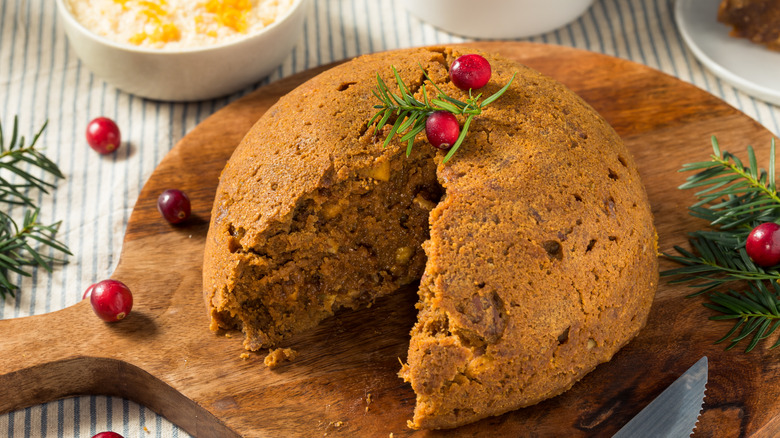
Figgy duff, which sounds like something from a childhood rhyme, comes to Newfoundland, Canada's Easternmost province, from Britain. It's a typical Christmas dessert beloved by many, but that has not been exported to the rest of Canada or the world quite as much as butter tarts or beaver tails.
Based on classic British desserts like figgy pudding and spotted dick, Newfoundland's figgy duff is actually a boiled pudding that, despite its name, traditionally contains no figs at all. Instead, "figgy" refers to raisins in Newfoundland dialect, an expression that comes from Cornwall, England. The pudding is made with breadcrumbs, molasses, butter, and spices. It's then studded with dried fruit, wrapped in a cloth, and boiled until firm.
Like many dishes from this island province, figgy duff reflects Newfoundland's strong British heritage. It also connects to the area's heavy reliance on fishing; boiled puddings were practical for cooking aboard ships. A figgy duff is typically served with a generous pour of rum or caramel sauce, as part of a "Jiggs dinner," which is Newfoundland's version of a Sunday roast.