

The Popular Sports Drink Banned In Parts Of Europe

For years now, people who have traveled to Europe from the United States have noticed a drastic difference in dietary health and habits while abroad. Many have attributed this to certain foods being banned in Europe, some of which are considered commonplace in the United States. Even certain ingredients like Olestra are banned in Europe.
Drinks are subject to bans in Europe, too. In fact, the popular sports drink brand Gatorade was banned by the European Union in 2012. Several ingredients, including certain dyes such as Yellow 5 and 6, resulted in the drink being removed from shelves in several European countries.
Another reason why Gatorade was banned by the European Union was the presence of an ingredient known as BVO. Short for brominated vegetable oil, BVO was added to drinks to stop ingredients from separating. However, BVO is banned in Europe; it was also eventually banned by the FDA, and Gatorade no longer contains the ingredient.
Where and why is Gatorade banned?
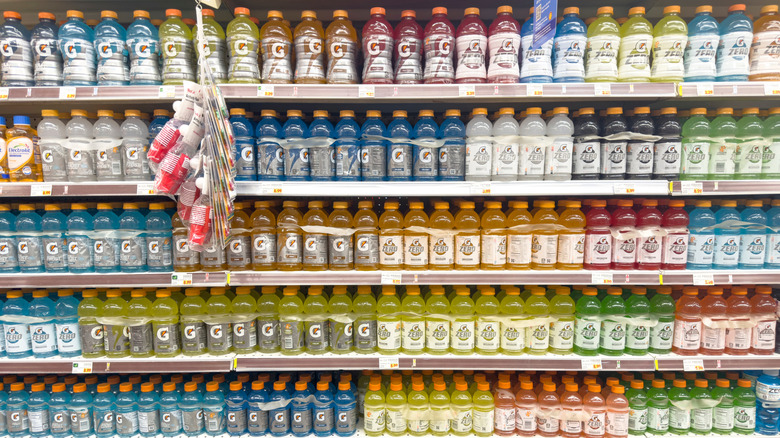
The use of BVO is what initially got Gatorade banned by the European Union. The ingredient itself was banned by the EU in 2008, and as such, Gatorade was driven out of Europe along with it a few years later in 2012. In 2013, Gatorade made an effort to remove the ingredient from its drinks in a bid to circumvent the ban. However, the removal of BVO wasn't enough to lift the ban. Several Gatorade flavors have certain dyes that are added to give the drinks their signature color. Dyes like Yellow 5 and Yellow 6 require a warning label in all EU countries and are outright banned for consumption by infants and children.
Countries like Norway and Austria have completely banned these dyes. As such, Gatorade is banned in these countries. Some dye-free or naturally colored versions of Gatorade are available in Europe as well as other alternatives, which include Powerade, Vitaminwater, and Lucozade, a popular U.K. brand.