

Where Is Jim Beam Whiskey Made?
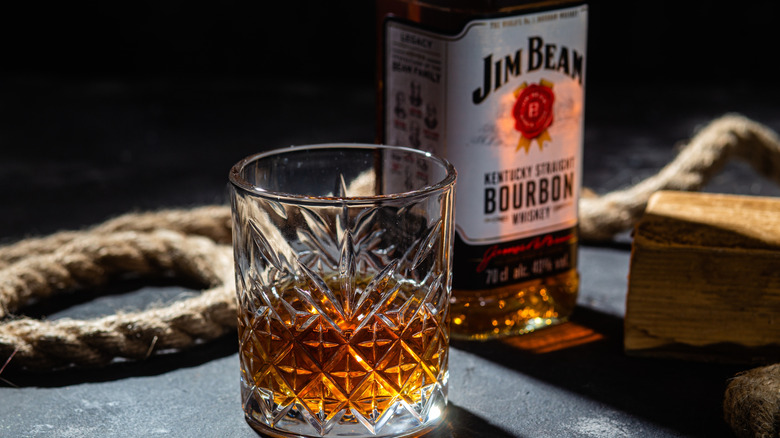
The star of Kentucky bourbon is without a doubt Jim Beam, producing over 50% of the bourbon (or is it whiskey?) made in the state (via UFCW). But at the end of 2025, Jim Beam made headlines when it announced it would stop production at its flagship distillery in Clermont, Kentucky. And nearly one year later, in November of 2026, it extended the pause through 2027. Thankfully, this does not mean the storied company is shutting down, and it's certainly not leaving the state of Kentucky. In fact, the James B. Beam Distilling Company on Happy Hollow Road remains open to the public. Whiskey barrels are still being aged in its rackhouses. You can still tour the facility and enjoy bourbon tastings. Also, the visitor center remains open for you to buy merch and special bottles.
Whiskey is still being made in nearby Boston, Kentucky, where the Booker Noe Distillery is located. This is Jim Beam's second distillery, which was already its highest-volume plant. It briefly ran on a four-day week when the Jim Beam production pause began but went back to seven-day production around mid-year. Beyond the "white label" original Jim Beam, specialty Jim Beam expressions are made here, as well as sister brands of bourbon like Knob Creek. As for aging, Jim Beam keeps bourbon barrels in roughly 100 rackhouses throughout Clermont, Boston, and Frankfort. Meanwhile, the Clermont distillery is undergoing some structural updates according to the company. Not only does Jim Beam continue to operate in Kentucky, it hasn't laid off staff during the pause.
The bourbon industry is at the center of Jim Beam's pause
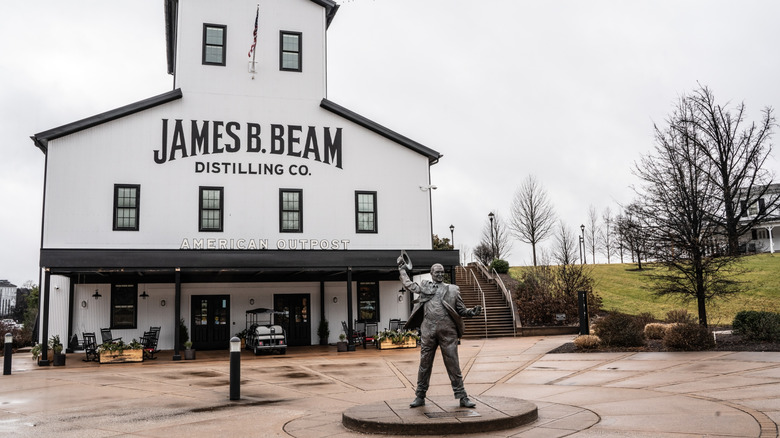
Bourbon saw a boom at the start of the 2000s that lasted nearly 20 years. People flocked to Kentucky for the Bourbon Trail looking to try several award-winning bourbons. During this time, distilleries expanded production at record rates. But in the 2020s, bourbon has faced steady and steep declines for a number of reasons. This has led to more than 16 million barrels of bourbon aging in rackhouses (via The Spirits Business), and the state is running out of space. Not only that, distilleries must pay an annual barrel tax on the inventory, which amounted to $75 million in 2025 (via BBC). And because Jim Beam accounts for the majority of those barrels, it absorbs a hefty portion of that bill, all before anything's been bottled.
One major factor that's hurt the bourbon industry is ongoing trade disputes. Canada is one of the industry's largest export markets, and overall American whiskey sales to the country tanked in 2025, falling 57% compared to 2024 (via The Drinks Business). Decreases also occurred throughout the European Union and Japan markets, leaving Jim Beam and other bourbon makers with lots of inventory originally destined for international store shelves. You can also add drinking habits to the equation, as younger generations are either not drinking or leaning toward premixed alternatives like Cutwater or On The Rocks. Others are simply buying less alcohol due to budget constraints or dietary restrictions. The Jim Beam faithful don't have to worry about supply issues, however. The Clermont facility may be taking a breather, but there's plenty of Jim Beam available, always made in Kentucky, and perfect for you to sip neat, on the rocks, or any other way you like.