

The Major Disadvantage Of Shopping At Dollar General
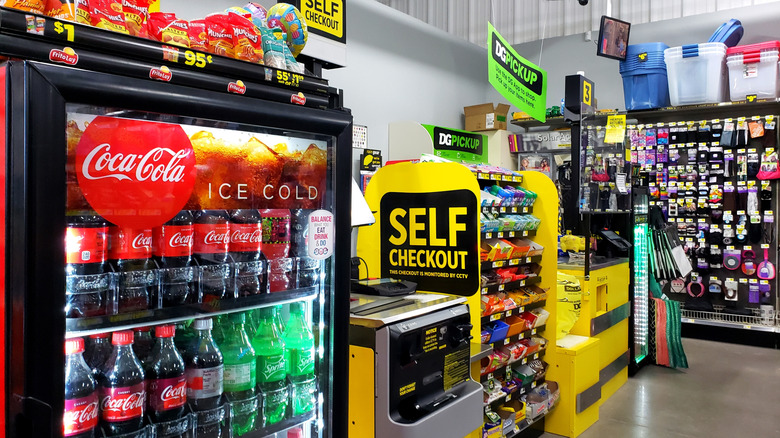
At the checkout, Dollar General can seem inexpensive — but look closer at the volume of groceries you're getting for that low price, and you'll see a less rosy picture. Dollar General's pricing can be deceptive because the retailer sells smaller packages of food, which can have a per-ounce or per-unit price that actually exceeds what you'd pay at a major (and ostensibly more expensive) supermarket.
Let's consider some examples (and bear in mind, the prices here may vary regionally): A 16-ounce jar of Clover Valley peanut butter costs $2.25 at Dollar General, or 14 cents an ounce. Meanwhile, Walmart's Great Value peanut butter is $4.18 for a 40-ounce jar, or slightly over 10 cents per ounce, a better deal overall. You see the same thing with plain white sugar: Dollar General sells a four-pound package for $3.25 (81 cents per pound), compared to $7.38 (74 cents per pound) for a 10-pound bag at Walmart.
Sometimes, Dollar General also sells items the same size as you'd get at supermarkets, but at a higher price: For example, it sells five-pound bags of self-rising flour for $4.25, compared to $3.98 at Walmart.
A 15.5-ounce can of pinto beans is $1.50 at Dollar General, compared to $0.92 at Walmart and $1.19 for the organic equivalent at Target. It's not just Dollar General, either: Prices at comparable stores like Dollar Tree are also considered to follow the same pattern.
Why does Dollar General do this?
In short, it's the chain's business strategy: Selling smaller packages allows Dollar General to lower an item's total price. This is aimed at cash-strapped shoppers who can't necessarily afford to buy in bulk due to its higher price tag (even if it's a better deal) — so, someone who just needs to scrape through to the next paycheck.
According to The Street, Dollar General's CEO has even admitted that the company doesn't aim to have the lowest prices; rather, it aims to keep them around three or four percent higher than its bigger competitors like Walmart and Target, rather than undercutting them. Often, Dollar General doesn't need to offer a better deal anyway: Another part of its strategy is to open up small stores in towns that aren't big enough to support supermarkets like Walmart, so it's not necessarily facing much in the way of competition.
When it comes to prices, there's another issue to watch out for at Dollar General: In October 2026, the Federal Trade Commission and 20 states sued the company for allegedly ringing up prices that were higher than what was listed on the shelf. So if you do go there, you may want to pay attention to make sure you're not overpaying. In any case, it's hard to make Dollar General cover all your needs anyway: It doesn't typically offer fresh produce in order to keep prices low (although this is shifting a bit), so you may need a trip to a bigger supermarket anyway — where it's perhaps better to shop for all your groceries and get a better overall deal.