

Skip The Salt And Add This Sauce To Scrambled Eggs For A Major Umami Boost
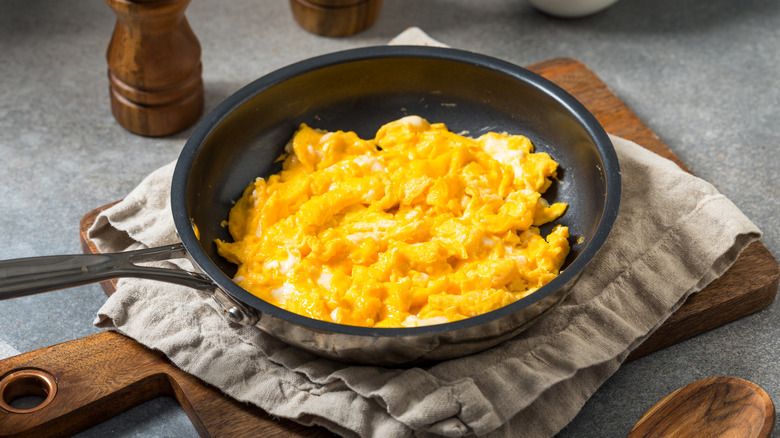
If you're hoping to elevate the flavor of your scrambled eggs, salt can help, but it's not really going to shift the flavor beyond just "egg". Enter fish sauce: A fermented, amber-colored sauce that's made by layering small fish with salt (often anchovies) and letting the mixture slowly break down over months. The end product is a pungent sauce rich in glutamates (the amino acid compound responsible for umami) that adds a deeply savory flavor. During this process, the proteins break down, freeing up amino acids and creating an umami taste; this is partially similar to the way soy sauce is made.
It's popular in many southeast Asian cuisines and likely goes by different names depending on which country you're in: These include nam pla (Thailand), nuoc mam (Vietnam), and patis (Philippines). To add it to scrambled eggs, you can keep things simple and just whisk it right into the eggs. You won't want to add salt, since fish sauce is already saltier (to the tune of 1 ½ times saltier than soy sauce). That also means you'll want to go easy on it: a teaspoon for every three or four eggs is a rough ratio (if in doubt, add less to start).
The idea of such a boldly fishy addition may be a bit intimidating to those who don't love intense flavors. However, despite its name (and strong smell), fish sauce is not necessarily so fishy in actual taste: Some have described it as closer to earthy porcini mushrooms rather than an intense wallop of anchovies — so, measured right, it should blend smoothly into eggs.
History and other ways to flavor-maxx your eggs
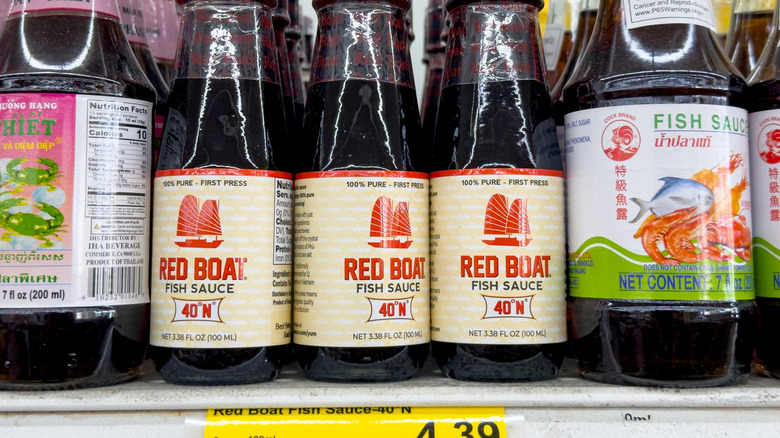
Although fish sauce is commonly associated with cuisines in places like Thailand and Vietnam, it may actually go back to at least the Roman times. Around the period of ancient Rome, a sauce called garum was made using a similar process. Some historians argue that this process made its way to Southeast Asia via the Silk Road, although it's debated. Some also suggest that it developed on its own as an evolution of Chinese methods of fermenting fish and beans together, likely being developed in Vietnam. Needless to say, there are plenty of uses for it beyond Southeast Asian cuisines, too — just look to French chef Eric Ripert, who uses it in his own cooking to add umami depth.
That said, if you're working it into eggs and looking for other additions, it's probably most straightforward to draw on flavors from places where it's most commonly used. These tend to be bright or sharp flavors that will cut through or balance out that intense umami element. If you go Thai-style, you could add a little sugar, white pepper, and squeeze some lime over it at the end. You could also consider grated ginger, scallions, red chili slices, or cilantro. Ripe tomatoes are an option if you want a bigger addition; their sweetness can balance the fish sauce. Serve the eggs over rice, or perhaps with some stir-fried veggies.