

Your Airplane Coffee Isn't Actually Teeming With Bacteria — But There's A Catch
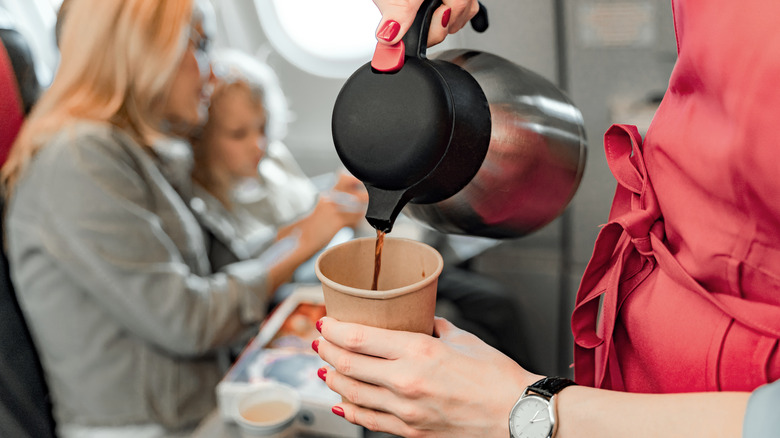
Airplane food has long had a bad rap, so it's no shock that there are certain foods you should avoid ordering on a plane. This may leave you wondering about how airlines prepare your in-flight food and other refreshments. A simple coffee or tea might seem innocuous, but it's possible these beverages could pose potential health risks depending on the airplane. This can be due to the viability of the in-flight water supply, cleanliness of the water tanks, and whether your hot beverages reach boiling point in order to kill potential bacteria (which can be affected by altitude).
Airplane drinking water is regulated by the Environmental Protection Agency, the Food and Drug Administration, and the Federal Aviation Administration. The EPA is the main agency involved and has prompted a number of in-flight surveys regarding water quality and its relative contamination. The organization specifically focuses on ensuring the Aircraft Drinking Water Rule is routinely followed, which was established to monitor safe drinking water on planes. However, compliance with and enforcement of these standards isn't necessarily absolute. It turns out that a range of both regional and major airliners ranked poorly in a 2026 study conducted by the Center For Food as Medicine and Longevity nonprofit on in-flight water supply safety.
The results suggest that not all in-flight offerings are up to standard, with findings that about 2.7% of over 35,000 water samples collected from 21 airlines contained total coliform bacteria. (Note that results vary between airlines; for instance, about 33% of CommuteAir's samples tested positive for such bacteria.) How water safety standards are enforced is part of the problem. But if an airline is known to practice consistent cleaning protocols, it's likely not as big of a concern. Providers like Delta and Frontier received particularly high water safety scores, per the study, meaning you may have nothing to worry about if you enjoy a coffee or tea on board those airlines' planes.
Opinions on the airplane water quality debate vary
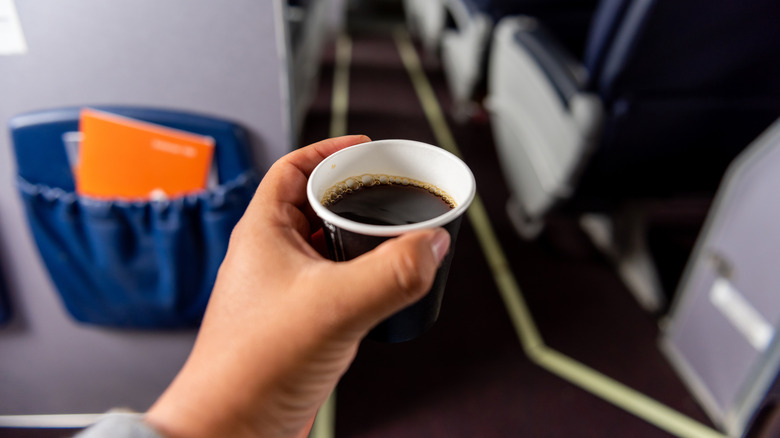
While this insight may present new worries when considering airplane refreshments, you don't have to swear off hot drinks indefinitely. The discrepancy primarily arrives when it comes down to the cleanliness of the coffee makers and water tanks on board. Former airline employee Kat Kamalani shared some anecdotal experiences online via TikTok. She stated that, in her experience, the hot water tanks in the galley were rarely cleaned properly, and therefore may contain unsafe bacteria.
On the other hand, one comment on Reddit suggested that while it may be a concern, it doesn't seem as dangerous as some studies may suggest. "If airplane coffee made everyone sick there would be a lot more people getting sick." Another Redditor shared, "I'm an airline mechanic and can say that the potable water system does get cleaned... I wouldn't worry too much. As someone else pointed out, if the pilots are drinking it every day you should be alright."
Ultimately, it's up to you whether or not you accept a hot beverage on your next flight. Though if you are personally worried, it may just be best to skip it. This ultimately reflects individual preference. Instead, you could always opt for a canned or bottled coffee to get your caffeine fix, or snag a cup when inside the airport before boarding. And as you're planning your next trip around how best to eat on a flight, try any of these five genius in-flight food and beverage hacks.